
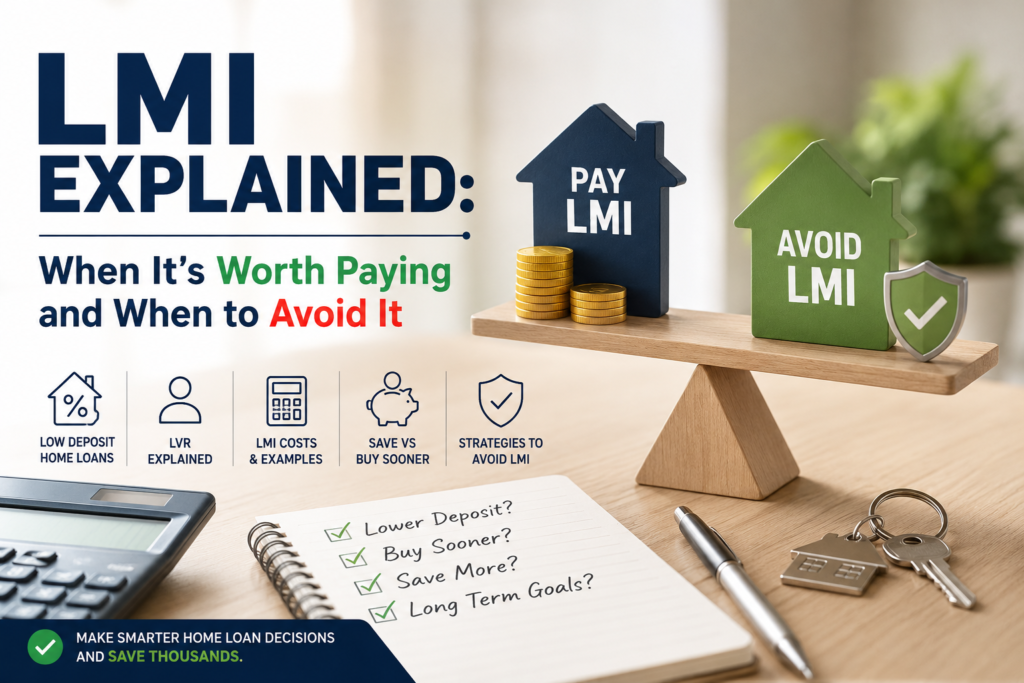
If you’re shopping for a home loan and haven’t put down a 20% deposit, you’ve probably encountered the term LMI (Lenders Mortgage Insurance). It sounds ominous, and honestly? Many borrowers dismiss it as a cost to avoid at all costs. But here’s the reality: LMI isn’t always the villain in your home-buying story. In fact, for thousands of Australian home buyers, paying LMI is the smartest financial decision they’ll make.
This guide explains everything you need to know about LMI—what it costs, who pays it, when it makes financial sense, and when you should absolutely avoid it. By the end, you’ll have the knowledge to make a decision that’s right for your situation, not just what someone else did.
What Exactly is LMI (Lenders Mortgage Insurance)?
Lenders Mortgage Insurance is a one-off insurance premium that protects the lender—not you—if you default on your home loan. Here’s the key insight: it’s not about protecting you; it’s about protecting the bank.
Why Do Lenders Require It?
When you borrow more than 80% of a property’s value (in other words, you’ve put down less than a 20% deposit), you’re entering what’s considered a “higher-risk” lending scenario in the eyes of banks. From their perspective, they’re more exposed. If property values drop and you can’t pay, they might not recover their full loan amount when selling the property.
LMI transfers some of that risk to an insurance company. It’s a safety net that makes lenders comfortable lending to borrowers with smaller deposits.
Who Pays LMI?
You do. The borrower always pays LMI premiums, even though the insurance protects the lender. This is important because it directly affects your loan costs.
How LMI Works: LVR Explained Simply
To understand when LMI applies and how much it costs, you need to understand Loan-to-Value Ratio (LVR).
What is LVR?
LVR is simply the loan amount divided by the property’s value, expressed as a percentage.
Formula:
LVR = (Loan Amount ÷ Property Value) × 100%
Practical Example:
- Property value: $600,000
- Your deposit: $60,000 (10%)
- Loan amount: $540,000
- LVR = ($540,000 ÷ $600,000) × 100% = 90%
The 80% LVR Threshold
In Australia, LMI is typically required if your LVR is above 80%. This means:
- LVR ≤ 80% (20%+ deposit) = No LMI required
- LVR 80.01% to 95% = LMI required (most common)
- LVR 95%+ = Much higher LMI costs (rare, usually only for first home buyers with government schemes)
The higher your LVR, the higher your LMI premium. It’s graduated—a 90% LVR costs less than a 95% LVR.
Typical LMI Costs: Real Numbers Australians Should Know
LMI premiums are expressed as a percentage of your loan amount and vary based on several factors:
LMI Cost Factors
- Loan-to-Value Ratio (LVR) – The biggest factor
- Loan amount – Larger loans cost more in absolute dollars
- Lender – Different banks have different rates (usually within a range)
- Loan type – Investment properties often cost more than owner-occupied
- Property type – Apartments may cost slightly more than houses
Real-World LMI Cost Examples
Scenario 1: First Home Buyer, Modest Deposit
- Property price: $500,000
- Deposit: $50,000 (10%)
- Loan amount: $450,000
- LVR: 90%
- Estimated LMI cost: $18,000–$21,000 (approximately 4–4.7% of loan)
- This amount is added to your loan, so you’d borrow $468,000–$471,000
Scenario 2: First Home Buyer, Medium Deposit
- Property price: $600,000
- Deposit: $90,000 (15%)
- Loan amount: $510,000
- LVR: 85%
- Estimated LMI cost: $10,200–$12,240 (approximately 2–2.4% of loan)
Scenario 3: Investment Property, Lower Deposit
- Property price: $750,000
- Deposit: $75,000 (10%)
- Loan amount: $675,000
- LVR: 90%
- Estimated LMI cost: $28,000–$32,000 (approximately 4.1–4.7% of loan)
- Investment property premiums are typically 10–20% higher than owner-occupied
Why Does LMI Get Added to Your Loan?
Most borrowers don’t pay LMI upfront in cash. Instead, it’s capitalised into your loan, meaning:
- The lender calculates your LMI premium
- This amount is added to your total loan balance
- You pay it back over the loan term (usually 30 years)
- You pay interest on the LMI amount itself
Example:
- LMI cost: $20,000
- Interest rate: 6.5%
- Repayment period: 30 years
- Total amount you’ll pay back: approximately $47,500 (including interest)
This is why some people say “paying LMI costs double”—because you’re financing it over 30 years with interest.
Who Actually Pays LMI? When Does It Apply?
Standard Borrowers (Most Cases)
LMI applies to you if:
- You’re borrowing more than 80% of the property value
- You’re buying a residential property (owner-occupied or investment)
- You don’t have a guarantor or special scheme access
LMI is not required if:
- Your deposit is 20% or more (LVR ≤ 80%)
- You have a guarantor (parent or family member)
- You access a first home buyer scheme (in eligible states)
- You’re a professional with specific lender waivers
First Home Buyers
First home buyers are not exempt from LMI, but they have advantages:
- Lower premiums – Usually 5–10% cheaper than investors
- Government schemes – Many states offer deposit assistance or LMI waivers
- Wider lender accessibility – Some lenders have special first home buyer programs
Investment Property Buyers
Investment property LMI premiums are typically 10–20% higher than owner-occupied equivalents because:
- Default risk is higher (investors are more likely to sell if cash flow struggles)
- Lenders view them as riskier
Professional Lenders (Doctors, Lawyers, Accountants)
Some banks offer LMI waivers to high-income professionals:
- Doctor mortgages – Available at major banks (Commonwealth, Westpac, NAB, ANZ)
- Professional home loans – For lawyers, accountants, engineers, etc.
- These allow borrowing up to 90–95% LVR without paying LMI
- Usually require proof of income and professional registration
If you’re a professional, ask your lender about waivers—this alone could save $20,000–$40,000+.
The Pros and Cons of Paying LMI
Advantages of Paying LMI
1. Buy Sooner, Not Later Rather than spending 5–10 years saving a 20% deposit, you can buy now. If property values appreciate 3–5% annually, this often more than outweighs LMI costs.
2. Lock in Lower Property Prices Property markets don’t stay flat. In many Australian markets, waiting means paying more later. Example:
- Today: $500,000 property, 10% deposit + $18,000 LMI
- In 3 years: Same property is $575,000; your deposit needs to be $57,500
- You’ve paid an extra $75,000 for the same house
3. Start Building Equity Immediately The moment you buy, you start gaining equity from mortgage payments. Every dollar of principal you pay is wealth building—something renters don’t experience.
4. Rent Price Certainty By owning, you eliminate rent increases. Renters in Australia have seen rents jump 25–40% over 5 years. A fixed-rate mortgage provides stability.
5. Access to Wealth-Building Tools Once you own, you can:
- Use equity for future investments
- Refinance to better rates
- Access investment property portfolios
6. Psychological Benefits Homeownership provides security and the satisfaction of building wealth, not enriching landlords.
Disadvantages of Paying LMI
1. High Upfront Cost $15,000–$35,000 added to your loan is significant. Capitalised over 30 years with interest, it can cost $35,000–$75,000.
2. Increases Total Interest Paid Because LMI is financed, you pay interest on it for 30 years. This is where the “paying double” narrative comes from.
3. Higher Monthly Repayments A larger loan = higher monthly commitments. A $20,000 LMI addition typically adds $100–$150/month to your repayment.
4. Reduces Borrowing Serviceability Lenders assess whether you can service the debt. A larger loan (due to LMI) might reduce how much you can borrow overall.
5. Only Benefits the Lender LMI doesn’t protect you. If you default, the insurer pays the lender, not you. You still owe the debt.
6. Doesn’t Protect Against Market Falls If property values drop significantly, LMI doesn’t help. You’re still underwater on the loan.
When Paying LMI Makes Financial Sense: Real Scenarios
Scenario 1: Strong Income Growth Expected
Profile: 28-year-old professional with entry-level salary, clear career trajectory
- Current salary: $65,000
- Expected salary in 3 years: $85,000+
- Has saved: $50,000 (10% deposit on $500,000 property)
Why LMI Makes Sense:
- Rent is currently $400/week ($20,800/year)
- Mortgage + LMI repayment: $430/week ($22,360/year)
- In 3 years, salary increase will make repayments feel easy
- Rents will likely increase; mortgage won’t
- Property will likely appreciate $50,000–$75,000 in 3 years, far exceeding LMI costs
- Recommendation: Pay LMI, buy now
Scenario 2: Property Market is Appreciating Rapidly
Profile: First home buyer in a growing market (e.g., Sydney fringe, Brisbane, Perth)
- Property prices rising 5–7% annually
- You can afford LMI repayments
- You plan to stay 5+ years
Why LMI Makes Sense:
- A $500,000 property will likely be worth $650,000–$700,000 in 5 years
- LMI cost: $18,000–$21,000
- Property appreciation: $150,000–$200,000
- Net benefit: $130,000–$180,000 gain
- Recommendation: Pay LMI
Scenario 3: Rents Are Extremely High Relative to Mortgage Costs
Profile: Renting in an expensive area (e.g., inner Sydney, Melbourne CBD)
- Current rent: $550/week ($28,600/year)
- Equivalent mortgage + LMI: $480/week ($24,960/year)
- You’d save $150/week ($7,800/year) by buying with LMI
Why LMI Makes Sense:
- You’re paying more in rent than you would in mortgage repayments
- The “cost” of LMI is offset by rent savings
- After 5 years: Paid down principal + equity + rent savings = significant wealth gain
- Recommendation: Pay LMI
Scenario 4: Family Situation Requires Stability
Profile: Young family, tired of renting, school catchments matter
- Renting creates instability (lease renewals, price increases)
- Want to settle in specific area long-term
- Can afford LMI repayments
Why LMI Makes Sense:
- Homeownership provides stability (crucial for families)
- You control your environment (no landlord restrictions)
- Children can attend same school for full education
- Psychological stability is undervalued in financial planning
- Recommendation: Pay LMI
When You Should Absolutely Avoid LMI
Scenario 1: You’re Only 1–2 Years Away From a 20% Deposit
Profile: Have saved $120,000, need $150,000 for 20% deposit on $750,000 property
Why Avoid LMI:
- 12–18 months of additional saving achieves the goal
- LMI would cost $25,000–$30,000
- Better to wait and invest the extra savings into offset account
Recommendation: Wait 18 months, save the extra $30,000, avoid LMI entirely
Scenario 2: Interest Rates Are Rising
Profile: Fixed-rate period ending, interest rates climbing
Why Avoid LMI:
- Adding LMI increases your loan balance when rates are rising
- Every $20,000 in LMI × 7% interest rate = $1,400/year in extra interest
- If rates continue rising, this compounds painfully
- Better to wait for rates to stabilize
Recommendation: Delay purchase 6–12 months, wait for rate certainty
Scenario 3: Your Income Is Unstable or Uncertain
Profile: Freelancer, contractor, or business owner with variable income
Why Avoid LMI:
- Larger loan due to LMI creates serviceability risk
- If income drops, you’re more vulnerable to default
- Lenders may already be hesitant with variable income
- Extra risk isn’t worth it
Recommendation: Build larger deposit, reduce risk profile
Scenario 4: Property Values Are Declining
Profile: Buying in a depressed market (resource-dependent town, declining area)
Why Avoid LMI:
- LMI only makes sense if property appreciation outweighs costs
- In declining markets, appreciation might not happen
- You could end up underwater (owing more than property is worth)
Recommendation: Save larger deposit, reduce LVR risk
Scenario 5: You’re Buying for Short-Term (Under 3 Years)
Profile: Job transfer likely, relationship uncertain, lifestyle in flux
Why Avoid LMI:
- LMI costs front-load your loan
- In first 3 years, most repayments go to interest/LMI, not principal
- You won’t build enough equity to recoup LMI costs
- If you sell in 3 years, you’ll likely make a loss
Recommendation: Rent instead, delay purchase until situation is stable
Strategies to Avoid LMI Without Waiting Years
If you want to avoid LMI but don’t want to wait a decade, here are legitimate strategies:
1. Use a Family Guarantee (Guarantor Loan)
A guarantor (usually a parent) doesn’t give you money—they guarantee the loan. Banks may waive LMI if a guarantor pledges assets (home equity).
How it works:
- Parent with $300,000 home equity guarantees your $450,000 loan
- Lender waives LMI because of security
- You avoid $18,000–$21,000 LMI cost
- Parent’s home is at risk if you default (serious commitment)
Pros:
- Avoid LMI entirely
- Possible with banks like Commonwealth, Westpac, NAB, ANZ
Cons:
- Guarantor’s borrowing capacity is reduced
- Significant risk for guarantor
- Relationship stress if financial problems arise
- Limited to family with substantial home equity
Who should use it: First home buyers with supportive family members
2. Access First Home Buyer Government Schemes
Many states offer schemes to reduce or eliminate LMI:
New South Wales
- First Home Loan Deposit Scheme: Borrow up to 95% LVR with 5% deposit, no LMI (eligible first home buyers)
- Government guarantees 5–15% of loan amount
- Income cap: ~$180,000 (single), $288,000 (couple)
- Property price cap: $950,000
Victoria
- Home Builders Scheme: Grants up to $20,000 for new builds
- First Home Buyer Duty Exemption (previously available; check current)
Queensland
- First Home Buyer Duty Exemption: Up to $300,000
- Off-the-Plan Concessions for new apartments
Western Australia
- Home Buyer Grant: Up to $10,000 for eligible purchases
- Stamp Duty Concessions
South Australia
- First Home Owner Grant: Up to $10,000
- Stamp Duty Exemption/Concession
Tasmania
- First Home Owner Grant: Up to $20,000
- Stamp Duty Exemption
ACT
- First Home Buyer Scheme: Grants and duty assistance
- First Home Buyer Rates Discount
Check your state government website for current, eligible schemes—they change regularly.
3. Negotiate a Professional Lender Waiver
If you’re a professional (doctor, lawyer, accountant, engineer), ask about LMI waivers:
Doctor Mortgages:
- Commonwealth Bank: Medical Professional Home Loans (up to 90% LVR, no LMI)
- Westpac: Doctor Home Loan (up to 95% LVR, no LMI for select)
- NAB: Professional Home Loan (up to 90% LVR, no LMI)
- ANZ: Medical Professional Home Loan (up to 90% LVR, no LMI)
Other Professionals:
- Lawyers, accountants, engineers, dentists often qualify
- Rates are competitive or better than standard loans
- Require proof of professional registration and income
Savings: $15,000–$40,000 in LMI avoidance
4. Purchase with a Co-Borrower or Co-Owner
If buying with a partner, combine incomes and deposits:
- Two people with $40,000 each = $80,000 deposit (16% on $500,000)
- Reduces LVR to 84%, lowers LMI cost
- Increases borrowing capacity
Note: Both parties must be on the title and responsible for the loan.
5. Buy a Less Expensive Property
This is obvious but worth stating: buying a $450,000 property instead of $500,000 might eliminate LMI entirely if your deposit is larger as a percentage.
- $500,000 property + $50,000 deposit = 90% LVR (LMI required)
- $450,000 property + $50,000 deposit = 88.9% LVR (LMI required, but lower cost)
- $400,000 property + $50,000 deposit = 87.5% LVR (LMI required, lower still)
6. Delay and Save (The Honest Truth)
Sometimes the best strategy is patience:
- Save aggressively for 18–24 months
- Reach 15–17% deposit (pushing LVR to 83–85%)
- Significantly reduce LMI cost
- Or reach 20% and eliminate it
This works if: Property market is stable, interest rates aren’t rising, you can tolerate renting longer.
The Great Debate: Save a 20% Deposit vs. Buy Now With LMI?
This is the decision that keeps first home buyers awake at night. Here’s a framework for deciding:
Buy Now With LMI If:
✅ Property values are rising 3–5%+ annually in your target market ✅ You expect income to increase significantly (25%+ in 3–5 years) ✅ Rents in your area are high relative to mortgage costs ✅ You plan to stay in the property 5+ years ✅ Interest rates are stable or expected to fall ✅ You have a stable income and good serviceability ✅ You want to lock in a property in a competitive market
Save for 20% Deposit If:
❌ You’re only 12–18 months away from 20% deposit savings ❌ Interest rates are rising rapidly ❌ Your income is unstable or uncertain ❌ Property values are stagnant or falling ❌ You plan to move within 3 years ❌ Your income is unlikely to increase ❌ You’re in a buyer’s market with less competition
The Math: A Case Study
Scenario: Sydney market, 3-year horizon
Option A: Buy Now with LMI
- Property price: $500,000
- Deposit: $50,000 (10%)
- Loan: $450,000
- LMI: $19,000
- Total borrowed: $469,000
- Monthly repayment: $3,150 (at 6.5%)
- Property value in 3 years: $580,000 (4% annual appreciation)
- Equity after 3 years (after principal repayment): ~$140,000
- Total advantage: $140,000 equity + $80,000 appreciation = $220,000 wealth gain
Option B: Save for 20% Deposit
- Save aggressively for 3 years: $30,000 additional
- Total deposit: $80,000 (16%)
- Property price in 3 years: $580,000
- Loan: $464,000
- No LMI
- Monthly repayment: $3,120 (slightly less)
- Equity after 3 years: ~$95,000
- Total advantage: $95,000 equity + could buy any property = flexibility
Analysis: Option A (buy now) creates $45,000 more wealth in 3 years because property appreciation outweighs LMI costs. However, Option B provides more flexibility and lower risk if the property market slows.
Verdict: In appreciating markets, buying now with LMI typically wins.
Common LMI Misconceptions: Myths Vs. Facts
Myth 1: “LMI Protects You if You Default”
Fact: LMI only protects the lender. If you default, the insurer pays the lender but you still owe the debt. You can still be pursued for any shortfall.
Myth 2: “If You Pay LMI, You’ll Pay Double”
Fact: Over 30 years with interest, LMI costs approximately 2.5–2.7× the original amount, not double. Still significant, but not literally “double.”
Myth 3: “You Can Remove LMI Later”
Fact: Most lenders don’t remove LMI once charged. Some allow removal after reaching 80% LVR through equity build-up (10+ years), but this is rare. Once paid, it’s permanent.
Myth 4: “All Lenders Charge the Same LMI”
Fact: Premiums vary by 20–30% between lenders. Shopping around for the best LMI rate is crucial.
Myth 5: “You Can Avoid LMI by Adding a Co-Borrower”
Fact: Not unless the co-borrower adds meaningful deposit. Banks assess the total LVR, not individual contributions. However, combining strong incomes + deposits can help.
Myth 6: “Professional Lender Waivers Aren’t Real”
Fact: Doctor mortgages and professional home loans with LMI waivers are very real. Many professionals don’t know about them.
Myth 7: “LMI Is Bad; Avoid at All Costs”
Fact: LMI is a tool. It’s bad if it keeps you renting longer while property values rise. It’s good if it enables you to build equity sooner. Context matters.
Mistakes Borrowers Make With LMI
Mistake 1: Not Shopping Around for Best LMI Rates
Different lenders have different LMI premiums. Failing to compare can cost $3,000–$6,000.
Fix: Use a mortgage broker (they access multiple lenders) or compare major banks’ LMI calculators.
Mistake 2: Overestimating How Long You’ll Stay
Many borrowers assume “I’ll be here forever,” but life changes. If you sell in 5 years and property values didn’t appreciate as expected, LMI is a loss.
Fix: Be honest about your timeline. If it’s under 5 years, reconsider LMI.
Mistake 3: Borrowing More Because You Can
Just because a bank will lend you $500,000 doesn’t mean you should. Adding LMI tempts people to over-borrow.
Fix: Borrow what you need, not what’s available. Remember, LMI increases your loan.
Mistake 4: Ignoring Government First Home Buyer Schemes
Millions of dollars in grants and LMI waivers go unclaimed because first home buyers don’t know about them.
Fix: Check your state government website and ask your lender about available schemes.
Mistake 5: Not Asking About Professional Waivers
If you’re a doctor, lawyer, or accountant, you might automatically qualify for LMI waivers. Many don’t ask.
Fix: Contact major banks’ professional lending teams before settling on a loan.
Mistake 6: Choosing Lender Based on Interest Rate Alone
A 0.1% lower interest rate might cost you $5,000+ more in LMI. Always compare total costs, not just rate.
Fix: Ask for full loan comparison (rate + LMI + fees) before committing.
Mistake 7: Not Exploring Guarantor Options
Family members with substantial equity can often guarantee loans, eliminating LMI. Many don’t explore this.
Fix: Have honest conversations with family about willingness to guarantee.
Real-World Examples: When Borrowers Got LMI Right (and Wrong)
Example 1: The Right Decision ✅
Profile: Sarah, 32, accountant, Sydney
- Salary: $90,000
- Saved: $60,000 (12% on $500,000 property)
- Renting: $500/week
- Options explored: Save 3 more years for 20%, or buy now with LMI
Decision: Bought with 12% deposit, paid $18,500 LMI
Outcome (5 years later):
- Property now worth: $680,000 (+$180,000)
- Paid down principal: $95,000
- LMI cost over 30 years: $47,000
- Net gain: $180,000 + $95,000 – $47,000 = $228,000
- Also: Avoided 5 years of rent increases ($130,000+ spent)
Why it worked: Property appreciation, stable income, appropriate risk tolerance.
Example 2: The Wrong Decision ❌
Profile: James, 28, tradesman, Melbourne, self-employed
- Income: Highly variable ($60k–$90k annually)
- Saved: $40,000
- Property target: $600,000
- LVR: 93% if purchased
- LMI: $28,000
Decision: Bought with 93% LVR, paid LMI despite unstable income
Outcome (3 years later):
- Business downturn; income dropped to $50,000
- Struggling with $4,200/month repayments
- Property value: $585,000 (down slightly)
- Still owes: $565,000
- Considering forced sale
Why it failed: Overestimated serviceability given income volatility, bought in weak market, 3-year timeline meant equity build-up insufficient to cover LMI costs.
Example 3: The Smart Avoidance ✅
Profile: Maya and Raj, 29 & 31, both professionals (doctor and accountant), Brisbane
- Combined income: $180,000
- Saved: $70,000 (14% on $500,000 property)
- Checked professional lender options: Both qualified for waivers
Decision: Used professional home loan with LMI waiver; bought at 86% LVR with no LMI
Outcome (5 years later):
- Property worth: $620,000 (+$120,000)
- Principal repaid: $85,000
- LMI avoided: $15,000
- Total gain: $220,000 with lower risk and no LMI cost
Why it worked: Knew about professional waivers, proactively asked, saved money without waiting years.
Expert Tips to Minimize Your Borrowing Costs
Tip 1: Use a Mortgage Broker
Brokers access 30+ lenders and can often negotiate better LMI rates or find lenders with waivers. Their fee is typically covered by lender commissions; you don’t pay extra.
Potential savings: $3,000–$8,000 in LMI
Tip 2: Increase Deposit by Even Small Amounts
Going from 10% to 12% can reduce LMI by 15–20%.
- $50,000 deposit (10%): LMI = $19,000
- $60,000 deposit (12%): LMI = $16,200
- Savings: $2,800 for an extra $10,000 saved (great ROI)
Tip 3: Look for Lenders with Graduated LMI Rates
Some lenders charge less at specific LVR thresholds. Shopping around matters.
Example:
- Bank A at 90% LVR: $19,500 LMI
- Bank B at 90% LVR: $17,800 LMI
- Savings: $1,700 for the same loan
Tip 4: Consider Fixed-Rate Mortgages if Rates Are Low
If you’re paying LMI, locking in a low fixed rate eliminates uncertainty. You know your exact repayment for 3–5 years.
Tip 5: Pay Off LMI Faster
If possible, use offset accounts and extra repayments to reach 80% LVR faster. Once you hit 80% equity, you can refinance without LMI.
- Reaching 80% in 12 years instead of 30 saves $15,000+ in interest
- Every extra $100/month towards principal accelerates this
Tip 6: Don’t Capitalize LMI if You Can Pay Upfront
If you have cash, paying LMI upfront (rather than capitalizing it) saves 25–30% in interest costs.
- LMI cost: $20,000
- Capitalized over 30 years: $47,000 total cost
- Paid upfront: $20,000 total cost
- Savings: $27,000
If possible, scrape together cash for this one-off cost.
Tip 7: Refinance When You Hit 80% LVR
Once you’ve built 20% equity, refinance to remove LMI from your loan. This eliminates LMI-related interest permanently.
Tip 8: Review Your Loan Annually
Interest rates change, lender offerings change, and your circumstances change. Reviewing annually ensures you’re on the best deal.
FAQ
Q1: Is LMI Required in Australia?
A: LMI is required by most Australian lenders if you borrow more than 80% of the property’s value (i.e., deposit is less than 20%). However, exceptions exist: government first home buyer schemes, professional lender waivers, guarantor loans, and certain lenders’ programs can waive LMI. Always ask your lender if you qualify for a waiver.
Q2: Can You Remove LMI From Your Loan Later?
A: Standard LMI cannot be removed once paid. However, if you refinance at a lower LVR (once you’ve built 20%+ equity), you can refinance into a loan without LMI, effectively removing it from future repayments. This typically takes 10–15 years of additional principal repayment. Some lenders allow LMI refunds if you reach 80% LVR within a specific timeframe, but this is rare.
Q3: How Much Does LMI Cost?
A: LMI typically ranges from 2–5% of your loan amount, depending on your LVR and lender. At 90% LVR, expect 4–4.5%; at 95% LVR, expect 4.5–5%+. For a $450,000 loan at 90% LVR, you’d expect $18,000–$21,000 in LMI. Investment properties cost 10–20% more. Always get a loan estimate from your lender with exact LMI costs.
Q4: Should I Avoid LMI or Buy Now?
A: It depends on your situation. Buy now with LMI if: property prices are rising 3%+, your income is growing, you plan to stay 5+ years, and rents are high. Avoid LMI if: you’re 12–18 months away from 20% deposit, interest rates are rising, your income is unstable, or property values are falling. Use the scenarios and case studies above to guide your decision.
Q5: What’s the Difference Between LMI and PMI?
A: LMI (Lenders Mortgage Insurance) is Australia’s version of mortgage insurance. PMI (Private Mortgage Insurance) is the U.S. equivalent. Both serve the same purpose (protecting the lender if you default), but premiums, regulations, and removal processes differ between countries. If you’re comparing to U.S. mortgages, know they work similarly but aren’t identical.
Additional FAQ (General Questions)
Q: Can I Use the First Home Buyer Scheme to Avoid LMI?
A: Many first home buyer schemes do offer LMI waivers or elimination. For example, NSW’s First Home Loan Deposit Scheme lets you borrow at 95% LVR with no LMI. However, schemes vary by state and have income/property price caps. Check your state’s government website or ask your lender about available options.
Q: If My Parent Guarantees My Loan, Can I Avoid LMI?
A: Yes, in many cases. If your guarantor pledges assets (like home equity), lenders often waive LMI. This is called a “guarantor loan” or “guaranteed loan.” The guarantor doesn’t gift you money—they guarantee the debt. If you default, their assets are at risk. It’s a serious commitment, but it can eliminate $15,000–$30,000 in LMI costs.
Q: What Happens to LMI if Property Values Fall?
A: LMI doesn’t protect you against falling property values. It only protects the lender if you default. If your property drops in value and you can’t pay, the insurer pays the lender the shortfall, but you remain liable for the full debt. LMI doesn’t offset market risk.
Q: Is It Possible to Get a 95% LVR Loan Without LMI?
A: Rarely for standard borrowers. The First Home Loan Deposit Scheme in NSW allows this, but most other lenders require LMI at 95% LVR. Professional lenders (doctors, lawyers) sometimes offer 90–95% LVR loans without LMI, but high LVR alone doesn’t guarantee a waiver. Always ask your lender.
Q: How Do I Calculate My LMI Cost?
A: Use your lender’s LMI calculator online, or ask your mortgage broker. You’ll need:
- Property value
- Loan amount (or deposit amount)
- Loan type (owner-occupied vs. investment)
- Lender (premiums vary)
The calculation is automated; you don’t need to do it manually. Most bank websites have free calculators.
3 Responses