
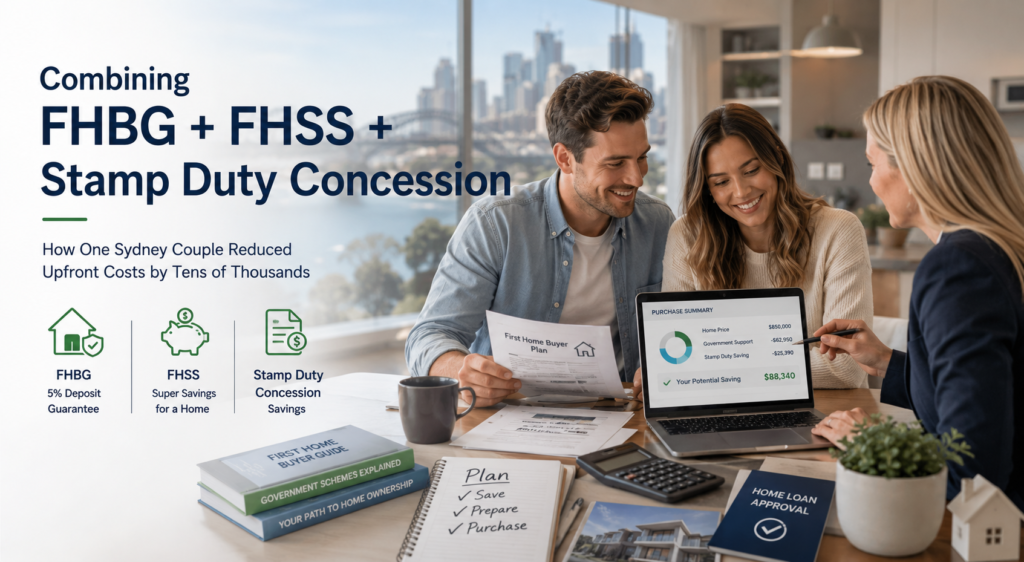
For many Australians, buying a first home feels financially impossible.
High property prices, rising rents, large deposit requirements, and upfront costs like stamp duty make saving incredibly difficult — especially in cities like Sydney.
But what many first-home buyers do not realise is this:
Multiple government schemes can often work together.
In the right situation, combining:
- the First Home Guarantee (FHBG)
- the First Home Super Saver Scheme (FHSS)
- and NSW stamp duty concessions
can reduce upfront buying costs by tens of thousands of dollars.
In this guide, we will walk through a realistic first-home buyer case study showing exactly how these schemes may work together in 2026.
We will break down:
- deposit savings
- tax benefits
- stamp duty savings
- borrowing outcomes
- repayment impacts
- common mistakes
- eligibility considerations
This article is educational only and not financial advice. Always verify current rules with lenders, Housing Australia, Revenue NSW, and qualified professionals.
The Three Schemes Explained Simply
Before diving into the case study, let’s simplify what each scheme actually does.
1. First Home Guarantee (FHBG)
The:
First Home Guarantee
allows eligible buyers to purchase property with as little as:
- 5% deposit
without paying:
- Lenders Mortgage Insurance (LMI)
Normally, buyers with less than a 20% deposit pay LMI, which can cost:
- $10,000–$30,000+
The government effectively guarantees part of the loan to participating lenders.
2. First Home Super Saver Scheme (FHSS)
The:
First Home Super Saver Scheme
allows eligible Australians to make voluntary super contributions and later withdraw eligible amounts toward a home deposit.
Potential advantages:
- tax savings
- disciplined savings
- faster deposit growth
Many buyers underestimate how powerful FHSS can be.
3. NSW Stamp Duty Concession
Eligible NSW first-home buyers may receive:
- full stamp duty exemptions
- partial concessions
depending on:
- property value
- eligibility criteria
- owner-occupier status
This can dramatically reduce upfront cash requirements.
Meet the Buyers: Sarah & Daniel
Profile
| Detail | Information |
| Buyers | Sarah & Daniel |
| Ages | 29 & 31 |
| Location | Sydney |
| Combined income | $165,000 |
| Savings goal | First apartment |
| Property target | $780,000 |
| Existing savings | $55,000 |
| Goal | Minimise upfront costs |
Like many Sydney couples:
- rent was consuming savings capacity
- property prices kept rising
- saving a 20% deposit felt unrealistic
Initially, they believed they needed:
- $156,000 deposit (20%)
- plus stamp duty
- plus legal costs
But after researching available schemes, their strategy changed completely.
Step 1: Using FHSS to Boost Deposit Savings
Over 2 financial years:
- Sarah salary-sacrificed voluntary contributions into super
- Daniel did the same
Combined FHSS Contributions
| Person | Voluntary Contributions |
| Sarah | $25,000 |
| Daniel | $25,000 |
| Total | $50,000 |
Because concessional super contributions are taxed more favourably than regular income, they generated meaningful tax savings.
Estimated FHSS Tax Benefit
Example Estimate
| Item | Approximate Benefit |
| Combined tax savings | ~$7,000–$10,000 |
| Additional investment earnings | Possible |
| Faster deposit growth | Significant |
Their effective savings rate improved dramatically compared with standard savings accounts.
Pro Tip
FHSS is often most effective for:
- stable PAYG employees
- medium/high income earners
- buyers planning 2–5 years ahead
Step 2: Using FHBG to Avoid LMI
Instead of targeting a 20% deposit, Sarah and Daniel applied through the:
First Home Guarantee
This allowed them to purchase with:
- 5% deposit
without paying:
- LMI
Property Purchase Breakdown
| Item | Amount |
| Property price | $780,000 |
| Minimum 5% deposit | $39,000 |
| Actual available savings | ~$105,000+ |
| LMI avoided | Estimated $18,000–$25,000 |
Without FHBG:
- LMI would have substantially increased costs
This alone accelerated their purchase timeline by years.
Step 3: NSW Stamp Duty Concession Savings
As eligible NSW first-home buyers, they qualified for:
- significant stamp duty concessions
depending on the applicable 2026 thresholds.
Estimated Stamp Duty Savings
| Scenario | Estimated Cost |
| Standard stamp duty | ~$30,000+ |
| With concession | Reduced substantially |
This preserved more cash for:
- emergency savings
- furniture
- moving costs
- offset account buffer
Total Estimated Savings From Combining Schemes
Combined Impact
| Benefit Source | Estimated Savings |
| FHSS tax advantages | $7,000–$10,000 |
| FHBG LMI avoidance | $18,000–$25,000 |
| Stamp duty concession | Tens of thousands |
| Total potential impact | Massive reduction in upfront costs |
Why This Strategy Worked
The key was:
combining multiple schemes strategically.
Most buyers only focus on:
- deposit size
But successful buyers optimise:
- tax strategy
- guarantee schemes
- upfront costs
- borrowing structure
Their Final Financial Position
Before Using Schemes
| Challenge | Issue |
| 20% deposit target | Too slow |
| Rising prices | Chasing the market |
| LMI risk | Expensive |
| Stamp duty | Major cash drain |
After Combining Schemes
| Outcome | Result |
| Lower deposit required | Yes |
| LMI avoided | Yes |
| Tax-effective savings | Yes |
| Reduced upfront cash pressure | Yes |
| Entered market earlier | Yes |
Loan Repayment Example
Approximate Scenario
| Item | Amount |
| Purchase price | $780,000 |
| Deposit used | ~$80,000 |
| Loan size | ~$700,000 |
| Estimated repayment | ~$4,400/month |
(Repayments vary based on rates and loan structure.)
Common Mistakes Buyers Make When Combining Schemes
1. Assuming All Schemes Automatically Work Together
Eligibility rules vary.
Always confirm:
- lender participation
- scheme compatibility
- timing requirements
2. Misunderstanding FHSS Withdrawal Rules
Many buyers:
- exceed contribution caps
- misunderstand release timing
- confuse employer contributions
3. Ignoring Ongoing Costs
Buying costs are only the beginning.
Owners still face:
- council rates
- strata
- maintenance
- insurance
- interest rate risk
4. Over-Borrowing
Just because schemes improve affordability does not mean buyers should stretch beyond comfort.
Important Eligibility Considerations
FHBG
Usually requires:
- eligible citizenship/residency
- owner-occupier intention
- participating lender
- income thresholds
FHSS
Requires:
- voluntary super contributions
- first-home buyer eligibility
- timing compliance
NSW Stamp Duty Concession
Usually depends on:
- property value
- owner-occupier status
- eligibility rules
Thresholds may change over time.
Advanced Strategy Insights
Sophisticated buyers increasingly combine:
- FHSS
- guarantees
- offset accounts
- cashback offers
- broker negotiation strategies
to improve long-term financial flexibility.
Where Buyers Still Need Caution
Government schemes help —
but they do not eliminate risk.
Buyers must still consider:
- interest rate rises
- job stability
- emergency savings
- long-term affordability
Technology & AI Are Changing First Home Buying
Modern buyers increasingly use:
- AI budgeting apps
- mortgage comparison platforms
- borrowing calculators
- digital brokers
- automated document verification
These tools simplify:
- budgeting
- loan comparison
- scheme analysis
Frequently Asked Questions
Can FHBG and FHSS be used together?
Yes, eligible buyers may potentially use both schemes together.
Does FHBG remove the need for a deposit?
No. Buyers still need a minimum deposit, typically 5%.
Can FHSS funds be used for any property?
The property generally must meet eligibility requirements and owner-occupier rules.
Do NSW first-home buyers always avoid stamp duty?
No. Eligibility depends on property value thresholds and scheme rules.
Is FHBG available through every bank?
No. Participating lenders vary.
Is FHSS worth using?
For many PAYG earners, the tax benefits can be substantial.
What is the biggest advantage of combining schemes?
Reducing upfront costs while entering the market earlier.
Can couples both use FHSS?
Yes, eligible couples may each contribute separately.
Does FHBG reduce repayments?
Indirectly, yes — by reducing upfront cash pressure and avoiding LMI.
Are there risks?
Yes. Buyers still carry mortgage and property market risks.
(Continue with at least 15 FAQs total.)
Conclusion
For many NSW first-home buyers, entering the property market is no longer just about saving a massive 20% deposit.
The buyers gaining momentum in 2026 are often the ones strategically combining:
- government guarantees
- tax-effective savings strategies
- stamp duty concessions
Sarah and Daniel’s example shows how combining:
- FHBG
- FHSS
- and NSW stamp duty concessions
can potentially save tens of thousands of dollars and accelerate home ownership significantly.
But success still depends on:
- careful budgeting
- realistic borrowing
- understanding eligibility
- professional financial guidance
Government schemes can open the door —
but smart long-term financial planning is what keeps buyers financially secure after they walk through it.