
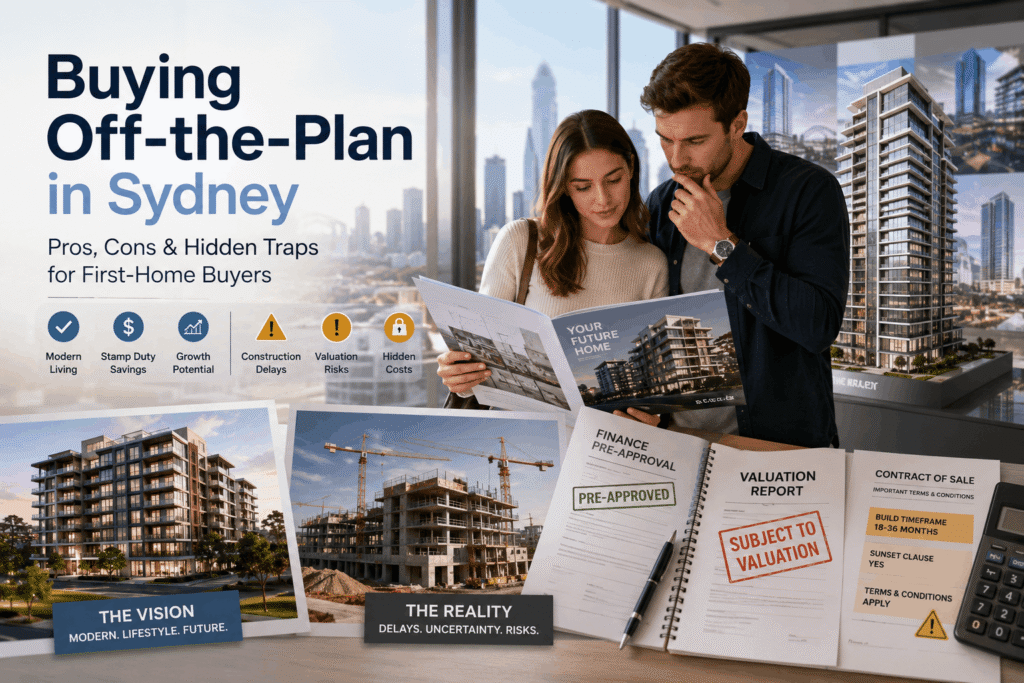
For many Sydney first-home buyers, buying off-the-plan apartments feels like one of the few realistic ways to enter the property market.
New apartment developments often promise:
- Modern living
- Lower maintenance
- Stylish amenities
- Stamp duty savings
- Flexible settlement timing
- Government incentives
And in a city where property affordability remains one of the biggest challenges facing younger Australians, locking in a property price before construction finishes can sound incredibly attractive.
But there’s another side to the story.
Behind glossy brochures and beautifully styled display suites, off-the-plan purchases also come with real financial and legal risks that many buyers underestimate.
Some first-home buyers end up:
- Winning from market growth during construction
- Saving thousands on stamp duty
- Entering the market earlier than expected
Others face:
- Valuation shortfalls
- Construction delays
- Defect issues
- Financing problems
- Apartments worth less than the purchase price
The reality is that buying off the plan in Sydney can either become:
- A smart long-term property move
- Or an expensive lesson in property risk
This guide explains exactly how off-the-plan purchases work, the real pros and cons, the hidden traps many buyers miss, and what first-home buyers should know before signing anything.
What Does “Off-the-Plan” Mean?
An off-the-plan property is purchased before construction is completed.
In many cases:
- The apartment does not physically exist yet
- Buyers rely on floor plans, renders, brochures, and display suites
Settlement happens later after construction finishes and the property is registered.
How Off-the-Plan Purchases Work
Typically:
- Buyer signs contract
- Buyer pays deposit (often 5–10%)
- Construction occurs
- Property completes months or years later
- Buyer obtains finance and settles
Settlement timelines commonly range between:
- 12 months
- 24 months
- Sometimes longer
Off-the-Plan vs Established Property
| Off-the-Plan | Established Property |
| Purchased before completion | Already built |
| Delayed settlement | Immediate settlement |
| Limited physical inspection | Full inspection possible |
| Potential stamp duty savings | Fewer concessions |
| Higher uncertainty | Lower uncertainty |
| New condition | Existing wear and tear |
Why First Home Buyers Consider Off-the-Plan in Sydney
Lower Initial Deposit Pressure
One major attraction is that buyers often only need:
This can help buyers enter the market sooner.
More Time Before Settlement
A delayed settlement gives buyers extra time to:
- Save money
- Improve borrowing power
- Reduce debts
- Prepare financially
Stamp Duty Savings
NSW first-home buyers may qualify for:
- Stamp duty exemptions
- Concessions
- Off-the-plan duty reductions
depending on eligibility and property value.
Modern Apartment Features
New apartments often include:
- Gyms
- Pools
- Smart-home features
- Energy-efficient appliances
- Open-plan layouts
Potential Government Incentives
Eligible buyers may access:
- First Home Owner Grant
- First Home Guarantee
- Stamp duty concessions
depending on current rules and eligibility.
The Pros of Buying Off-the-Plan
Potential Stamp Duty Savings
One of the biggest financial advantages can be reduced transfer duty.
Depending on NSW rules and construction stage, some buyers may pay substantially lower stamp duty.
More Time to Save
A 2-year construction timeline can help buyers:
- Build stronger savings buffers
- Improve loan eligibility
- Reduce financial pressure
Brand-New Property Appeal
New apartments usually require:
- Less maintenance initially
- Fewer immediate repairs
- Lower short-term upkeep costs
Energy Efficiency
Modern developments often meet newer environmental standards.
This may reduce:
- Electricity costs
- Heating and cooling expenses
Modern Lifestyle Features
Developers frequently market:
- Rooftop areas
- Coworking spaces
- Concierge services
- Wellness facilities
to attract buyers.
Potential Capital Growth During Construction
If market prices rise during construction:
- Buyers may gain equity before settlement
But this is never guaranteed.
Customisation Opportunities
Early-stage buyers sometimes choose:
- Colour palettes
- Fixtures
- Flooring upgrades
- Appliance packages
Pro Tip
Buying earlier in a development cycle sometimes provides stronger negotiation opportunities and better apartment selection.
The Cons & Risks of Buying Off-the-Plan
Valuation Risk at Settlement
This is one of the most dangerous risks first-home buyers face.
If the bank valuation comes in below the contract price at settlement:
- Buyers must cover the difference themselves
Example
Purchase Price:
$900,000
Bank Valuation at Settlement:
$830,000
Shortfall:
$70,000
This situation can create enormous financial stress.
Market Downturn Risk
Sydney apartment markets can weaken during long construction periods.
Oversupplied suburbs are especially vulnerable.
Construction Delays
Projects may be delayed due to:
- Labour shortages
- Material shortages
- Weather
- Council approvals
- Builder issues
Builder Insolvency
If developers or builders collapse financially:
- Projects may stall
- Buyers may face major uncertainty
Apartment Defects
Defect issues remain one of the biggest concerns in some apartment markets.
Common examples include:
- Waterproofing failures
- Balcony leaks
- Cracking
- Fire compliance problems
Sunset Clauses
Some contracts allow developers to terminate contracts after long delays.
This creates additional uncertainty for buyers.
Financing Uncertainty
A pre-approval today may not apply years later.
During construction:
- Interest rates may rise
- Borrowing capacity may fall
- Lending rules may tighten
Oversupply Risks
Suburbs with too many apartment projects may experience:
- Weak price growth
- Lower rental demand
- Reduced resale appeal
Smaller-Than-Expected Apartments
Display suites are carefully designed to feel:
- Bigger
- Brighter
- More luxurious
than reality.
Hidden Trap
Many buyers focus only on the apartment itself and ignore future supply coming into the surrounding suburb.
That mistake can affect long-term value significantly.
Hidden Traps Many Sydney Buyers Miss
Display Suite Psychology
Developers invest heavily in emotional marketing.
Display suites often use:
- Premium styling
- Strategic lighting
- Oversized windows
- Minimal furniture
to create emotional excitement.
High Strata Costs
Luxury buildings can carry expensive ongoing strata fees.
Examples:
- Pools
- Gyms
- Concierge services
- Extensive landscaping
Poor Build Quality
Not all developments are built equally.
Researching the developer and builder is critical.
Noise & Location Issues
Nearby:
- Roads
- Construction sites
- Entertainment precincts
can create lifestyle problems buyers never anticipated.
Limited Parking & Storage
Storage cages and parking spaces should always be reviewed carefully.
Investor-Heavy Buildings
Buildings dominated by investors sometimes experience:
- Lower community engagement
- Higher rental turnover
- Weaker long-term owner-occupier demand
Tight Bank Lending Rules
Some lenders restrict exposure to:
- Tiny apartments
- Certain postcodes
- High-density towers
Real-World Sydney Examples
Example 1: Equity Growth Success
Buyer purchased:
$720,000 apartment
Settlement valuation:
$810,000
Outcome:
Buyer entered settlement with immediate equity.
Lesson
Strong locations with limited supply can perform well.
Example 2: Valuation Shortfall
Buyer purchased:
$950,000 apartment
Settlement valuation:
$860,000
Buyer needed additional cash urgently.
Lesson
Never assume valuations will match contract prices.
Example 3: Construction Delays
Original completion estimate:
24 months
Actual completion:
41 months
Buyer circumstances changed dramatically during delay period.
Example 4: Defect Issues
New apartment experienced:
- Water leaks
- Balcony drainage problems
- Waterproofing concerns
Disputes became stressful and time-consuming.
Off-the-Plan vs Established Property
| Factor | Off-the-Plan | Established |
| Risk Level | Higher | Lower |
| Inspection Ability | Limited | Full |
| Settlement Timing | Delayed | Immediate |
| Maintenance | Lower initially | Variable |
| Stamp Duty Benefits | Potentially higher | Lower |
| Financial Certainty | Lower | Higher |
Capital Growth Potential
Established apartments in tightly held areas sometimes outperform new developments due to:
- Scarcity
- Character
- Established infrastructure
Rental Appeal
New apartments often attract tenants seeking:
- Modern finishes
- Amenities
- Energy efficiency
How Financing Works for Off-the-Plan Purchases
Pre-Approval Is Not Permanent
Pre-approval today does not guarantee future approval.
This is one of the biggest misunderstandings first-home buyers have.
Interest Rate Risk
Higher future rates may reduce:
- Borrowing power
- Affordability
- Approval chances
Deposit Structures
Most developers require:
- 5–10% deposit
held during construction.
Bank Valuation Process
Banks conduct updated valuations close to settlement.
FHBG & FHOG Considerations
Government scheme eligibility may depend on:
- Property type
- Price caps
- Settlement timing
- Current rules
Legal & Contract Risks
Sunset Clauses
These clauses may allow developers to rescind contracts after extended delays.
Variations Clauses
Developers may reserve rights to alter:
- Finishes
- Layouts
- Materials
within certain limits.
Cooling-Off Periods
NSW cooling-off rights vary depending on:
- Contract structure
- Legal representation
Deposit Protection
Buyers should understand:
- Where deposits are held
- Trust arrangements
- Refund conditions
Importance of Independent Legal Advice
Never sign off-the-plan contracts without independent solicitor or conveyancer review.
Due Diligence Checklist Before Buying
Research Developers Thoroughly
Check:
- Previous projects
- Defect history
- Delivery timelines
- Online reviews
Review Floor Plans Carefully
Focus on:
- Storage
- Natural light
- Ventilation
- Internal space efficiency
Check Future Supply Pipeline
Too much nearby apartment supply can weaken future growth.
Understand Strata Estimates
Review:
- Ongoing fees
- Building facilities
- Future maintenance risks
Finance Stress Testing
Can you still settle if:
- Interest rates rise?
- Your income changes?
- The bank valuation falls?
Off-the-Plan Buyer Checklist
✅ Research developer history
✅ Review contract carefully
✅ Obtain independent legal advice
✅ Stress-test borrowing capacity
✅ Check suburb oversupply risks
✅ Understand strata costs
✅ Verify apartment dimensions
✅ Review finance options early
Best Sydney Areas for Off-the-Plan Buyers (Educational Only)
Infrastructure Growth Corridors
Areas benefiting from:
- Transport upgrades
- Employment growth
- Lifestyle improvements
may support stronger demand over time.
Transport Accessibility
Walkability and train access remain major long-term value drivers.
Lifestyle Demand
Owner-occupier appeal often creates more resilient long-term demand than purely investor-driven areas.
Oversupply Warning
Buyers should be cautious in heavily saturated apartment corridors.
Common Off-the-Plan Mistakes
Buying Emotionally
Display suites are designed to trigger emotional decisions.
Ignoring Legal Clauses
Many buyers do not fully understand contract risks.
Overstretching Finances
Settlement risks become dangerous under financial pressure.
Assuming Guaranteed Capital Growth
Property markets do not always rise.
Failing to Budget for Settlement Costs
Settlement expenses can be significant.
Skipping Independent Legal Advice
This remains one of the most expensive mistakes buyers make.
How Technology & AI Are Changing Apartment Buying
AI Property Valuation Tools
Modern buyers can access:
- Automated value estimates
- Market comparisons
- Suburb analytics
Virtual Property Inspections
Technology is improving digital apartment walkthroughs significantly.
Predictive Suburb Analytics
AI-driven platforms increasingly analyse:
- Demand
- Supply
- Infrastructure
- Rental pressure
Though forecasts are never guaranteed.
PropTech Trends
Technology continues transforming:
- Lending
- Property research
- Settlement processes
- Buyer education
Pro Tips
✅ Stress-test your finances before signing.
✅ Research developers deeply.
✅ Understand oversupply risks.
✅ Never rely solely on marketing material.
✅ Obtain independent legal and financial advice.
Frequently Asked Questions
What does off-the-plan mean?
Buying property before construction completion.
Is buying off-the-plan risky?
Yes. Risks include valuation shortfalls, delays, and defects.
Can first-home buyers get stamp duty savings?
Potentially yes, depending on NSW eligibility rules.
Do banks revalue off-the-plan apartments?
Yes, usually at settlement.
What happens if valuation is lower than purchase price?
Buyers may need additional funds to settle.
What is a sunset clause?
A clause allowing developers to terminate contracts after long delays.
Are new apartments better than established ones?
It depends on goals, risk tolerance and location quality.
Can developers change apartment designs?
Sometimes, depending on contract terms.
Are display suites realistic?
Not always.
Should buyers use solicitors?
Absolutely.
Can construction be delayed?
Yes, sometimes significantly.
Are strata fees expensive in new buildings?
Luxury facilities can create high ongoing costs.
What are common apartment defects?
Waterproofing and structural issues are common concerns.
Is off-the-plan suitable for investors?
It depends on risk profile and market conditions.
Can buyers lose deposits?
Potentially, depending on contract breaches and settlement failure.
Are oversupplied suburbs risky?
Yes. Oversupply can impact prices and demand.
Do interest rate rises affect settlement?
Yes. Borrowing power may reduce before settlement.
Can first-home buyers use government schemes?
Potentially yes, depending on eligibility.
Is buying established property safer?
Generally there is lower uncertainty.
Should buyers stress-test finances?
Absolutely.