
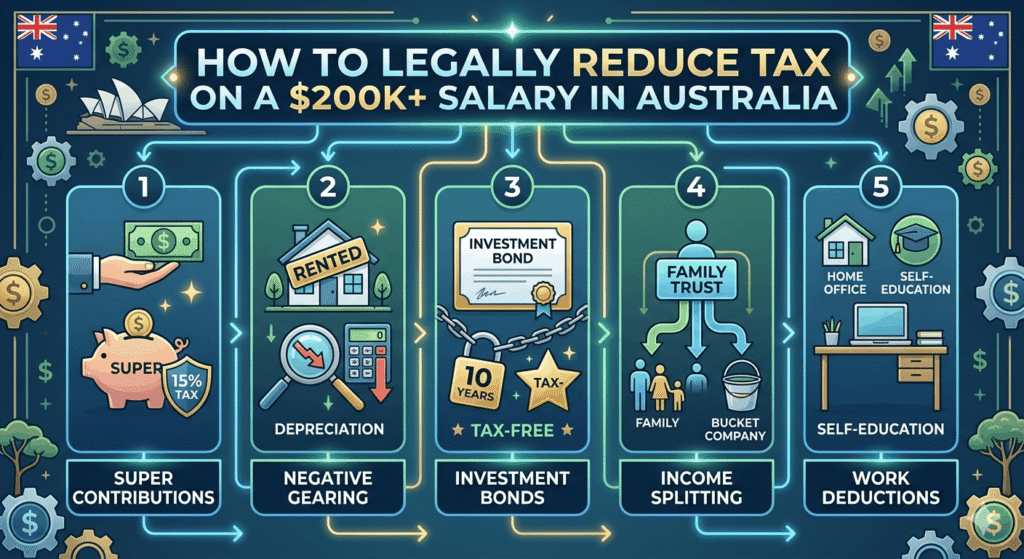
Earning $200,000 or more in Australia feels like it should mean financial comfort. For a lot of high-income earners, it doesn’t quite feel that way — because once you cross into the top tax brackets, a huge chunk of every extra dollar disappears before it ever reaches your bank account.
That frustration is valid. At $200,000+, your marginal tax rate sits at 37% or 45%, plus the Medicare levy. On the next dollar you earn, less than 53 cents stays in your pocket. It’s no surprise that high-income earners — employees, executives, doctors, lawyers, consultants, and tech professionals — actively look for ways to keep more of what they earn.
It’s worth being clear about the difference between three very different things. Tax evasion is illegal: hiding income, falsifying records, or simply not declaring what you owe. Aggressive tax avoidance sits in legally grey territory — contrived arrangements designed purely to avoid tax, which the ATO actively targets and can unwind. Legal tax planning is neither of these. It’s using the structures, deductions, and concessions Parliament has deliberately built into the tax and superannuation systems, exactly as intended.
This guide sticks firmly to the third category. Every strategy below is legal, ATO-recognised, and widely used by accountants and financial advisers across Australia. The goal isn’t to minimise tax at any cost — it’s to build wealth tax-efficiently, so the strategies you use also strengthen your super balance, your investment portfolio, and your long-term financial position, not just your tax return.
Here’s what you’ll learn: how Australia’s progressive tax system actually affects a $200k+ salary, the seven core strategies high-income earners use to legally reduce their tax bill, how to structure investments and ownership correctly, common mistakes to avoid, and a quarter-by-quarter plan so tax planning becomes a year-round habit rather than a scramble before 30 June.
Quick Answer: How Can You Legally Reduce Tax on a $200k+ Salary?
The most effective legal strategies for reducing tax on a $200,000+ Australian salary are: maximising concessional superannuation contributions, claiming every legitimate work-related and investment deduction, using debt recycling to convert non-deductible debt into deductible debt, investing tax-efficiently through franking credits and the CGT discount, optimising who owns which assets, and timing capital gains and losses strategically across financial years.
| Strategy | Typical Annual Tax Saving Potential* |
| Maximise concessional super contributions | Up to $4,500–$13,500, depending on cap usage and marginal rate |
| Claim all eligible deductions | $1,000–$5,000+, depending on occupation and circumstances |
| Debt recycling | Varies widely; compounds over years as deductible debt grows |
| Tax-efficient investing (franking credits, ETFs) | Several hundred to several thousand dollars, depending on portfolio size |
| Optimised ownership structures | Can be substantial for couples with uneven incomes or families with trusts |
| Strategic capital gains timing | Highly variable; can defer or reduce CGT by thousands in a sale year |
*Figures are illustrative only and depend heavily on individual income, structure, and timing. They are not a guarantee of savings for any specific person.
Understanding Australian Tax Rates for High-Income Earners
Australia uses a progressive tax system, which means you don’t pay one flat rate on your entire income. Instead, each portion of your income is taxed at the rate for that bracket. Understanding this distinction matters, because it’s easy to overestimate how much tax you’re actually paying.
Individual Tax Brackets for FY2025–26
| Taxable Income | Marginal Tax Rate |
| $0 – $18,200 | 0% |
| $18,201 – $45,000 | 16% |
| $45,001 – $135,000 | 30% |
| $135,001 – $190,000 | 37% |
| $190,001 and over | 45% |
These rates exclude the Medicare levy, which is calculated separately.
The Medicare Levy
Most Australian residents pay an additional 2% Medicare levy on their taxable income, on top of the rates above. High-income earners without private hospital cover may also pay the Medicare Levy Surcharge, an extra 1–1.5% depending on income tier, which is one of the simplest reasons many $200k+ earners hold private health insurance.
Effective Tax Rate vs. Marginal Tax Rate
Your marginal tax rate is the rate applied to your next dollar of income. Your effective tax rate is your total tax bill divided by your total income — and it’s always lower than your marginal rate, because the lower brackets still apply to the earlier portions of your income.
| Taxable Income | Marginal Rate | Approx. Effective Rate* | Approx. After-Tax Income* |
| $200,000 | 45% | ~30% | ~$140,000 |
| $250,000 | 45% | ~33% | ~$167,000 |
| $350,000 | 45% | ~37% | ~$220,000 |
*Approximate figures including the 2% Medicare levy, before any deductions or offsets. Actual outcomes vary based on individual circumstances.
Pro Tip: If you’re earning close to a bracket threshold (for example, just over $190,000), even a small reduction in taxable income — through super contributions or deductions — can meaningfully lower the tax paid on that portion of your income.
Maximise Concessional Super Contributions
For most high-income earners, this is the single most powerful and accessible legal tax strategy available. Concessional contributions are taxed at only 15% inside your super fund, instead of your marginal rate of up to 45% plus Medicare levy — an immediate, substantial saving on every dollar contributed.
Employer Contributions
Your employer is required to pay the Superannuation Guarantee, currently 12% of your ordinary time earnings, directly into your super fund. This counts toward your concessional contributions cap.
Salary Sacrifice
You can arrange with your employer to redirect part of your pre-tax salary into super, on top of the compulsory Superannuation Guarantee. This reduces your taxable income immediately and is one of the simplest strategies to set up — usually just a form through payroll.
Personal Deductible Contributions
If salary sacrifice isn’t available, or you have other income (such as investment income or a bonus), you can make a personal contribution to super and then claim a tax deduction for it, provided you submit a notice of intent to your fund before lodging your tax return.
Contribution Caps
The concessional contributions cap for FY2025–26 is $30,000 per year. This cap includes everything: employer Superannuation Guarantee payments, salary sacrifice, and personal deductible contributions combined — not each separately.
Carry-Forward Concessional Contributions
If your Total Superannuation Balance was below $500,000 at the end of the previous financial year, you may be able to carry forward unused concessional cap amounts from the past five years and contribute more than $30,000 in a single year without extra tax. This is particularly useful after a bonus, inheritance, or asset sale.
Example: Sarah, an executive earning $230,000, had $20,000 of unused concessional cap built up from previous years. By contributing the full $30,000 cap for this year plus her unused carry-forward amount, she was able to direct a much larger lump sum into super at the concessional 15% rate, rather than paying up to 47% tax on that income outside super.
Common Mistake: Exceeding your concessional cap (including employer contributions you may have forgotten about) triggers additional tax and added complexity. Always check your cap usage through myGov before making large personal or salary sacrifice contributions.
Note on Division 293 tax: If your income plus concessional super contributions exceeds $250,000 in a financial year, an additional 15% tax applies to the contributions above that threshold — bringing the effective tax on that portion to 30% instead of 15%. It’s still usually worthwhile, since 30% remains well below the 47% top marginal rate including Medicare levy, but it’s worth factoring into your calculations if you’re a high earner.
Claim Every Legitimate Deduction
Many high-income earners under-claim simply because they don’t keep adequate records throughout the year. Good record-keeping habits, not aggressive interpretations, are what separate confident deduction claims from ATO audit risk.
Work-Related Expenses
This includes uniforms (where required and not conventional clothing), tools and equipment, union and license fees directly tied to your role, and travel between work sites (not your regular commute).
Home Office Expenses
If you work from home, the ATO’s fixed-rate method (67 cents per hour for FY2025–26) covers electricity, internet, and phone use without needing to apportion every bill, provided you keep a record of hours worked from home.
Self-Education Costs
Courses, certifications, and study directly connected to your current role (not a future career change) are generally deductible, including textbooks, course fees, and related travel.
Professional Memberships
Annual fees for professional associations, registration bodies, and union memberships relevant to your occupation are deductible in the year paid.
Income Protection Insurance
Premiums for income protection insurance held outside super are generally tax-deductible, since the policy is designed to replace assessable income if you can’t work.
Investment-Related Expenses
Interest on loans used to generate investment income, ongoing investment advisory fees, and costs of managing your tax affairs (such as accountant fees) are typically deductible.
Eligibility generally requires that the expense was incurred in earning your income, was not reimbursed by your employer, and that you can substantiate it with a receipt or record. Common audit triggers include claiming expenses far above the average for your occupation, claiming private expenses as work-related, and missing or estimated receipts for larger claims.
Pro Tip: Use a dedicated app or simple spreadsheet to log deductible expenses as they happen throughout the year, rather than trying to reconstruct twelve months of expenses in June. This single habit prevents more missed deductions than almost any other strategy.
Use Debt Recycling Strategically
Debt recycling is a strategy that converts non-deductible debt (like your home loan) into deductible debt (like an investment loan), without necessarily increasing your overall debt load.
What Debt Recycling Is
In Australia, interest on your home mortgage isn’t tax-deductible, but interest on a loan used to buy income-producing investments generally is. Debt recycling uses the equity in your home to fund investments, while simultaneously paying down the original non-deductible mortgage.
How It Works — Step by Step
- Step 1: Make extra repayments on your home loan to build equity.
- Step 2: Set up a separate investment loan (a split or line of credit) secured against that equity.
- Step 3: Use the investment loan funds to purchase income-producing assets, such as shares or an investment property.
- Step 4: Direct the investment income, plus any tax refund generated by the deductible interest, back onto your home loan.
- Step 5: Repeat the cycle over time, gradually shifting your overall debt from non-deductible to deductible.
Potential Tax Benefits
Over time, debt recycling can convert a large portion of your home loan into a deductible investment loan, reducing your taxable income each year through interest deductions, while you also build an investment portfolio.
Risks and Considerations
This strategy increases your investment exposure and leverage, which magnifies both gains and losses. It also relies on disciplined cash flow management and works best with professional guidance, since incorrectly structured loans can jeopardise the deductibility of the interest.
Common Mistake: Mixing investment loan funds with personal expenses, even briefly, can taint the loan and make the interest only partially deductible. Keep investment loans and personal accounts strictly separate.
Build Tax-Efficient Investments
Not all investment income is taxed the same way. Choosing tax-aware investment types can materially affect your after-tax return.
Australian Shares and Franking Credits
Many Australian companies pay franked dividends, which come with a credit for company tax already paid. These franking credits reduce your personal tax bill, and any excess can be refunded if your tax payable is lower than the credits available.
ETFs
Exchange-traded funds offer diversification and, depending on the underlying holdings, can pass through franking credits and capital gains discounts in a relatively simple, low-cost structure.
Investment Bonds
Investment bonds (sometimes called insurance bonds) are taxed internally at a maximum of 30%, and become tax-free to the investor if held for 10 years without certain withdrawals — useful for high earners already at the top marginal rate.
Negative Gearing
When the costs of holding an investment (typically a property) exceed the income it generates, the shortfall can be deducted against your other income, reducing your overall tax bill. This is a legitimate, ATO-recognised strategy, but it should support a genuine investment decision, not be the sole reason for buying an asset.
Capital Growth vs. Income Strategies
Growth-focused assets (which pay less income but appreciate over time) can be more tax-efficient for high earners, since capital gains are only taxed when realised, and the 50% CGT discount applies to assets held over 12 months — unlike income, which is taxed every year it’s received.
Important context: Under tax reforms announced in the May 2026 Federal Budget, negative gearing on established residential properties purchased after 12 May 2026 will be limited from 1 July 2027, and the 50% CGT discount will be replaced with cost base indexation plus a 30% minimum tax rate on gains from that date. Properties held before the announcement are largely grandfathered. This makes the timing of new property purchases and the choice between new builds and established dwellings more important than ever — speak with your adviser about how these changes affect your specific plans.
Structure Investments Correctly
Who legally owns an asset can be just as important as which asset you buy. The right structure depends on your income, your partner’s income, your asset protection needs, and how much complexity you’re willing to manage.
Personal Ownership
Simple and low-cost, but means investment income is taxed at your full marginal rate — often the least efficient option for a high earner.
Joint Ownership
Splits income (and capital gains) between both owners, which can reduce overall tax if one partner has a lower income, but both owners share liability equally.
Lower-Income Spouse Ownership
Holding income-producing assets in the name of the lower-earning spouse can significantly reduce the household’s overall tax bill, since that income is taxed at their lower marginal rate.
Family Trusts
A discretionary family trust allows income to be distributed flexibly each year to beneficiaries on lower marginal rates, offering both tax flexibility and a layer of asset protection — at the cost of additional setup and ongoing administration.
Investment Companies
Companies pay a flat tax rate, which can be advantageous for retaining and reinvesting income, but extracting profits to use personally (via dividends) is taxed again at the individual’s marginal rate, with franking credits offsetting some of this.
SMSFs
A self-managed super fund lets you control your own investment strategy within superannuation’s concessional 15% tax environment, but comes with strict compliance obligations, setup costs, and is generally only cost-effective at larger balances.
| Structure | Tax Efficiency | Asset Protection | Complexity | Typical Costs |
| Personal ownership | Low for high earners | Low | Low | Minimal |
| Joint ownership | Moderate | Low | Low | Minimal |
| Lower-income spouse | High (if income gap is large) | Low | Low | Minimal |
| Family trust | High (flexible distributions) | Moderate–High | Moderate–High | Setup + annual admin |
| Investment company | Moderate (flat rate, but double tax on extraction) | Moderate | Moderate | Setup + annual admin |
| SMSF | Very high (15% environment) | High (within super) | High | Setup + ongoing compliance |
Pro Tip: There’s no single “best” structure — the right answer depends on your income gap with your partner, how many assets you’re accumulating, and your appetite for ongoing compliance. A good accountant will model the after-cost outcome of each option for your specific numbers.
Optimise Capital Gains Tax (CGT)
CGT applies when you sell an asset for more than you paid for it, and for high-income earners, the timing of a sale can be just as important as the sale itself.
The 50% CGT Discount
If you’ve held an asset for more than 12 months before selling, individuals and trusts can generally discount the taxable capital gain by 50%, meaning only half the gain is added to your assessable income.
Timing Asset Sales
Selling an asset in a financial year where your income is lower (for example, after reducing work hours, taking leave, or in retirement) can mean the gain is taxed at a lower marginal rate. Where possible, spreading large gains across two financial years can also reduce the overall tax impact.
Offsetting Capital Gains With Losses
Capital losses from other investments can be used to offset capital gains in the same year, or carried forward indefinitely to offset gains in future years.
Tax-Loss Harvesting
This involves deliberately realising losses on underperforming investments before 30 June to offset gains elsewhere in your portfolio — a legitimate, widely used strategy, provided the investment decision itself still makes commercial sense and isn’t purely a wash sale designed solely to manufacture a tax outcome.
Example: An investor with a $40,000 capital gain from selling shares held for three years can apply the 50% CGT discount (reducing the taxable gain to $20,000), and further offset this with a $12,000 capital loss carried forward from a previous year — reducing the taxable amount to just $8,000.
Common Tax Mistakes High-Income Earners Make
- Exceeding super caps — losing track of employer contributions and accidentally breaching the $30,000 concessional cap.
- Failing to keep records — missing legitimate deductions simply because receipts and logbooks weren’t kept throughout the year.
- Ignoring debt recycling opportunities — paying down a low-rate home loan instead of restructuring debt to be more tax-effective.
- Overusing negative gearing — buying underperforming properties purely for a tax deduction, rather than for genuine investment merit.
- Triggering unnecessary CGT events — selling assets without considering timing, available losses, or the 12-month discount threshold.
- Buying investments purely for tax reasons — a tax benefit should support a sound investment, never replace one.
Year-Round Tax Planning Checklist
Tax planning shouldn’t be a once-a-year scramble in June. Spreading key actions across the financial year gives you more options and fewer surprises.
July – September
- Review last year’s tax return with your accountant to identify missed opportunities.
- Set your salary sacrifice and savings targets for the new financial year.
- Check your super contribution caps and any available carry-forward amounts.
October – December
- Review investment performance and consider any structural changes for the year ahead.
- Top up income protection insurance or other deductible policies if under-insured.
- Begin organising receipts and records for the first half of the financial year.
January – March
- Mid-year check-in on concessional contributions made so far versus your annual cap.
- Review any capital gains realised year-to-date and identify potential tax-loss harvesting candidates.
- Reassess debt recycling progress if you’re running this strategy.
April – June
- Finalise any remaining concessional super contributions before 30 June (allow processing time — don’t leave this to the last day).
- Complete tax-loss harvesting before the financial year ends.
- Prepay any eligible deductible expenses (such as income protection premiums) if cash flow allows.
- Book a pre-30 June review with your accountant to confirm everything is finalised correctly.
Downloadable checklist opportunity: Convert this quarterly schedule into a one-page printable PDF checklist as a lead-generation download, with checkboxes for each action item.
Real-World Case Studies
Case Study 1: Employee Earning $220,000
Starting position: Marcus, a corporate manager earning $220,000, was making no extra super contributions and claiming only minimal deductions.
Strategies implemented: Salary sacrificed $15,000 into super, claimed legitimate home office and self-education deductions worth $3,200, and switched to income protection insurance held outside super for the deduction.
Estimated annual tax saving: Approximately $6,000–$7,000, while simultaneously growing his retirement savings.
Case Study 2: Medical Professional Earning $350,000
Starting position: Dr. Chen, a specialist earning $350,000, had significant unused concessional cap from previous years and an investment property held in her own name.
Strategies implemented: Used carry-forward concessional contributions to contribute a larger lump sum to super in one year, restructured the investment property loan as part of a debt recycling plan, and engaged an accountant to review trust distribution options for future investments.
Estimated annual tax saving: Substantial in the contribution year due to the carry-forward amount, with ongoing annual savings from the restructured deductible debt.
Case Study 3: Dual-Income Household Earning $450,000+
Starting position: James and Priya, a dual-income couple earning a combined $450,000, held all their investments jointly and had not considered a family trust.
Strategies implemented: Both maximised concessional super contributions, set up a family trust for new investments to allow flexible income distribution, and timed a planned asset sale to fall in a lower-income year for one partner.
Estimated annual tax saving: Meaningful combined savings from maximised super contributions alone, with additional flexibility and savings from the trust structure on future investment income.
These case studies are illustrative composites based on common scenarios and do not represent guaranteed outcomes. Actual results depend on individual circumstances.
How Technology and AI Are Changing Tax Planning
Tax planning is becoming faster and more data-driven, though professional judgement remains essential for anything beyond straightforward situations.
Open Banking
The Consumer Data Right allows you to securely share verified transaction data with accountants and financial planning tools, speeding up expense categorisation and reducing manual data entry.
Tax Apps
Apps that automatically track deductible expenses, log work-from-home hours, and categorise transactions throughout the year make it far easier to claim everything you’re entitled to, without a stressful June scramble.
AI-Powered Forecasting Tools
Modern tax and financial planning software can model the after-tax impact of different super contribution levels, investment structures, or sale timing scenarios, helping you and your adviser compare strategies side by side before committing.
Digital Record-Keeping
Cloud-based receipt scanning and digital logbooks mean substantiation is less of a burden than it used to be, directly reducing the audit risk that comes with poor record-keeping.
When to Seek Professional Advice
The strategies in this guide are general in nature. Several points in your financial life are worth a dedicated professional conversation.
Registered Tax Agents
Essential for accurate lodgement, claiming deductions correctly, and staying compliant — particularly once your affairs include investments, trusts, or multiple income streams.
Financial Advisers
Valuable for modelling super contribution strategies, investment structuring, and longer-term wealth planning that goes beyond a single tax return.
Mortgage Brokers
Important if you’re considering debt recycling or restructuring loans, since the right loan structure is central to making the strategy work as intended.
Estate Planning Lawyers
Worth engaging once your asset base grows, particularly if you’re using trusts or company structures, to ensure your estate plan and tax structure work together rather than against each other.
FAQs
What is the top marginal tax rate in Australia for 2025–26?
45%, applying to taxable income over $190,000, plus the 2% Medicare levy — bringing the effective top rate to 47%.
How much can I contribute to super to reduce my tax?
The concessional contributions cap is $30,000 for FY2025–26, though you may be able to contribute more using unused carry-forward amounts if your super balance is under $500,000.
What is Division 293 tax?
An additional 15% tax on concessional super contributions for individuals whose income plus contributions exceeds $250,000 in a financial year.
Is negative gearing still worthwhile in 2026?
It remains a legitimate strategy for many investors, though it should support a genuine investment decision rather than be the sole reason for a purchase, and recent Budget changes affect properties purchased after 12 May 2026.
What’s the difference between tax avoidance and tax planning?
Legal tax planning uses concessions and structures as intended by law; aggressive tax avoidance uses contrived arrangements purely to avoid tax, which the ATO can challenge and unwind.
Can I claim a tax deduction for income protection insurance?
Yes, generally, if the policy is held outside superannuation and is designed to replace your assessable income.
How does debt recycling actually reduce tax?
It converts non-deductible debt, like a home loan, into deductible investment debt, allowing you to claim the interest as a tax deduction while building an investment portfolio.
What is the 50% CGT discount?
A concession that allows individuals and trusts to reduce the taxable portion of a capital gain by half, provided the asset was held for more than 12 months before sale.
Should I set up a family trust to reduce tax?
It depends on your circumstances — trusts offer flexible income distribution and asset protection but come with setup and ongoing compliance costs, so it’s worth modelling the numbers with an accountant first.
Can my spouse’s lower income help reduce our household tax bill?
Yes — holding income-producing investments in the name of the lower-earning spouse can reduce the household’s overall tax, since that income is taxed at their lower marginal rate.
What records do I need to keep for tax deductions?
Receipts, invoices, logbooks (for work-from-home hours or vehicle use), and bank statements showing the expense was incurred and not reimbursed.
How often should I review my tax strategy?
At least annually, ideally each quarter, since income changes, new investments, and policy updates can all affect what strategies make sense for you.
Is an SMSF worth it for a $200k+ salary earner?
It can be, particularly at larger super balances, but the compliance costs and obligations mean it’s generally only cost-effective once your balance reaches a meaningful size — worth discussing with a financial adviser.
What happens if I exceed my super contribution cap?
Excess concessional contributions are added to your assessable income and taxed at your marginal rate, with an additional interest charge — so it’s worth tracking your cap usage carefully.
Can I do tax-loss harvesting on shares and property?
It’s commonly used with shares and managed funds; with property, the practical and cost barriers to selling purely for a tax loss are usually much higher.
Conclusion
Reducing tax on a $200,000+ salary in Australia isn’t about finding a clever loophole — it’s about consistently using the legal tools the system already provides: superannuation concessions, legitimate deductions, smart debt structuring, tax-aware investing, and sensible ownership choices.
None of these strategies work in isolation, and none of them should be the only reason you make a financial decision. The best outcomes come from strategies that also build genuine wealth — a stronger super balance, a well-structured investment portfolio, and assets held in the right names for the right reasons.
One Response