
Every year, thousands of high-income Australians lodge their tax return, move on with life, and then receive a letter from the ATO months later asking for more money. It’s called a Division 293 notice, and for many people, it’s the first time they’ve ever heard the term — despite having done absolutely nothing wrong.
That surprise is understandable, but it’s worth saying clearly upfront: Division 293 tax is not a penalty, an audit flag, or a sign you’ve made a mistake. It’s a routine, automatic assessment that applies to a defined group of taxpayers based on income and super contributions, calculated the same way for everyone who meets the threshold.
What it actually does is quite specific: it reduces the size of the tax concession high-income earners receive on their concessional super contributions, bringing it closer (though still not equal) to the concession received by someone on a more typical income. Understanding why it exists, how it’s calculated, and how to plan around it turns an unwelcome surprise into a predictable, manageable part of your annual tax planning.
This guide explains exactly who Division 293 applies to, walks through the calculation step by step with real examples, covers how and when you actually pay it, and looks at legitimate planning strategies and common misconceptions — including how it differs from a newer, separate measure called Division 296, which is frequently and incorrectly confused with it.
Quick Answer: What Is Division 293 Tax?
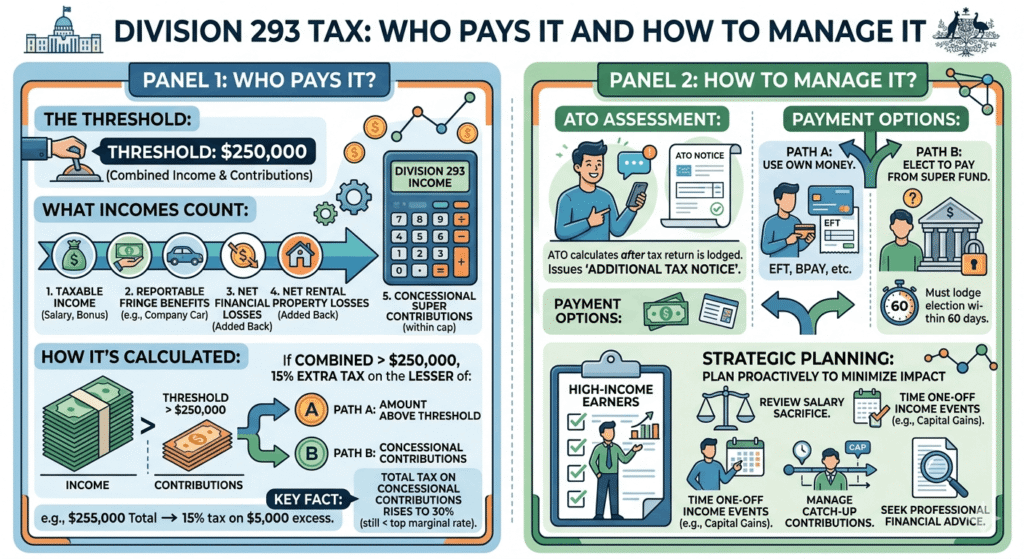
Division 293 tax is an additional 15% tax on some concessional (before-tax) superannuation contributions for individuals whose combined income and concessional contributions exceed $250,000 in a financial year. It applies to the portion of contributions above the threshold, not your entire contribution, and effectively raises the tax on that portion from 15% to 30% — still well below the top marginal tax rate of 45% plus Medicare levy.
| Question | Quick Answer |
| What triggers it? | Combined income and concessional super contributions exceeding $250,000 in a financial year |
| What rate applies? | An additional 15% on the contributions above the threshold (on top of the standard 15% fund tax) |
| Is it a penalty? | No — it’s a routine tax adjustment, not a fine or compliance flag |
| Who issues it? | The ATO, automatically, after processing your tax return and your fund’s contribution data |
| How is it paid? | Personally from your own funds, or released from your super account, within set deadlines |
Why Does Division 293 Tax Exist?
To understand Division 293, it helps to understand the concession it’s designed to limit.
Tax Concessions Within Super
Concessional super contributions are taxed at a flat 15% inside your super fund, instead of your personal marginal tax rate. For someone on a high income paying 45% (plus the 2% Medicare levy) on their top dollar, redirecting that dollar into super at 15% is an enormous concession — far larger than the concession available to someone earning a more modest income.
Equity Considerations
Because the concession is a flat rate rather than scaled to income, it disproportionately benefits higher earners. Division 293 was introduced to narrow that gap — not eliminate it, but bring the value of the concession for high earners closer to what a middle-income earner receives, while still leaving a meaningful tax advantage in place.
Historical Background
The measure has applied since the 2017–18 financial year, when the income threshold was set at $250,000. That threshold has remained unchanged since, meaning more people are captured by it over time as wages rise — a phenomenon sometimes called bracket creep, even though Division 293 isn’t technically a tax bracket.
Pro Tip: Because the $250,000 threshold hasn’t moved since 2017, more professionals cross into Division 293 territory every year simply through normal salary growth. It’s worth checking your position annually, even if you’ve never been affected before.
Who Pays Division 293 Tax?
Division 293 applies based on a specific, broader measure of income — not just your salary.
Income Thresholds Applicable in 2026
For the 2025–26 financial year, the Division 293 threshold remains $250,000. If your income for Division 293 purposes, plus your low-tax concessional contributions, exceeds this amount, you’re liable for the additional tax on the excess.
What Counts Toward Division 293 Income
Division 293 income is broader than your taxable income. It generally includes your taxable income, reportable fringe benefits, net investment losses, and certain other amounts — plus your concessional super contributions for the year.
Reportable Fringe Benefits
If your employer provides benefits like a novated lease or other salary-packaged items reported on your income statement, these are added to your Division 293 income, even though they aren’t taxed the same way as salary.
Net Investment Losses
If you have negatively geared investments, the net loss is added back for Division 293 purposes — meaning a strategy that reduces your taxable income through negative gearing doesn’t necessarily reduce your Division 293 income in the same way.
Salary Sacrifice Contributions
Amounts you salary sacrifice into super count as concessional contributions and are included in the Division 293 calculation, even though they’ve already reduced your taxable salary.
Employer Contributions
The compulsory Superannuation Guarantee your employer pays (currently 12% of ordinary time earnings) also counts as a concessional contribution for Division 293 purposes, alongside any salary sacrifice or personal deductible contributions.
Example: Wei has a salary of $245,000, a reportable fringe benefit of $8,000 from a novated lease, and concessional super contributions (employer plus salary sacrifice) of $32,000 for the year — though only $30,000 counts toward the cap and Division 293 calculation, since contributions above the concessional cap aren’t treated as low-tax contributions for this purpose. His Division 293 income is $253,000 ($245,000 + $8,000), and adding his $30,000 of concessional contributions brings the relevant total well past $250,000, triggering a liability on the excess.
Common Mistake: Many people calculate their Division 293 exposure using salary alone and are caught off guard by reportable fringe benefits or a one-off bonus pushing them over the threshold. Always use the broader Division 293 income definition, not just your base salary, when estimating your position.
How Division 293 Tax Is Calculated
The calculation follows a consistent four-step process, regardless of your specific income sources.
Step 1: Calculate Income for Division 293 Purposes
Add together your taxable income, reportable fringe benefits, net investment losses, and other relevant amounts as defined by the ATO.
Step 2: Add Concessional Contributions
Add your low-tax concessional contributions for the year (generally your concessional contributions up to the cap) to the income figure from Step 1.
Step 3: Compare Against the Threshold
Compare this combined total against the $250,000 threshold. If it’s below the threshold, no Division 293 tax applies.
Step 4: Calculate the Additional Tax
Division 293 tax is 15% of whichever is less: the amount by which your combined total exceeds $250,000, or your total low-tax concessional contributions for the year.
Example: Employee Earning $260,000
| Item | Amount |
| Taxable income | $260,000 |
| Concessional contributions (employer + salary sacrifice) | $28,000 |
| Division 293 income + contributions total | $288,000 |
| Amount over $250,000 threshold | $38,000 |
| Lesser of excess ($38,000) or contributions ($28,000) | $28,000 |
| Division 293 tax payable (15% of $28,000) | $4,200 |
Example: Executive Earning $320,000
| Item | Amount |
| Taxable income | $320,000 |
| Concessional contributions (at the $30,000 cap) | $30,000 |
| Division 293 income + contributions total | $350,000 |
| Amount over $250,000 threshold | $100,000 |
| Lesser of excess ($100,000) or contributions ($30,000) | $30,000 |
| Division 293 tax payable (15% of $30,000) | $4,500 |
Example: Medical Professional With Bonus Income
Dr. Lim normally earns $225,000, comfortably under the threshold. In one year, a one-off performance bonus of $40,000 lifted her taxable income to $265,000.
| Item | Amount |
| Taxable income (including bonus) | $265,000 |
| Concessional contributions for the year | $25,000 |
| Division 293 income + contributions total | $290,000 |
| Amount over $250,000 threshold | $40,000 |
| Lesser of excess ($40,000) or contributions ($25,000) | $25,000 |
| Division 293 tax payable (15% of $25,000) | $3,750 |
This example matters because it illustrates a common surprise: a single bonus, capital gain, or redundancy payment can trigger Division 293 tax in an otherwise unaffected year, even if your regular income normally sits below the threshold.
Pro Tip: If you know a bonus, vested equity, or other lump sum is coming, model your Division 293 position in advance with your accountant. There’s often little you can do once the income is received, but knowing ahead of time avoids a surprise assessment.
What Counts as Concessional Contributions?
Only certain types of contributions count toward both the concessional cap and the Division 293 calculation.
Employer Super Contributions
The compulsory Superannuation Guarantee, currently 12% of ordinary time earnings, is a concessional contribution.
Salary Sacrifice Contributions
Amounts you voluntarily redirect from your pre-tax salary into super are concessional contributions.
Personal Deductible Contributions
Contributions you make personally and then claim a tax deduction for (after submitting a valid notice of intent to your fund) are also concessional.
What’s Excluded
Non-concessional (after-tax) contributions, such as personal contributions you don’t claim a deduction for, are not included in the Division 293 calculation, since they’ve already been taxed at your marginal rate before entering super.
How Division 293 Interacts With Other Super Rules
Division 293 doesn’t operate in isolation — it sits alongside several other superannuation rules that affect high-income earners.
Concessional Contribution Caps
The concessional contributions cap for FY2025–26 is $30,000. Division 293 only applies to contributions within this cap (your low-tax contributions); amounts above the cap are taxed differently, at your marginal rate, and aren’t double-counted under Division 293.
Carry-Forward Contributions
If you use unused concessional cap amounts from previous years (available if your Total Superannuation Balance was under $500,000 at the end of the prior financial year), the full carried-forward contribution still counts toward your Division 293 calculation for the year it’s made.
Excess Contribution Tax
If you exceed your concessional cap altogether, the excess is treated differently — added to your assessable income and taxed at your marginal rate, with an additional interest charge, separate from the Division 293 calculation on your in-cap contributions.
Total Super Balance Limits
Your Total Superannuation Balance affects your eligibility for carry-forward contributions and non-concessional contributions, but it isn’t the trigger for Division 293 itself — that’s a separate measure entirely, addressed below.
Don’t confuse Division 293 with Division 296: Division 293 taxes concessional contributions for individuals whose income exceeds $250,000. Division 296, a newly legislated and separate measure taking effect from 1 July 2026, instead taxes investment earnings on the portion of an individual’s Total Super Balance above $3 million. They use different triggers, different bases, and apply to largely different groups of people — high income versus large super balance — though some individuals may eventually be affected by both.
How the ATO Collects Division 293 Tax
The process is automatic and follows a predictable timeline once your tax return and super contribution data are processed.
Assessment Notices
After both your personal tax return and your super fund’s contribution data have been received and processed, the ATO issues a Division 293 notice of assessment. This typically arrives some months after the end of the financial year, separate from your regular tax assessment.
Payment Deadlines
Division 293 tax is generally due within 21 days of the date on your notice of assessment.
Paying Personally
You can pay the amount from your own funds outside super, which keeps your super balance fully intact — often preferred by those wanting to maximise their retirement savings or who are approaching the Transfer Balance Cap.
Releasing Funds From Super
Alternatively, you can elect within 60 days of the notice date to have the ATO issue a release authority to your super fund, which then pays the amount directly to the ATO on your behalf, reducing your super balance instead of your personal cash.
| Stage | Typical Timing |
| Tax return lodged | After end of financial year (per normal lodgement deadlines) |
| Super contribution data received by ATO | Reported by your fund, generally within months of contributions |
| Division 293 notice issued | Some months after both data sources are processed |
| Payment due (if paying personally) | Within 21 days of the notice of assessment date |
| Election to release from super | Within 60 days of the notice issue date — this deadline is firm |
Common Mistake: If you plan to pay Division 293 tax from an SMSF, you must wait for the ATO to issue an official release authority before making any payment. Paying early, even with good intentions, can be treated as illegal early access to superannuation and may result in penalties.
Strategies to Manage Division 293 Tax
You generally can’t avoid Division 293 entirely if you’re genuinely over the threshold, but there are legitimate ways to plan around it.
Forecasting Taxable Income
Working with your accountant to forecast your likely Division 293 income each year — including bonuses, fringe benefits, and investment income — helps you budget for the liability rather than being surprised by it.
Managing Bonus Timing
Where you have genuine flexibility (such as choosing between two financial years for a discretionary bonus or vesting event), understanding the Division 293 impact of each option can inform the decision, alongside other tax considerations.
Reviewing Salary Sacrifice Arrangements
Even with Division 293 applying, salary sacrifice into super at an effective 30% tax rate is usually still considerably better than paying tax on that income at the 47% top marginal rate (including Medicare levy) — so reducing contributions purely to avoid Division 293 often isn’t the most tax-effective response.
Spouse Contribution Strategies
If one spouse earns significantly less, directing more contributions or investment income toward the lower-income spouse (within the rules) can help manage the household’s overall tax position, even if it doesn’t directly change one individual’s Division 293 liability.
Alternative Investment Structures
For income that would otherwise push you further over the threshold, considering investment structures like family trusts or tax-efficient investments (covered in more detail in our broader high-income tax planning guide) may help manage your overall tax position, separate from the super contribution decision itself.
Pro Tip: Even after accounting for Division 293, concessional super contributions are usually still tax-effective for high-income earners, since the effective 30% rate remains well below the 47% top marginal rate including Medicare levy. The right response to Division 293 is usually to plan for it, not to avoid contributing to super altogether.
Common Division 293 Mistakes
- Exceeding contribution caps — losing track of total concessional contributions (including employer contributions) and breaching the $30,000 cap.
- Forgetting reportable fringe benefits — calculating Division 293 exposure using salary alone, missing benefits like novated leases that count toward Division 293 income.
- Ignoring bonus income — not forecasting how a one-off bonus or vesting event could push income over the threshold for that year only.
- Misunderstanding carry-forward contributions — not realising that a large carry-forward contribution still counts in full toward the Division 293 calculation for the year it’s made.
- Assuming super contributions are always taxed at only 15% — overlooking that the effective rate becomes 30% on the portion of contributions affected by Division 293.
Is Contributing to Super Still Worth It?
Yes, in almost all cases — Division 293 reduces the size of the concession, but doesn’t remove it.
Effective Tax Rates
Even at the Division 293 rate of 30%, super contributions remain considerably more tax-effective than receiving the same income as salary and paying tax at the top marginal rate of 47% (including Medicare levy) — a meaningful gap of 17 percentage points.
Long-Term Compounding
Money inside super also benefits from a concessional 15% tax rate on investment earnings (lower again in pension phase), compounding over decades — an advantage that exists independently of Division 293 and applies to every dollar contributed, not just the portion above the threshold.
Retirement Benefits
Beyond the immediate tax comparison, super contributions build toward your retirement, in a structure specifically designed and regulated for that purpose, with its own protections and long-term tax advantages on withdrawal.
Alternative Investment Options
Investing the same amount outside super (for example, in your own name) avoids Division 293 entirely, but typically means paying tax on investment earnings at your full marginal rate each year, rather than the concessional rate inside super — usually a worse outcome for genuine long-term savers, even accounting for Division 293.
| Scenario | Effective Tax Rate on the Contribution |
| Salary, no super contribution | Up to 47% (top marginal rate + Medicare levy) |
| Concessional super contribution, under Division 293 threshold | 15% |
| Concessional super contribution, affected by Division 293 | 30% (15% fund tax + 15% Division 293 tax) |
Real-World Case Studies
Case Study 1: The Surprised First-Timer
Income level: Anthony, a senior engineer, had a salary increase from $235,000 to $258,000 this year.
Contributions made: $27,500 in combined employer and salary sacrifice contributions, unchanged from previous years.
Division 293 liability: Approximately $1,200, his first-ever Division 293 notice, simply as a result of crossing the threshold through ordinary salary growth.
Planning opportunity: Now aware of the threshold, Anthony budgets for the liability annually and continues salary sacrificing, since the after-Division 293 outcome still beats paying tax on that income at his marginal rate.
Case Study 2: The Bonus-Year Surprise
Income level: Fatima, a finance executive, usually earns $220,000 but received a $60,000 bonus this year.
Contributions made: $30,000 at the full concessional cap.
Division 293 liability: Approximately $4,500, the maximum possible given her contribution level, due to the bonus pushing her well over the threshold for that year only.
Planning opportunity: Fatima now flags bonus years to her accountant in advance, setting aside funds for the expected liability rather than being caught short months later.
Case Study 3: The Carry-Forward Catch-Up
Income level: Trevor, a contractor who took two years of reduced work for family reasons, returned to a $260,000 income with $100,000 of unused concessional cap built up.
Contributions made: Used his full carry-forward entitlement, contributing $100,000 in a single year.
Division 293 liability: A meaningful Division 293 tax bill on the contribution, since the full $100,000 counted toward the calculation — but still resulting in a substantial net tax saving compared with that income being taxed entirely outside super at his marginal rate.
Planning opportunity: Even after Division 293, large carry-forward contributions can still be worthwhile — the key is going in with a clear-eyed view of the tax cost involved, not a surprise after the fact.
These case studies are illustrative composites based on common scenarios and do not represent guaranteed outcomes for any individual.
Division 293 Checklist
Use this checklist each year to stay ahead of your Division 293 position rather than being surprised by a notice.
- Income forecasting: estimate your likely Division 293 income for the year, including salary, bonuses, fringe benefits, and investment income or losses
- Contribution tracking: confirm your total concessional contributions (employer plus salary sacrifice plus personal deductible) against the $30,000 cap
- Tax planning: discuss any expected bonus, vesting event, or asset sale with your accountant before it occurs, not after
- Record keeping: retain payment summaries, contribution statements, and notices of assessment for at least five years
- Payment planning: set aside funds in advance if you expect a Division 293 liability, so the 21-day payment deadline isn’t a scramble
- myGov monitoring: check your myGov inbox regularly after lodging your tax return, since the notice can arrive months later
Downloadable checklist opportunity: Convert this checklist into a one-page printable PDF with checkboxes, as a lead-generation download for high-income earners reviewing their super strategy.
FAQs
What is the Division 293 threshold?
$250,000 for the 2025–26 financial year. This threshold has been unchanged since Division 293 was introduced in 2017–18.
How do I pay Division 293 tax?
You can pay it personally from your own funds, or elect within 60 days of the notice date to have it released from your super fund via an ATO release authority.
Can I avoid Division 293 tax?
If your income and concessional contributions genuinely exceed $250,000, you generally can’t avoid it entirely, though forecasting and timing can help you plan for the liability rather than reduce it artificially.
Does Division 293 apply to salary sacrifice?
Yes. Salary sacrifice contributions count as concessional contributions and are included in the Division 293 calculation.
Is Division 293 a one-off tax?
No. It can apply every year your income and concessional contributions exceed the threshold, including in years where a bonus or one-off payment pushes you over.
What is Division 293 income?
A broader measure than taxable income, generally including taxable income, reportable fringe benefits, net investment losses, and certain other amounts, plus your concessional super contributions.
How much is Division 293 tax?
15% of the lesser of your income and contributions above the $250,000 threshold, or your total low-tax concessional contributions for the year.
Does superannuation guarantee count toward Division 293?
Yes, employer Superannuation Guarantee contributions are concessional contributions and count toward the Division 293 calculation.
What happens if I don’t pay Division 293 tax on time?
Interest and potential penalties may apply if the tax isn’t paid by the due date shown on your notice of assessment.
Is Division 293 the same as Division 296?
No. Division 293 taxes concessional contributions based on income over $250,000; Division 296 is a separate, newer measure taxing investment earnings on super balances above $3 million, effective from the 2026–27 financial year.
Can a one-off capital gain trigger Division 293 tax?
Yes. A capital gain added to your taxable income can push your Division 293 income over the threshold for that year, even if your regular income is normally lower.
Do I need an accountant to manage Division 293 tax?
It’s strongly recommended, particularly if your income is variable, you receive bonuses, or you’re using carry-forward concessional contributions, since forecasting your position accurately requires a full picture of your income.
Can I reduce my Division 293 liability by contributing less to super?
Reducing concessional contributions lowers your Division 293 liability, but it also means receiving that income as salary taxed at your full marginal rate instead — usually a worse overall outcome for genuine long-term savers.
Does Division 293 apply to self-employed people?
Yes, if their personal deductible super contributions plus other Division 293 income exceed the $250,000 threshold, the same rules apply regardless of employment type.
Will the Division 293 threshold increase in future years?
The threshold has remained at $250,000 since 2017–18 with no indexation, though tax policy can change — it’s worth checking current ATO guidance each year rather than assuming the figure is fixed forever.
Conclusion
Division 293 tax can feel like an unwelcome surprise the first time it lands in your myGov inbox, but it’s a predictable, well-defined part of the tax system for high-income earners — not a penalty, and not a sign anything has gone wrong.
Understanding the $250,000 threshold, what counts toward your Division 293 income, and how the calculation works turns this from an annual surprise into something you can forecast, budget for, and plan around. In almost every case, concessional super contributions remain a strong tax and retirement strategy even after accounting for Division 293 — the effective 30% rate is still well below what the same income would attract outside super.
Because your income, bonus timing, and super contributions can all shift from year to year, it’s worth reviewing your Division 293 position annually rather than only thinking about it after a notice arrives.
Want a clear picture of your Division 293 position? Speak with the Centria Finance team about your broader financial and lending position, and connect with a registered tax agent or financial adviser to forecast and plan for your specific Division 293 exposure.