
Most Australian homeowners are taught one rule above all others: pay off your mortgage as fast as you can. It’s sound advice, but it leaves a real opportunity on the table — because every extra dollar that goes onto your home loan is a dollar that isn’t working for you anywhere else, and the interest you’ve already paid down can’t be claimed as a tax deduction.
With interest rates higher than the ultra-low levels of the early 2020s, that opportunity cost has become harder to ignore. Homeowners are increasingly asking the same question: is there a smarter way to pay down the mortgage and build an investment portfolio at the same time, without needing a much bigger income or taking on reckless risk?
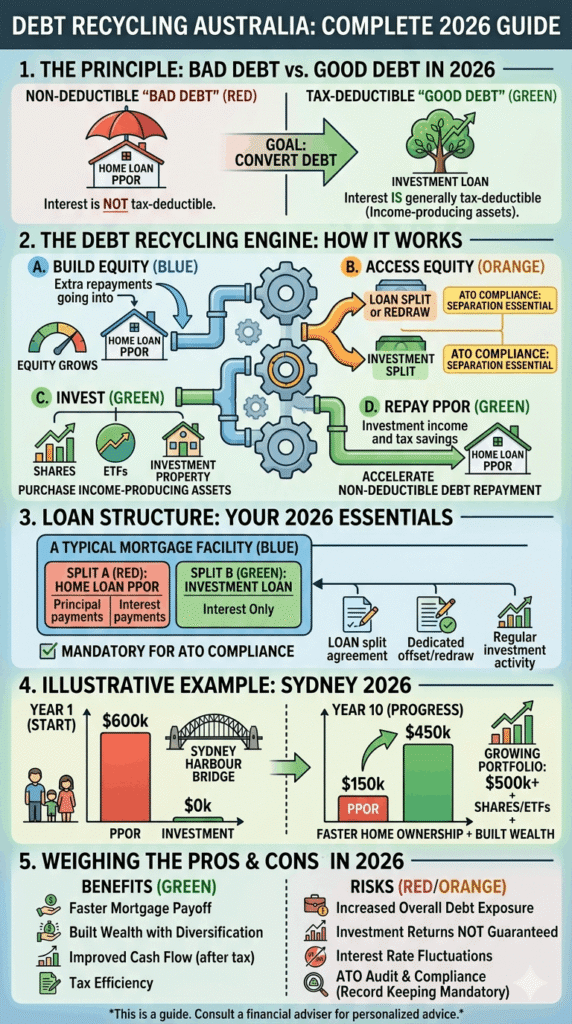
This is exactly the gap debt recycling is designed to fill. It’s a long-term wealth-building strategy that gradually converts non-deductible home loan debt into tax-deductible investment debt, using the equity and cash flow you already have rather than requiring you to save up a separate investment deposit from scratch.
Debt recycling isn’t right for everyone. It suits homeowners with stable income, healthy equity, a genuine appetite for investment risk, and a long time horizon — typically ten years or more. It is not a quick win, a tax loophole, or a substitute for proper financial advice. This guide walks through exactly how it works, what it can realistically achieve, the risks and compliance requirements involved, and how to set it up correctly with the right professionals.
Quick Answer: What Is Debt Recycling?
Debt recycling is a strategy that converts non-deductible home loan debt into tax-deductible investment debt. You pay down your mortgage, then redraw or borrow the same amount through a separate loan split to invest in income-producing assets like shares, ETFs, or property. Because the new debt is used to generate investment income, the interest is generally tax-deductible — and the investment income, plus tax savings, can be redirected back onto your home loan to accelerate the cycle.
| Feature | Traditional Mortgage Repayment | Debt Recycling Strategy |
| Goal | Pay off home loan as quickly as possible | Pay off home loan while simultaneously building an investment portfolio |
| Debt composition over time | Total debt shrinks; remains entirely non-deductible | Non-deductible debt shrinks; deductible investment debt grows |
| Tax outcome | No interest deduction on home loan | Interest on investment loan split is generally tax-deductible |
| Investment exposure | None, until mortgage is fully repaid | Begins immediately, using existing equity |
| Risk profile | Low — limited to interest rate risk | Higher — adds investment, market, and leverage risk |
| Complexity | Low — minimal ongoing management | Moderate to high — requires correct loan structuring and record-keeping |
The main benefit is converting an unproductive expense (non-deductible mortgage interest) into a deduction while simultaneously building wealth outside super. The main risk is that you’re adding leveraged investment exposure to your household balance sheet — if investments underperform or rates rise sharply, cash flow can come under real pressure.
Understanding Good Debt vs. Bad Debt
The entire logic of debt recycling rests on one core distinction: not all debt is treated equally by the tax system, and not all debt builds wealth in the same way.
Non-Deductible Debt
This is debt where the interest cannot be claimed as a tax deduction, because the borrowed funds aren’t used to produce income. The classic example is your home loan on the property you live in — it’s a personal expense, however essential, and the ATO doesn’t allow a deduction for it.
Tax-Deductible Debt
This is debt where the borrowed funds are used to produce assessable income, making the interest generally deductible. A loan used to buy shares that pay dividends, or a rental property that generates rental income, typically falls into this category.
Owner-Occupied Mortgages
The loan on the home you live in is non-deductible debt, full stop — regardless of how large the loan is or how the property’s value changes over time.
Investment Loans
A loan taken out specifically to acquire an income-producing asset is investment debt, and the interest is generally deductible against the income that asset produces (and against your other income, if the deduction exceeds that income — which is how negative gearing works).
Example: Anna has a $500,000 home loan (non-deductible) and a $300,000 investment property loan (deductible, since the rental income is assessable). If she pays down $40,000 of her home loan and then borrows $40,000 against her equity to buy ETFs, that new $40,000 of debt is also deductible — she has recycled $40,000 from the non-deductible column into the deductible column.
Pro Tip: A simple mental model: ask “what did this specific dollar of borrowed money buy?” If it bought your home, it’s not deductible. If it bought something that produces income, it generally is — provided you can prove it with clean records.
How Debt Recycling Works in Australia
Debt recycling follows a repeatable six-step cycle. Each time you complete the cycle, a little more of your total debt shifts from non-deductible to deductible.
Step 1: Build Equity and Cash Flow
You need genuine equity in your home (the gap between its value and what you owe) and enough spare cash flow to comfortably service both your home loan and a new investment loan. Lenders will assess this as part of any new borrowing.
Step 2: Split Your Home Loan
Rather than borrowing against one loan account, you split your mortgage into separate accounts — for example, your original home loan balance in Split A, and a new, empty investment loan facility in Split B. This separation is essential for keeping the two purposes cleanly distinct.
Step 3: Pay Down Non-Deductible Debt
You direct extra repayments (or a lump sum) onto Split A, your non-deductible home loan, reducing that balance.
Step 4: Redraw or Borrow for Investment Purposes
You then draw down the equivalent amount through Split B, the investment loan facility, drawing the funds directly into a dedicated investment or brokerage account — never into your everyday transaction account.
Step 5: Invest in Income-Producing Assets
The funds from Split B are used to purchase income-producing investments, such as Australian shares, ETFs, or (less commonly, given the larger amounts involved) a deposit toward an investment property.
Step 6: Claim Interest Deductions
Because Split B was used solely to acquire income-producing assets, the interest on that split is generally tax-deductible. The resulting tax saving, along with any investment income, can be redirected back onto Split A — restarting the cycle.
Diagram suggestion: This six-step cycle is ideal for a circular flowchart graphic, showing the loop from home loan → split → paydown → redraw → invest → deduction → back to home loan paydown.
Common Mistake: Never redraw investment funds into your everyday bank account “just to move them along” to an investment platform. Even a brief stop in a mixed-use account can break the traceability the ATO requires, potentially compromising the deduction. Draw funds directly from Split B into the investment account.
Debt Recycling Example With Real Numbers
These examples use illustrative figures and assumptions to show how the strategy plays out in practice. Actual results depend on your lender, your investments, and your personal circumstances.
Single Professional Earning $220,000
Assumptions: home valued at $1,100,000, mortgage balance of $550,000, marginal tax rate of 47% (including Medicare levy), investment loan rate of 6.5%, and $30,000 recycled in year one into a diversified ETF portfolio yielding 4% income plus long-term growth.
| Metric | Before Debt Recycling | After Year 1 of Debt Recycling |
| Non-deductible home loan | $550,000 | $520,000 |
| Deductible investment loan | $0 | $30,000 |
| Annual investment loan interest | $0 | ~$1,950 |
| Approximate annual tax saving | $0 | ~$915 (at 47% marginal rate) |
| Investment portfolio value (year 1) | $0 | ~$30,000 plus any growth |
Dual-Income Couple Earning $350,000
Assumptions: home valued at $1,600,000, mortgage balance of $700,000, combined marginal tax rate averaging 39%, investment loan rate of 6.5%, and $60,000 recycled in year one, split between ETFs and a small parcel of direct Australian shares.
| Metric | Before Debt Recycling | After Year 1 of Debt Recycling |
| Non-deductible home loan | $700,000 | $640,000 |
| Deductible investment loan | $0 | $60,000 |
| Annual investment loan interest | $0 | ~$3,900 |
| Approximate annual tax saving | $0 | ~$1,520 (at average 39% marginal rate) |
| Investment portfolio value (year 1) | $0 | ~$60,000 plus any growth and franking credits |
Over a longer horizon — typically 10 to 15 years — repeating this cycle annually can shift a meaningful share of total household debt from non-deductible to deductible, while simultaneously building an investment portfolio that wouldn’t otherwise exist. The long-term wealth outcome depends heavily on investment performance, which is never guaranteed.
These figures are illustrative only, based on the stated assumptions. They do not account for loan fees, brokerage costs, changes in interest rates, or investment performance, and are not a forecast or guarantee of any individual outcome.
Which Investments Can Be Used?
Debt recycling requires the borrowed funds to be used for income-producing investments. Several asset types are commonly used, each with different characteristics.
Australian Shares
Direct shares in dividend-paying companies offer the benefit of franking credits, which can further improve the after-tax return on the recycled debt, though concentration in individual stocks carries more company-specific risk than a diversified fund.
ETFs
Exchange-traded funds are one of the most common vehicles for debt recycling, since a single purchase provides broad diversification across many companies, reducing the risk of any one holding dragging down the whole portfolio.
Managed Funds
Similar to ETFs in offering diversification, though typically with higher fees and sometimes less flexibility around buying and selling compared with an ETF traded on the exchange.
Investment Properties
Property can be used for debt recycling, but the amounts involved are usually much larger and less divisible than shares or ETFs, which makes property a less common choice for the early stages of a recycling strategy, more often layered in once a share portfolio is established.
Whatever the asset, it must genuinely be income-producing (or have a reasonable expectation of producing income) for the interest to be deductible. Diversification matters because debt recycling already adds leverage to your finances; concentrating that leveraged exposure in a single stock or sector compounds the risk considerably.
Tax Benefits of Debt Recycling
The tax treatment of debt recycling rests on well-established, longstanding principles of Australian tax law — not a special concession created for this strategy.
Interest Deductibility
Interest is deductible where it’s incurred in earning assessable income. The Australian Taxation Office’s longstanding position, set out in Taxation Ruling TR 95/25, is that the deductibility of interest depends on tracing what the borrowed funds were actually used for — not on what asset secures the loan.
Franking Credits
If your debt-recycled investments include Australian shares or ETFs holding them, franking credits attached to dividends can reduce your overall tax bill, and any excess credits beyond your tax payable may be refunded.
Capital Gains Tax Implications
Selling debt-recycled investments triggers normal CGT rules. If held for more than 12 months, individuals generally qualify for the 50% CGT discount on the taxable gain. Because debt recycling is typically a long-term, buy-and-hold strategy, this discount is usually available when assets are eventually sold.
Record-Keeping Requirements
You need to keep clear, contemporaneous records: loan statements showing each draw-down, the destination account for those funds, purchase confirmations for investments, and a clear log connecting each dollar borrowed to the asset it bought.
The Purpose Test
At the moment funds are drawn from the loan, they must be used for an income-producing purpose. The later performance of that investment is irrelevant to deductibility — what matters is the purpose at drawdown, not whether the investment turned out to be a good one.
Tracing Rules
The ATO expects you to be able to trace borrowed funds directly from the loan account to the investment. Funds that pass through a shared personal account, even briefly, become harder to trace and risk having the deduction challenged or denied for that portion.
Example: If you draw $40,000 from your investment loan split and use $38,000 to buy ETFs but the remaining $2,000 covers a personal bill, the ATO’s general approach (illustrated in real cases such as Domjan) is that mixing purposes within a single drawdown can compromise the deductibility of that drawdown, not just the misused portion.
Pro Tip: Set up a dedicated, empty bank or brokerage account used solely for debt recycling drawdowns and investment purchases. Never let your everyday transaction account touch any part of the borrowed funds, even temporarily.
Debt Recycling vs. Redraw vs. Refinancing
These three terms get confused often, but they serve different purposes and have different tax outcomes.
| Feature | Debt Recycling | Simple Redraw | Refinancing |
| Purpose | Convert non-deductible debt into deductible investment debt | Access extra repayments you’ve already made, for any purpose | Replace your existing loan, often for a better rate or different lender |
| Tax outcome | Interest on the new investment split is generally deductible | Depends entirely on what the redrawn funds are used for | No automatic change in deductibility; purpose of funds still governs tax outcome |
| Flexibility | Requires correct loan splitting and discipline | High — funds can be used for anything | Can include cash-out for any purpose, with associated tax implications |
| Risk | Adds investment, market, and leverage risk | Low, if used for non-investment purposes | Low directly, though cash-out portions carry the same risks as new borrowing |
| Costs | Loan splitting and ongoing investment costs | Usually minimal or no extra cost | May involve discharge fees, application fees, or break costs |
The key distinction is purpose, not mechanism. Redrawing $20,000 to renovate your kitchen is not deductible, even though it uses the same redraw facility you might otherwise use for debt recycling. It’s what the money is used for that determines the tax outcome, every time.
Debt Recycling vs. Investing Outside Your Mortgage
Debt recycling is one option among several for building wealth alongside a mortgage. It’s worth understanding how it compares to the alternatives.
Cash Investing
Investing spare cash directly, without touching your mortgage at all, avoids adding leverage but means you’re investing only what you can save, rather than accessing the (potentially larger) pool of equity already sitting in your home.
Offset Accounts
Keeping savings in an offset account reduces the interest charged on your home loan without paying down the loan balance itself, preserving flexibility and liquidity — but it doesn’t create any investment exposure or deductible debt.
Extra Mortgage Repayments
Simply paying extra off your mortgage is the lowest-risk option and guarantees a return equal to your mortgage interest rate, but means your money isn’t building a separate investment portfolio, and that paid-down equity sits unproductive until you sell or refinance.
Debt Recycling
Allows you to simultaneously reduce non-deductible debt and build an investment portfolio, with the added benefit of interest deductibility — at the cost of additional complexity, leverage, and investment risk.
The opportunity cost of choosing one path over another isn’t just financial. Cash investing and offset strategies are simpler and lower-stress; debt recycling demands more attention, more discipline, and a genuine tolerance for investment risk and market volatility. There’s no universally “correct” answer — it depends on your goals, timeline, and comfort with leverage.
Risks and Drawbacks
Debt recycling is a legitimate, ATO-recognised strategy, but it is not risk-free, and it isn’t suitable for every homeowner.
Investment Risk
The investments you buy with recycled debt can fall in value, just like any other investment. Leverage magnifies both gains and losses.
Interest Rate Risk
If interest rates rise, the cost of servicing your investment loan rises too, which can squeeze cash flow if your investment income doesn’t keep pace.
Cash Flow Pressure
You’re servicing two loans rather than one larger loan, and if your income drops unexpectedly, that added repayment burden can become genuinely difficult to manage.
Market Volatility
A market downturn shortly after you’ve recycled a large amount can mean your investment is worth less than the debt used to buy it, at least temporarily — a scenario you need to be psychologically and financially prepared for.
Reduced Liquidity
Money tied up in investments and used to pay down a mortgage isn’t as readily accessible as cash sitting in an offset account, which matters if you need funds quickly for an emergency.
Borrowing Discipline
The strategy only works cleanly if you maintain strict discipline around loan splits and fund movements over many years — a single lapse in record-keeping or fund mixing can jeopardise deductions built up over time.
Common Mistake: Debt recycling is generally unsuitable for homeowners with unstable income, minimal cash buffers, low risk tolerance, a short time horizon, or limited equity. If any of these apply to you, it’s worth discussing simpler alternatives, like offset accounts or extra repayments, with your adviser first.
Common Debt Recycling Mistakes
- Mixing personal and investment debt — using the same loan account or redraw facility for both purposes, which compromises the deductibility of the entire balance.
- Failing to split loans correctly — not setting up genuinely separate loan accounts from the outset, making tracing difficult later.
- Using redraw incorrectly — redrawing funds into a personal account before forwarding them to an investment, even briefly, breaking the traceable link the ATO expects.
- Poor record keeping — not retaining loan statements, transfer records, and purchase confirmations that clearly link each drawdown to a specific investment.
- Overleveraging — recycling more debt than your cash flow and risk tolerance can genuinely support, especially without adequate buffers.
- Investing without diversification — concentrating recycled debt into a single stock or asset, multiplying the risk of an already leveraged position.
How to Set Up Debt Recycling Correctly
Getting the structure right from day one matters more with debt recycling than almost any other strategy, because mistakes can be expensive and hard to unwind retroactively.
Implementation Checklist
- Engage a mortgage broker to assess your available equity, borrowing capacity, and the right lender for loan splitting.
- Engage a registered tax agent or accountant to confirm the tax treatment of your specific plan and ensure record-keeping is set up correctly from the start.
- Engage a licensed financial adviser to determine appropriate investments and overall risk tolerance for your situation.
- Set up properly split loan accounts with your lender — never rely on a single mixed-purpose loan or informal tracking.
- Establish a dedicated investment or brokerage account used solely for debt-recycled funds.
- Set up a simple, consistent record-keeping system (a spreadsheet or dedicated app) logging every drawdown, transfer, and purchase.
Questions to Ask Your Professionals
- Mortgage broker: “Can this lender support a clean loan split, and what fees apply to setting it up?”
- Accountant: “Based on my specific income and circumstances, how should I structure and document this to support the deduction?”
- Financial adviser: “Given my risk tolerance and timeline, what mix of investments suits a debt recycling strategy for me?”
Downloadable checklist opportunity: Convert the implementation checklist above into a one-page printable PDF, with checkboxes and space to note each professional’s name and contact details, as a lead-generation download.
Debt Recycling and AI-Powered Finance Tools
Managing a debt recycling strategy well over many years is significantly easier with the right tools.
Open Banking
The Consumer Data Right lets you securely share verified transaction data with your broker, accountant, or financial planning software, making it easier to demonstrate clean fund flows if your structure is ever reviewed.
Portfolio Tracking Apps
Dedicated investment tracking apps can consolidate your recycled investment holdings, dividend and distribution income, and overall performance in one place, simplifying both decision-making and tax time.
Mortgage Optimisation Tools
Some lenders and brokers now offer digital tools that model different debt recycling drawdown schedules, helping you visualise how your deductible-to-non-deductible debt ratio shifts over time under different scenarios.
AI Budgeting Tools
AI-assisted budgeting apps can help monitor cash flow across two loan accounts and an investment portfolio, flagging early if servicing costs are creeping toward an uncomfortable level.
Real-World Case Studies
Case Study 1: The Cautious Starter
Starting position: Tom and Liz, a couple in their late 30s, had $200,000 of equity in their home and stable dual incomes totalling $260,000, but had never invested outside super.
Strategy used: Started conservatively, recycling just $20,000 in year one into a broad-market ETF, with a properly split loan and a dedicated brokerage account.
Tax outcome: Modest but genuine interest deduction in year one, building their confidence and record-keeping habits before scaling up.
Wealth creation result: A small but growing investment portfolio established without touching their savings, with a clear plan to increase the recycled amount annually.
Case Study 2: The High-Income Professional
Starting position: Priya, a specialist earning $340,000, had substantial home equity and a high marginal tax rate, but limited time to actively manage investments.
Strategy used: Recycled $80,000 in year one into a diversified ETF portfolio, working with a financial adviser to set an annual recycling target aligned with her cash flow.
Tax outcome: A meaningful annual interest deduction at her high marginal rate, materially improving the after-tax cost of the strategy.
Wealth creation result: A sizeable, low-maintenance investment portfolio building over time, run alongside her existing super contributions strategy.
Case Study 3: The Overleveraged Lesson
Starting position: David, motivated by a finance podcast, recycled $150,000 in a single year into a concentrated position in two growth stocks, without a cash buffer.
Strategy used: An aggressive, single-year approach without diversification or professional advice.
Tax outcome: The interest was deductible as intended, but a market downturn the following year left his investment worth significantly less than the loan used to buy it, while interest rates also rose.
Wealth creation result: Significant stress and a forced reassessment of the strategy — a clear illustration of why diversification, buffers, and a longer time horizon matter.
Case Study 4: The Property-Focused Investor
Starting position: Marcus and Sophie had built a share-based debt recycling strategy over five years and were ready to diversify into property.
Strategy used: Used a larger recycled amount, built up gradually over several years, as the deposit for a small investment property, layering property alongside their existing ETF holdings.
Tax outcome: Continued interest deductions on both the share-based recycling and the new investment property loan, with rental income adding to their overall serviceability.
Wealth creation result: A genuinely diversified investment base spanning shares and property, built incrementally without ever needing a separate, large cash deposit.
These case studies are illustrative composites based on common scenarios and do not represent guaranteed outcomes. Investment performance, interest rates, and individual circumstances all affect actual results.
FAQs
Is debt recycling legal in Australia?
Yes. Debt recycling relies on long-established tax principles around interest deductibility and is widely used and recognised, provided it’s implemented correctly and the borrowed funds are genuinely used for income-producing investments.
Is debt recycling worth it?
It can be, for homeowners with stable income, healthy equity, a long time horizon, and a genuine tolerance for investment risk — but it adds complexity and leverage, so it’s not automatically worthwhile for everyone.
Can I debt recycle into ETFs?
Yes, ETFs are one of the most common investment vehicles used for debt recycling, due to their diversification and relative simplicity.
Does debt recycling increase risk?
Yes. It adds investment risk, market risk, and leverage to your overall financial position, on top of your existing mortgage.
Can I use an offset account with debt recycling?
Yes, offset accounts can still be used alongside a debt recycling strategy for your non-deductible loan split, though the investment loan split itself is structured differently.
Do I need an accountant for debt recycling?
Strongly recommended. A registered tax agent helps ensure your structure and record-keeping support the deduction and reduces audit risk.
What is the purpose test in debt recycling?
It refers to the requirement that, at the time funds are borrowed, they must be used for an income-producing purpose for the interest to be deductible.
What are tracing rules in debt recycling?
Tracing rules require you to be able to clearly show that borrowed funds flowed directly from the loan account to the investment, without being mixed with personal funds.
How much equity do I need to start debt recycling?
There’s no fixed minimum, but most homeowners start with at least $20,000–$50,000 of available equity to make the strategy worthwhile relative to its setup and ongoing complexity.
Can I debt recycle into an investment property?
Yes, though the amounts involved are usually larger, making property a less common starting point than shares or ETFs for most homeowners.
What happens if I mix investment and personal funds?
Mixing funds can compromise the deductibility of the interest on the affected drawdown, since the ATO requires a clear, traceable link between the loan and the investment purpose.
Is debt recycling the same as negative gearing?
No. Debt recycling is about converting non-deductible debt into deductible debt using existing home equity; negative gearing refers to claiming a deduction when an investment’s costs exceed its income, which can apply with or without debt recycling.
How long does it take to see results from debt recycling?
Most benefits compound over a long horizon — typically 10 years or more — as the deductible debt portion and investment portfolio both grow with each annual cycle.
Can self-employed people use debt recycling?
Yes, provided they have stable, demonstrable income and can service both loan splits comfortably, though lenders may apply additional scrutiny to variable self-employed income.
What’s the biggest mistake people make with debt recycling?
Mixing personal and investment funds, or failing to split loans correctly from the outset — both of which can jeopardise the tax deduction the entire strategy depends on.
Conclusion
Debt recycling is one of the more powerful long-term wealth strategies available to Australian homeowners, precisely because it makes use of equity that’s often sitting idle in the family home. Done correctly, it can simultaneously reduce non-deductible debt and build a genuine investment portfolio, with the tax system working in your favour rather than against you.
It is not a tax loophole, a quick win, or a strategy to attempt without proper guidance. It requires clean loan structuring, disciplined record-keeping, a genuine tolerance for investment and leverage risk, and a time horizon measured in years, not months.
If the fundamentals fit your situation — stable income, real equity, a long-term outlook, and comfort with investment risk — debt recycling is well worth exploring with the right professionals beside you. If any of those fundamentals are missing, simpler strategies like offset accounts or extra mortgage repayments may serve you better, at least for now.
Ready to explore whether debt recycling suits your situation? Speak with the Centria Finance team about your borrowing capacity and loan structuring options, and connect with a registered tax agent and licensed financial adviser before implementing any strategy discussed in this guide.
One Response