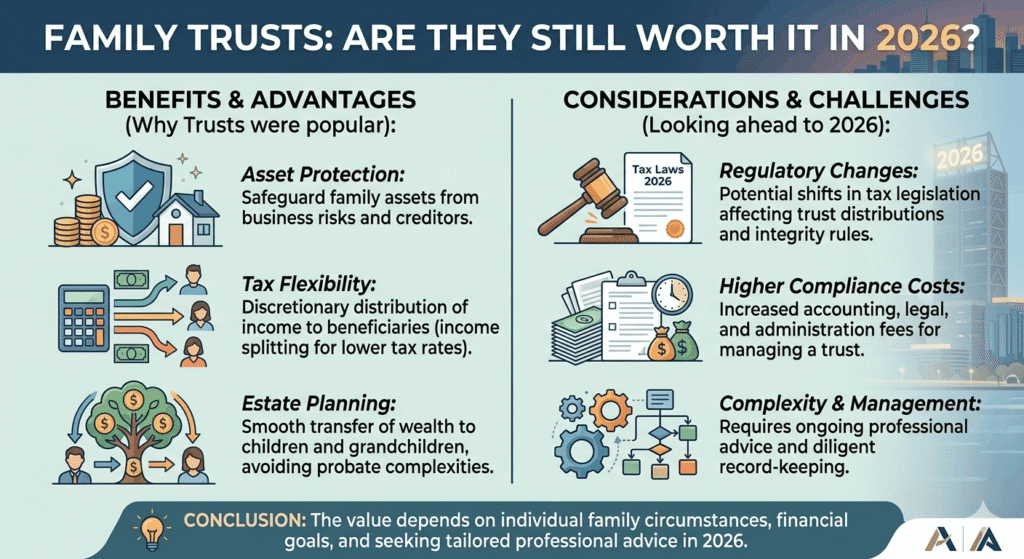
Family trusts have been a fixture of Australian tax and estate planning for decades, used by business owners, medical professionals, and property investors to split income, protect assets, and pass wealth down through generations. They’ve also attracted growing scrutiny — from increased ATO focus on how distributions are actually used, to a genuinely significant proposed tax change that could reshape how trusts are taxed from 2028.
So the question in the title is a fair one, and it deserves an honest answer rather than a sales pitch: yes, family trusts can still offer real tax planning and asset protection benefits, but they are not a “set and forget” structure, and they are not automatically worth it for everyone. The costs, the compliance obligations, and a meaningful proposed reform mean the decision genuinely depends on your specific circumstances.
This guide explains what a family trust actually is and how it works, the genuine tax and asset protection benefits it can offer, how it compares to other structures like companies and personal ownership, the costs involved, the traps that catch trustees out (including the increasingly scrutinised Section 100A), and what the proposed 2028 minimum tax means for anyone currently using or considering a trust.
Quick Answer: Are Family Trusts Still Worth It?
Family trusts can still provide meaningful tax flexibility and asset protection benefits in 2026, particularly for families with investment income, a business, or significant assets to manage across generations. They tend to be most effective where there’s genuine income to split across beneficiaries on different marginal tax rates, or a real need to separate asset ownership from business or professional risk. However, setup and ongoing compliance costs, increased ATO scrutiny of distributions under Section 100A, and a proposed 30% minimum tax on trust distributions from 1 July 2028 mean trusts are not automatically worthwhile for every family or every situation.
| Factor | Family Trust Outlook in 2026 |
| Income splitting | Still effective today, though the value is reduced for distributions to beneficiaries on rates below 30% once the proposed 2028 measure applies |
| Asset protection | Genuine benefits remain, particularly for business owners and professionals facing liability risk |
| Compliance burden | Increasing — the ATO’s focus on Section 100A and unpaid present entitlements means documentation matters more than ever |
| Future tax certainty | A proposed 30% minimum tax from 1 July 2028 (not yet law) would be one of the most significant trust tax changes in decades |
| Best suited to | Families with genuine investment income, a business, or multiple properties — less compelling for a single modest investment |
What Is a Family Trust?
A family trust, in everyday usage, almost always refers to a discretionary trust — a legal structure where a trustee holds and manages assets on behalf of a group of beneficiaries, with discretion over how income and capital are distributed among them each year.
Settlor
The settlor is the person who establishes the trust, typically by contributing a small initial sum (often a nominal amount) to formally create it. The settlor generally has no further role once the trust is established and is usually not a beneficiary.
Trustee
The trustee — an individual or, more commonly for asset protection reasons, a corporate trustee — holds legal ownership of the trust’s assets and is legally responsible for managing them in accordance with the trust deed and trust law.
Beneficiaries
Beneficiaries are the people (and sometimes entities, like a company) who can potentially receive distributions of income or capital from the trust, as determined by the trustee’s discretion each year, within the scope defined by the trust deed.
Appointor
The appointor (sometimes called the principal) holds the power to appoint or remove the trustee, making this role the ultimate position of control over the trust — often more significant in practice than the trustee role itself.
Discretionary Trusts vs. Fixed Trusts
In a discretionary trust, no beneficiary has a fixed, guaranteed entitlement to any specific share of income or capital — the trustee decides each year. In a fixed trust, beneficiaries hold defined, fixed entitlements (similar to shares), which removes the flexibility that makes discretionary trusts attractive for tax planning, but can suit different purposes such as certain investment structures.
Pro Tip: The appointor role deserves just as much careful thought as the trustee role when setting up a family trust — whoever holds this power effectively controls the trust’s future direction, including in the event of separation, death, or family disputes.
How Family Trusts Work in Australia
Running a family trust correctly involves more ongoing process than many people expect when they first set one up.
Trust Deeds
The trust deed is the foundational legal document setting out how the trust operates, who can be a beneficiary, and what powers the trustee holds — every decision the trustee makes must be consistent with the deed, which makes reviewing it periodically (especially after law changes) genuinely important.
Annual Distributions
Each financial year, the trustee must formally resolve how the trust’s income will be distributed among beneficiaries, generally before 30 June, with the resolution properly documented at the time — not reconstructed afterward.
Trustee Responsibilities
Beyond distributions, trustees must keep proper accounting records, ensure the trust lodges its own tax return, and act within the scope of their legal duties to beneficiaries at all times.
Tax File Numbers
The trust itself needs its own tax file number (and generally an ABN if it carries on a business or holds an investment property), separate from those of the trustee or beneficiaries personally.
Bank Accounts
The trust should operate through its own dedicated bank account, held in the name of the trustee on behalf of the trust, kept entirely separate from personal or business accounts to maintain clean records and support the trust’s legal standing.
Step-by-Step Annual Framework
- Step 1: Review the trust’s expected income for the year, ideally well before 30 June.
- Step 2: Discuss distribution options with your accountant, considering each beneficiary’s other income and marginal tax rate.
- Step 3: Formally document the trustee’s distribution resolution before the deed’s deadline (commonly 30 June).
- Step 4: Ensure distributions are genuinely paid or made available to beneficiaries, not just recorded on paper.
- Step 5: Lodge the trust’s tax return and ensure beneficiaries correctly report their share of trust income in their own returns.
Common Mistake: Trustee resolutions finalised after 30 June, or resolutions that appear to have been reverse-engineered once the year’s income is already known, have been specifically challenged and rejected by the ATO and tribunals. The resolution needs to be genuinely made and documented within the timeframe set by the deed.
Tax Benefits of Family Trusts
The tax flexibility a discretionary trust offers is the primary reason most families set one up — but it’s worth understanding exactly how that flexibility works.
Income Splitting
Because the trustee can distribute income flexibly each year, income can be directed toward beneficiaries on lower marginal tax rates (such as a spouse with lower personal income, or an adult child), reducing the overall tax paid by the family group on that income.
Streaming Capital Gains
Trusts can generally stream particular types of income, including capital gains and franked dividends, to specific beneficiaries best placed to use the associated tax attributes (such as the 50% CGT discount or franking credits), provided the trust deed permits this and it’s done correctly.
Franking Credits
Franking credits attached to dividend income flow through to the beneficiary who receives that distribution, potentially reducing their personal tax bill or generating a refund if their tax payable is lower than the credits available.
Retained Earnings Limitations
Unlike a company, a trust generally cannot simply retain profits inside the structure at a flat tax rate — except in limited circumstances, undistributed trust income is typically taxed at the top marginal rate in the trustee’s hands, which is why most trusts distribute the bulk of their income each year rather than accumulating it.
Example for a high-income household: A couple with one partner earning $250,000 and the other earning $40,000 holds an investment portfolio inside a family trust. By distributing more of the investment income to the lower-earning partner, the household reduces its overall tax bill compared with holding the same investments in the high-income partner’s name alone.
Example for property investors: A couple uses a family trust to hold a positively-geared investment property, distributing the rental income to a beneficiary on a lower marginal rate, while retaining flexibility to change that allocation in future years as personal circumstances shift.
Example for business owners: A business operating through a trading trust distributes profits across a working spouse, a non-working spouse, and a corporate beneficiary (a “bucket company”) to manage the family’s overall tax rate, retaining some profit at the company tax rate for future reinvestment.
Asset Protection Benefits
Beyond tax, asset protection is often an equally important reason families establish a trust.
Separation of Ownership
Because trust assets are legally owned by the trustee, not by any individual beneficiary, a beneficiary’s personal financial troubles (such as bankruptcy) generally don’t directly expose the trust’s assets in the same way they would if those assets were held in the beneficiary’s own name.
Business Risk Mitigation
Holding personal assets, like the family home or an investment portfolio, separately from a trading business (and ideally separately from the trust that runs the business, if structured with multiple trusts or entities) helps insulate personal wealth from business-related liabilities.
Professional Liability Protection
For professionals exposed to personal liability risk (certain medical, legal, or consulting roles), holding investment assets in a family trust rather than personally can provide a genuine layer of separation from claims related to their professional practice.
Limitations
Asset protection through a trust isn’t absolute. Courts can and do look behind trust structures in certain circumstances (such as family law property settlements or where a trust was established specifically to defeat creditors), and a trustee who is also a beneficiary with significant control may have weaker protection than a properly independent structure.
Family Trusts vs. Other Structures
A family trust is one of several structures available for holding investments or running a business, each with a different balance of tax efficiency, protection, flexibility, and cost.
| Structure | Tax Efficiency | Asset Protection | Flexibility | Setup Costs |
| Personal ownership | Low for high earners; no splitting flexibility | Low | Low | Minimal |
| Joint ownership | Moderate; fixed split between owners | Low | Low | Minimal |
| Company | Flat company tax rate; no income splitting on retained profits | Moderate | Moderate | Low–moderate |
| Family trust | High; flexible annual income splitting and streaming | Moderate–high | High | Moderate |
| SMSF | Very high (concessional super rate); restricted access until retirement | High, within super | Low (heavily regulated) | Moderate–high |
Each structure suits different goals. A company suits retaining profits for reinvestment at a flat rate; a trust suits flexible income splitting and asset protection; an SMSF suits long-term retirement saving in a highly concessional but restricted environment. Many sophisticated structures actually combine several of these — for example, a trading trust with a corporate trustee and a corporate beneficiary.
Family Trust Costs and Administration
Setting up and running a family trust costs meaningfully more than simply holding assets personally — a cost that needs to be weighed against the tax and protection benefits.
| Cost Category | Realistic Range |
| Initial trust establishment (deed, ABN, TFN) | Roughly $500–$2,000, depending on complexity and whether a corporate trustee is used |
| Corporate trustee setup (if used) | Roughly $500–$1,500 in addition to the trust deed itself |
| Annual accounting and tax return preparation | Roughly $1,000–$3,000 per year, more with a business or multiple properties involved |
| Legal fees (deed reviews, updates, advice) | Varies, generally engaged periodically rather than annually |
| Record keeping | Time cost of maintaining separate bank accounts, resolutions, and distribution records each year |
These figures are general ranges only, and actual costs depend on your accountant, the complexity of the trust’s affairs, and your state. Always obtain specific quotes before establishing a trust.
Pro Tip: Weigh the annual running cost of a trust against the actual tax saving it generates each year. For a single modest investment with limited income to split, the ongoing compliance cost can sometimes outweigh the benefit — a trust tends to earn its cost back more clearly as the income or asset base grows.
Common Family Trust Traps
- Distributing income incorrectly — making distributions inconsistent with the trust deed’s terms, which can unwind the intended tax outcome entirely.
- Failing to document resolutions — not finalising and properly recording trustee resolutions before the deed’s deadline, commonly 30 June.
- Section 100A risks — distributing income to a beneficiary on a lower tax rate where someone else (often a parent) actually receives the economic benefit, which the ATO can challenge under this anti-avoidance provision.
- Unpaid present entitlements — leaving distributions unpaid and used by other family members or the trust itself for years, increasing both Section 100A and Division 7A risk.
- Loss of tax losses — failing to meet the specific tests required for a trust to carry forward and use prior-year tax losses, particularly after a change in trust control or beneficiaries.
Common Mistake: Where Section 100A applies, the trustee — not the beneficiary — is taxed on the relevant income at the top marginal rate of 45%, regardless of which beneficiary the distribution was nominally made to. This is a genuinely costly outcome, and increasingly an area of active ATO compliance focus.
Family Trust Election (FTE)
A Family Trust Election is a specific tax election that interacts with several other rules trust trustees need to understand.
Purpose
Making an FTE allows a trust to access certain tax concessions — including more flexible use of franking credits and access to the trust loss rules — that aren’t otherwise available without one.
Eligibility
To make a valid FTE, the trust must pass a family control test, broadly meaning the trust is genuinely controlled by, and for the benefit of, a defined family group centred around a chosen test individual.
Family Group Rules
Once an FTE is made, distributions outside the defined family group can trigger family trust distribution tax, a separate penalty tax — making the family group definition something to consider carefully before electing.
When an FTE Is Beneficial
An FTE is commonly beneficial where the trust holds franked share investments (to access franking credits more flexibly) or has carried-forward tax losses it wants to use against future income, but it’s worth discussing with your accountant rather than assumed as a default step for every trust.
Family Trusts for Property Investors
Property investors specifically need to weigh a few additional factors when considering a trust structure.
Negative Gearing Limitations
A significant practical limitation: tax losses from a negatively geared property held in a discretionary trust cannot be distributed to beneficiaries to offset their personal income — the loss stays trapped in the trust and can only be carried forward to offset future trust income, which makes trusts a poor fit for a heavily negatively geared property strategy specifically.
Land Tax Implications
Several states apply different (often less generous) land tax thresholds or surcharges to property held in a discretionary trust compared with personal ownership, which can meaningfully affect the holding cost of a property portfolio structured this way.
CGT Discount Eligibility
Trusts can generally still access the 50% CGT discount on properties held over 12 months, and can stream the resulting capital gain to specific beneficiaries, provided the trust deed allows it and the streaming is done correctly.
Borrowing Considerations
Lenders generally apply additional scrutiny to loans for property held in a trust, often requiring personal guarantees from the trust’s individual controllers, and not all lenders offer the same range of products for trust borrowers as for personal borrowers.
A key trade-off for investors: Trusts excel at splitting positive income but trap negative gearing losses inside the structure. Many property investors use a trust for positively-geared or growth assets, while holding heavily negatively geared properties personally — it’s worth discussing this split with your adviser rather than defaulting to one structure for an entire portfolio.
Who Should Consider a Family Trust?
Business Owners
Particularly those wanting to split trading profits across family members on different tax rates, while also separating personal assets from business risk.
Medical Professionals
Often attracted by both the income-splitting benefit and the additional layer of separation between personal assets and professional liability exposure.
Investors With Multiple Properties
Particularly where the properties are positively geared or growth-focused, allowing genuine income-splitting and capital gains streaming benefits without the negative gearing trap.
High-Income Households
Especially where one partner earns substantially more than the other, or there are adult children who can be included as beneficiaries on lower marginal rates.
Who May Not Benefit
Single-income individuals with no one to genuinely split income with, owners of a single heavily negatively geared property, and those unwilling to manage the additional annual compliance and cost burden may find a trust isn’t worth the complexity for their situation.
Real-World Case Studies
Business Owner Family
Initial structure: A tradesperson ran their business as a sole trader, with all profit taxed in their own name at their full marginal rate.
Changes implemented: Restructured into a trading trust with a corporate trustee, distributing profit across themselves, their spouse (working part-time in the business), and a bucket company for retained profits.
Tax and asset protection outcomes: Meaningfully reduced the family’s overall tax rate on business profits, while also separating personal assets from the trading entity’s business risk.
Property Investor Couple
Initial structure: A couple held two positively-geared investment properties jointly in their personal names.
Changes implemented: Purchased a third property through a newly established family trust, retaining the existing two properties personally, while using the trust to stream the new property’s income toward the lower-earning partner.
Tax and asset protection outcomes: Reduced the household’s overall tax on the new property’s income, while keeping their existing personally-held properties (with simpler land tax treatment) unaffected.
Professional Earning $350,000+
Initial structure: A specialist physician held an investment share portfolio personally, paying tax on all dividend and capital gains income at the top marginal rate.
Changes implemented: Transferred new investments into a family trust (triggering CGT considerations on any existing assets moved, carefully managed with their accountant), with income streamed to a non-working spouse and an adult child at university.
Tax and asset protection outcomes: Reduced the household’s overall tax on investment income, while adding a layer of separation between personal investment assets and professional liability risk.
These case studies are illustrative composites based on common scenarios and do not represent guaranteed outcomes for any individual or family.
Family Trust Setup Checklist
- Professional advice: engage a registered tax agent and, where significant assets or estate planning are involved, an estate planning lawyer
- Trust deed: ensure the deed is drafted (or reviewed, if using a template) to suit your specific family and asset situation
- Trustee selection: decide between an individual trustee or a corporate trustee, considering asset protection and succession implications
- Beneficiary review: confirm the intended beneficiaries are correctly defined and consider whether a Family Trust Election is appropriate
- Annual compliance: set a calendar reminder well before 30 June each year to finalise and document distribution resolutions
Downloadable checklist opportunity: Convert this setup checklist into a one-page printable PDF with checkboxes, as a lead-generation download for families considering a trust structure.
FAQs
Can family trusts reduce tax?
Yes, primarily through income splitting across beneficiaries on different marginal tax rates, though the benefit depends on having genuine income and beneficiaries to distribute to.
How much does a family trust cost?
Initial setup is typically a few hundred to a couple of thousand dollars, with ongoing annual accounting and compliance costs typically in the range of $1,000–$3,000 or more depending on complexity.
Can I pay myself a salary from a trust?
A trust generally distributes profit to beneficiaries rather than paying a salary in the traditional sense, though if you’re also employed by a related business entity, a salary can still apply through that entity.
Are family trusts worth it for one investment property?
Often not, particularly if the property is negatively geared, since trust losses can’t be distributed to offset other income — the ongoing compliance cost may outweigh the limited benefit for a single property.
What is Section 100A?
An anti-avoidance provision that can apply where a beneficiary is made presently entitled to trust income, but a reimbursement arrangement means someone else actually receives the economic benefit — potentially taxing the trustee at 45% instead.
What is the proposed 30% minimum trust tax?
A measure announced in the 2026–27 Federal Budget that would, from 1 July 2028, require trustees of discretionary trusts to pay a minimum 30% tax on the trust’s taxable income, with beneficiaries receiving a non-refundable credit.
Will the 30% minimum trust tax apply to existing trusts?
Based on current Budget announcements, no grandfathering relief is proposed, meaning existing discretionary trust structures would also be subject to the measure from 1 July 2028 if legislated as announced.
What is an unpaid present entitlement?
An amount a beneficiary is entitled to receive from a trust but hasn’t actually been paid, which the ATO increasingly scrutinises, particularly under enhanced 2026 trust statement reporting requirements.
Can a trust distribute losses to beneficiaries?
No — tax losses remain trapped within the trust and can only be carried forward to offset the trust’s own future income, not distributed to individual beneficiaries.
What’s the difference between a family trust and a unit trust?
A family (discretionary) trust gives the trustee discretion over distributions each year, while a unit trust allocates fixed, proportional entitlements to unit holders, similar to shares in a company.
Do I need a corporate trustee?
It’s not legally required, but a corporate trustee is commonly recommended for additional asset protection and smoother succession if a trustee changes over time.
Can a family trust own a business?
Yes, a trading trust is a common structure for operating a business, often combined with a corporate trustee for liability protection.
What happens to a family trust when someone dies?
The trust itself generally continues, governed by the deed’s terms; the deceased’s role (such as appointor or a key beneficiary) needs to be addressed through succession planning within the deed and broader estate plan.
Can I add or remove beneficiaries from a family trust?
This depends entirely on the powers set out in the specific trust deed — some deeds allow this flexibly, others are more restrictive, which is why reviewing your deed periodically matters.
Is a family trust the same as a testamentary trust?
No — a family (discretionary) trust is typically established during your lifetime, while a testamentary trust is established through a will and only comes into effect after death, often with different tax treatment for minor beneficiaries.
Conclusion
Family trusts remain a genuinely useful tool for the right circumstances in 2026 — particularly for business owners, professionals, and families with real investment income to split across different tax rates, or a genuine need to separate personal assets from business or professional risk. They are not, and have never been, a tax loophole; they’re a legitimate structure that comes with real costs, real compliance obligations, and increasing ATO scrutiny of how they’re actually used.
The proposed 30% minimum tax on discretionary trust distributions, set to apply from 1 July 2028 if legislated as currently announced, is the most significant development in trust taxation in decades, and it specifically affects the income-splitting benefit that’s long been a core reason families use trusts. Anyone currently running, or considering establishing, a family trust should factor this proposed change into their planning now, rather than waiting until closer to the start date.
Because trust structures involve genuine legal and tax complexity, and because the rules are evidently still evolving, this isn’t a decision to make from a blog post alone. A registered tax agent, financial adviser, and estate planning lawyer working together can help determine whether a family trust genuinely suits your circumstances, and how to structure and run one correctly if it does.
Considering a family trust, or reviewing an existing one? Speak with the Centria Finance team about your broader financial and lending position, and connect with a registered tax agent and estate planning lawyer to assess whether a family trust structure suits your specific circumstances.
2 Responses