
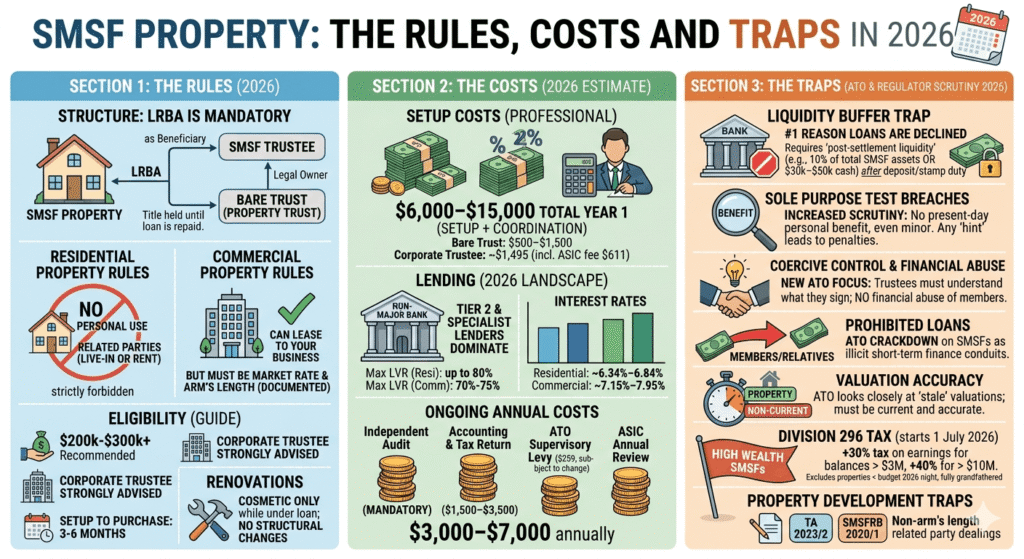
Despite higher interest rates and tighter lending standards over recent years, buying property through a self-managed super fund continues to attract serious interest from Australian business owners, professionals, and pre-retirees. The appeal is easy to understand: use the super balance you’ve already built up to acquire a tangible, income-producing asset, inside a concessionally taxed structure you control yourself.
But SMSF property is not simply “buying an investment property with a different bank account.” It sits inside one of the most heavily regulated corners of Australian financial law, governed by strict rules about who can use the property, how it can be financed, and what happens if those rules are breached. The consequences of getting it wrong aren’t minor — they can include the fund losing its complying status and significant tax and civil penalties for trustees.
This guide walks through exactly how SMSF property investing works: the foundational rules every trustee needs to understand, the real differences between residential and commercial property within an SMSF, how borrowing actually works through a limited recourse borrowing arrangement, realistic costs at every stage, and the traps that catch out otherwise careful trustees. It’s a genuinely powerful strategy for the right person and the wrong move for many others — by the end, you should have a clear sense of which side of that line you’re likely on.
Quick Answer: Can You Buy Property Through an SMSF?
Yes, an SMSF can buy property, including with borrowed money, but strict rules apply. The property must satisfy the sole purpose test, meaning it’s acquired and maintained solely to provide retirement benefits to fund members — not to benefit a member or their relatives in the present. Residential property generally cannot be lived in or rented by fund members or their relatives, while commercial property can, in some cases, be leased back to a member’s own business on strict arm’s length terms. Ownership and borrowing are also tightly restricted by related party and in-house asset rules.
| Question | Quick Answer |
| Can an SMSF buy residential property? | Yes, but it generally cannot be lived in or rented by a member or their relatives |
| Can an SMSF buy commercial property? | Yes, and it can sometimes be leased back to a member’s business, on strict arm’s length terms |
| Can an SMSF borrow to buy property? | Yes, through a Limited Recourse Borrowing Arrangement (LRBA) |
| What’s the sole purpose test? | The fund’s investments must be solely for providing retirement benefits to members, not present-day personal benefit |
| What happens if the rules are breached? | The fund risks losing its complying status, with significant tax and penalty consequences for trustees |
What Is an SMSF?
Before getting into property specifically, it’s worth being clear about what an SMSF actually is and what running one involves.
Definition
A self-managed super fund is a private superannuation fund with typically up to six members, where the members are generally also the trustees (or directors of a corporate trustee), giving them direct control over investment decisions in exchange for full legal responsibility for running the fund correctly.
Trustee Responsibilities
As a trustee, you’re legally responsible for acting in the best financial interests of all members, complying with superannuation law, and ensuring the fund’s investments and administration meet strict regulatory standards — regardless of whether you personally have the expertise to manage all of this.
Investment Strategy Requirements
Every SMSF must have a documented investment strategy, reviewed regularly, that considers diversification, liquidity, risk, and the fund’s ability to pay member benefits — a property purchase needs to genuinely fit within this strategy, not be a decision made independently of it.
Compliance Obligations
SMSFs must be audited annually by an approved SMSF auditor, lodge an annual return, and meet ongoing record-keeping and reporting requirements — all of which apply with extra weight once the fund holds property and, often, a loan.
Pro Tip: Before even looking at properties, make sure your fund’s investment strategy explicitly considers and supports a property purchase of the size and type you’re considering. This isn’t paperwork for its own sake — auditors and the ATO genuinely check it.
SMSF Property Rules in 2026
Several interlocking rules govern what an SMSF can and can’t do with property. Understanding each one is essential before going any further.
Sole Purpose Test
Every investment decision must be made solely to provide retirement benefits to members (or their dependants if a member dies before retirement) — not to provide a present-day benefit, such as somewhere for a member to live or run their own unrelated business rent-free.
Related Party Rules
Transactions with related parties (members, their relatives, and related companies or trusts) are heavily restricted. The fund generally cannot acquire residential property from a related party, and any dealings that do occur with related parties must meet strict conditions.
Arm’s Length Transactions
All transactions, including leasing a commercial property back to a member’s business, must be conducted on genuine commercial terms — market rent, a formal lease, and terms no different to what an unrelated tenant would be offered.
In-House Asset Rules
Generally, no more than 5% of an SMSF’s total assets can be ‘in-house assets’ (broadly, loans to, investments in, or leases with related parties), which is one reason residential property leased to a related party is so tightly restricted — it would typically breach this limit.
Personal Use Restrictions
A member or their relative generally cannot live in or otherwise use an SMSF-owned residential property, even temporarily or for a fair market rent — this is one of the most commonly misunderstood rules among new trustees.
Example: A business owner wants their SMSF to buy the building their company already trades from. If structured correctly (commercial property, market-rate lease, formal documentation), this can be compliant. If a member instead wants their SMSF to buy a beach house for the family to use on weekends, even paying “rent” to the fund, this breaches both the sole purpose test and the residential property restrictions.
Common Mistake: Believing that paying the SMSF market rent makes it acceptable for a member or relative to live in a fund-owned residential property is one of the most damaging misconceptions in SMSF property. For residential property, this is generally prohibited outright, regardless of rent paid.
Residential vs. Commercial SMSF Property
The distinction between residential and commercial property is one of the most important decisions an SMSF trustee makes, because the rules genuinely diverge.
| Factor | Residential Property | Commercial Property |
| Who can use the property | Cannot be lived in or rented by a member or their relative, under any circumstances | Can be leased to a member’s own business, if done on genuine arm’s length terms |
| Related party rules | Generally cannot be purchased from a related party | Can sometimes be purchased from a related party (e.g. a member’s existing business premises), subject to strict conditions |
| Leasing arrangements | Must be leased to unrelated tenants only | Can be leased to a related business tenant, with a formal market-rate lease |
| Borrowing considerations | LRBA available, generally with higher deposit requirements | LRBA available; lenders may apply different criteria for commercial security |
| Tax treatment | Rental income taxed at the standard concessional super rate | Rental income taxed at the standard concessional super rate; can suit business owners consolidating premises into super |
Example: Two scenarios illustrate the difference clearly. An SMSF buying a suburban house to rent to an unrelated tenant is a straightforward residential investment, taxed like any other SMSF asset. An SMSF buying a warehouse and leasing it to the member’s own logistics business, at a properly documented market rent, can be a legitimate and popular strategy — but the same warehouse leased rent-free, or below market rate, to that same business would breach the rules.
Can an SMSF Borrow to Buy Property?
Superannuation funds are generally prohibited from borrowing at all — property purchases funded by debt are only possible through one specific, tightly regulated exception.
Limited Recourse Borrowing Arrangements (LRBAs)
An LRBA is the legal mechanism that allows an SMSF to borrow to acquire a single asset, with the lender’s recourse in the event of default limited to that specific asset — protecting the rest of the fund’s assets from being at risk if the loan defaults.
Bare Trusts
Under an LRBA, the property is held by a separate holding (bare) trust during the loan period, with the SMSF holding beneficial ownership and receiving all rental income and capital growth. Legal ownership transfers to the SMSF once the loan is fully repaid.
Deposit Requirements
SMSF lenders typically require a substantially larger deposit than standard property loans, often in the order of 20–40% of the purchase price plus costs, varying by lender and whether the property is residential or commercial.
Lending Criteria
Lenders assess both the fund’s ability to service the loan from its existing cash flow and contributions, and its overall compliance standing — and most require a minimum fund balance, commonly in the order of $200,000–$300,000 or more, before considering an application.
Loan-to-Value Ratios
SMSF loan-to-value ratios are typically more conservative than standard investment lending, often capped around 60–80% for residential property and lower again for commercial property, reflecting the more conservative risk appetite of the relatively small number of lenders offering SMSF products.
Step-by-Step LRBA Framework
- Step 1: Confirm the property purchase aligns with the fund’s documented investment strategy.
- Step 2: Obtain advice from an SMSF specialist accountant and financial adviser on suitability and structuring.
- Step 3: Arrange SMSF-specific finance pre-approval through a broker experienced with LRBA lending.
- Step 4: Establish the bare trust (holding trust) and bare trustee, generally before exchanging contracts.
- Step 5: Exchange contracts and settle, with the property held in the bare trust and the SMSF providing beneficial ownership.
- Step 6: Service the loan from fund contributions and rental income, with legal ownership transferring to the SMSF once the loan is repaid.
Common Mistake: Borrowed LRBA funds can generally only be used to acquire, repair, and maintain the asset — not to improve it in a way that changes its fundamental character. Using LRBA funds for a renovation that goes beyond repair and maintenance is a common compliance trap.
Costs of Buying Property Through an SMSF
SMSF property purchases carry meaningfully higher costs than buying the same property personally, due to the additional legal structures and compliance obligations involved.
| Cost Category | Realistic Range |
| SMSF establishment (if not already set up) | Roughly $1,000–$3,000, plus corporate trustee costs if used |
| Bare trust and LRBA legal setup | Roughly $1,500–$3,500 per property |
| Conveyancing and stamp duty | Varies by state and property value, similar to a standard purchase |
| SMSF loan establishment and ongoing fees | Often higher than standard loans, plus the higher interest rate margin typical of LRBA lending |
| Annual accounting and tax return | Roughly $1,500–$3,500 per year, more with property and a loan in place |
| Annual independent audit | Roughly $500–$1,500 per year |
| Property management fees | Similar to standard investment property management, typically a percentage of rent |
| Ongoing fund administration | Varies depending on whether using a specialist administration platform |
These figures are general ranges only, and actual costs vary significantly depending on your state, property type, fund complexity, and the professionals you engage. Always obtain specific quotes before proceeding.
Pro Tip: Factor in the full cost stack, not just the deposit and loan repayments, when assessing whether SMSF property genuinely makes sense for your fund. The additional legal, accounting, and audit costs are recurring, not one-off, and need to be sustainable for the life of the investment.
Tax Benefits and Drawbacks
The tax treatment inside an SMSF is a significant part of the appeal, but it comes with real limitations worth understanding clearly.
Concessional Tax Rates
Rental income earned by the fund is generally taxed at the standard 15% concessional super rate during the accumulation phase, considerably lower than most members’ personal marginal tax rates.
Capital Gains Tax Treatment
Capital gains on assets held more than 12 months generally receive a discount within the fund (effectively a lower rate again), and if the asset is sold while supporting members in the retirement pension phase, the gain may be taxed very lightly or not at all, depending on the fund’s specific circumstances.
Pension Phase Benefits
Once members move into the retirement pension phase, investment earnings (including from property) can become tax-free within the fund, up to the relevant transfer balance cap limits — a substantial long-term benefit for funds that hold property through to this stage.
Contribution Limitations
Using super contributions to service an LRBA loan means those contributions are still subject to the standard concessional and non-concessional contribution caps — you can’t simply contribute unlimited amounts to keep up with loan repayments.
Division 296 and large SMSF balances: From 1 July 2026, an additional tax applies to a portion of investment earnings for individuals with a Total Superannuation Balance above $3 million. Because SMSF property holdings can be a significant single asset relative to overall fund size, members approaching or exceeding this threshold should specifically discuss the interaction between Division 296 and any property-holding strategy with their adviser.
Common SMSF Property Traps
- Insufficient diversification — committing a very large share of the fund’s total assets to a single property, leaving little flexibility elsewhere.
- Liquidity issues — not retaining enough cash buffer to cover loan repayments, fund expenses, and member benefit payments if rental income temporarily stops.
- Personal use breaches — a member or relative using a residential property, even briefly or while paying rent, which is generally prohibited outright.
- Related-party transactions — purchasing from, or leasing to, a related party without meeting the strict conditions that make this compliant.
- Poor record keeping — failing to maintain the documentation needed to demonstrate compliance with the sole purpose test, arm’s length terms, and LRBA requirements.
- Underestimating costs — focusing on the deposit and loan repayments while overlooking the ongoing legal, accounting, audit, and administration costs that come with property and borrowing inside an SMSF.
Who Should Consider SMSF Property?
SMSF property tends to suit specific circumstances rather than being a generally applicable strategy.
Business Owners Purchasing Commercial Premises
Consolidating a business’s own premises into the SMSF, leased back on proper commercial terms, can be a genuinely efficient use of the structure — building wealth in a concessional environment while securing long-term premises stability for the business.
High-Balance SMSF Members
Funds with a substantial existing balance are better placed to meet lender deposit and balance requirements, absorb the additional costs, and maintain diversification even after a significant property purchase.
Long-Term Investors
Because of the upfront costs and illiquidity involved, SMSF property tends to suit those with a genuinely long investment horizon, comfortable holding the asset through to and beyond retirement.
Who Should Avoid It
Trustees with smaller fund balances, limited cash buffers, a need for investment flexibility, or who are uncomfortable with the compliance burden and illiquidity involved are generally poor candidates for SMSF property, regardless of how attractive a specific property might seem.
Real-World Case Studies
Business Owner Buying Commercial Premises
Setup: A business owner’s SMSF, with a $400,000 balance, used an LRBA to purchase the commercial premises their business already operated from, with the business then paying market rent to the fund.
Costs: Standard LRBA setup and legal costs, plus ongoing accounting and audit fees reflecting the added complexity of the related-party lease arrangement.
Benefits: Business rent payments now build the owner’s retirement savings instead of going to an external landlord, within a concessionally taxed structure.
Risks: If the business itself struggles, both the business’s premises security and the fund’s main asset are affected simultaneously — a genuine concentration risk worth weighing carefully.
Couple Buying Residential Property Through an SMSF
Setup: A couple with a combined SMSF balance of $350,000 used an LRBA to purchase a residential investment property, leased to an unrelated tenant.
Costs: A substantial deposit requirement reduced the fund’s remaining liquid assets considerably, alongside ongoing loan, accounting, and audit costs.
Benefits: Rental income taxed at the concessional 15% rate, with potential CGT benefits if the property is held into the pension phase.
Risks: The fund became heavily concentrated in a single asset, with limited remaining liquidity to handle unexpected costs or take advantage of other opportunities.
Investor Using an LRBA
Setup: An experienced property investor with a larger SMSF balance used an LRBA to add a second property to the fund’s portfolio, alongside existing shares and cash.
Costs: A second round of bare trust and LRBA setup costs, since each property under an LRBA requires its own separate arrangement.
Benefits: Maintained reasonable diversification across asset classes within the fund, despite adding a second leveraged property.
Risks: Two simultaneous loan commitments increased the fund’s overall cash flow sensitivity to vacancy or interest rate rises across both properties at once.
These case studies are illustrative composites based on common scenarios and do not represent guaranteed outcomes for any individual or fund.
SMSF Property Checklist
Work through this checklist before committing to an SMSF property purchase.
- Investment strategy: confirm the fund’s documented investment strategy explicitly supports a property purchase of this type and size
- Professional advice: engage a licensed financial adviser and SMSF specialist accountant before signing anything
- Borrowing requirements: confirm the fund meets lender balance, deposit, and serviceability requirements for an LRBA
- Compliance obligations: confirm the property and any lease arrangement meet the sole purpose test, related party rules, and in-house asset limits
- Cash flow buffer: confirm the fund retains sufficient liquidity after settlement to cover loan repayments, fund expenses, and potential vacancy periods
- Documentation: ensure the bare trust, loan agreement, and (if applicable) lease are all properly drafted and executed before settlement
Downloadable checklist opportunity: Convert this checklist into a one-page printable PDF with checkboxes, as a lead-generation download for trustees considering an SMSF property purchase.
SMSF Property and AI Tools
Running an SMSF that holds property has become considerably easier with modern digital tools, though they don’t replace the need for professional advice.
Digital Administration Platforms
Dedicated SMSF administration platforms can automate much of the day-to-day bookkeeping, bank feed reconciliation, and reporting that property and loan transactions generate.
Portfolio Reporting Tools
These platforms typically provide real-time visibility of the fund’s overall asset allocation, helping trustees monitor diversification and liquidity alongside the property holding.
Compliance Software
Specialist SMSF compliance software can flag potential issues, such as in-house asset thresholds being approached, ahead of the annual audit, giving trustees time to address them proactively.
FAQs
Can I live in my SMSF property?
No, generally not, if it’s a residential property — this is one of the most strictly enforced SMSF rules, regardless of whether you pay rent.
Can my children rent an SMSF property?
No, generally not, for residential property — relatives of members are restricted in the same way members themselves are.
How much deposit do I need?
SMSF lenders typically require a larger deposit than standard property loans, often in the order of 20–40% of the purchase price plus costs, depending on the lender and property type.
Is SMSF property worth it?
It depends heavily on your fund’s balance, diversification, cash flow, and long-term goals — it can be a strong strategy for some, particularly business owners buying their own premises, and a poor fit for others.
Can my SMSF buy my business’s premises?
Yes, this is a common and often effective strategy for commercial property, provided the lease back to your business is on genuine arm’s length, market-rate terms.
What is a limited recourse borrowing arrangement?
A legal structure that allows an SMSF to borrow to acquire a single asset, with the lender’s recourse limited to that asset alone if the loan defaults.
Can an SMSF buy property from a family member?
Generally not for residential property; commercial property purchased from a related party is possible in some circumstances, subject to strict conditions including market value.
What happens if my SMSF breaches the rules?
The fund risks being deemed non-complying, which can result in significant tax consequences, along with potential penalties for trustees personally.
Can an SMSF renovate a property bought with a loan?
Borrowed LRBA funds can generally only be used for repairs and maintenance, not improvements that change the property’s fundamental character — using a separate funding source for genuine improvements may be possible, subject to specific rules.
Do I need a separate LRBA for each property?
Yes, each property acquired with borrowed funds requires its own separate LRBA and bare trust structure.
What’s the minimum SMSF balance for property?
There’s no legal minimum, but most lenders require a fund balance in the order of $200,000–$300,000 or more before considering an LRBA application, and a smaller balance can also create diversification and liquidity concerns.
Can an SMSF buy property overseas?
It’s technically possible in some circumstances, but considerably more complex from a compliance, lending, and practical management perspective, and far less common than buying Australian property.
How is rental income from SMSF property taxed?
Generally at the standard 15% concessional tax rate applicable to the fund during the accumulation phase, potentially reducing further or becoming tax-free once supporting members in the pension phase.
Can I use my SMSF to buy a holiday home for the family?
No — this would breach both the sole purpose test and the restriction on members or relatives using SMSF-owned residential property, regardless of how the purchase is structured.
Do I need a financial adviser for SMSF property?
It’s strongly recommended — SMSF property involves significant legal, tax, and lending complexity, and a licensed financial adviser alongside an SMSF specialist accountant helps ensure the strategy is both compliant and genuinely suitable for your fund.
Conclusion
SMSF property can be a genuinely powerful strategy — particularly for business owners looking to secure their own premises inside a concessionally taxed structure, or for trustees with a substantial, well-diversified fund balance and a long time horizon. Used well, it puts your superannuation to work in a tangible asset you understand and can see the value of directly.
But it is not a casual decision, and it is not the right fit for every fund or every trustee. The combination of strict compliance rules, higher borrowing costs, reduced liquidity, and genuine concentration risk means SMSF property rewards careful planning and properly qualified advice far more than it rewards enthusiasm alone.
Because the rules, lending criteria, and tax settings affecting SMSFs can and do change — as the upcoming Division 296 measure demonstrates — this isn’t a strategy to set up once and never revisit. Regular reviews with your adviser and accountant keep your fund’s property holding aligned with both the rules and your retirement goals.Considering SMSF property for your fund? Speak with the Centria Finance team about SMSF lending and borrowing structures, and connect with a licensed financial adviser and SMSF specialist accountan