Buying a property is the biggest purchase most Australians will ever make — and yet almost everyone does it without professional help on their side of the table. Think about that. The seller has an agent whose entire job is to get the highest price. The buyer, in most cases, has… themselves, a few weekend inspections, and a lot of hope.
That imbalance is exactly why buyer’s agents exist. But hiring one costs thousands of dollars, and plenty of Australians buy brilliantly on their own. So which is right for you?
This guide breaks down buyer’s agent vs DIY property buying in plain English — what a buyer’s agent actually does, what they cost in 2026, the real benefits of doing it yourself, who wins on negotiation, the risks of each path, and clear guidance on when each option makes sense. We’ll walk through real Australian scenarios for first-home buyers, investors and busy professionals, and finish with property buying tips you can use no matter which route you choose. Let’s settle the debate.
What Is a Buyer’s Agent? (And What They Actually Do)
A buyer’s agent (sometimes called a buyer’s advocate) is a licensed professional who represents you, the buyer — the opposite of the selling agent, who represents the vendor. Their job is to find, evaluate and negotiate the purchase of a property on your behalf.
In plain English: A selling agent works to get the seller the highest price. A buyer’s agent works to get you the right property at the lowest price.
A full-service buyer’s agent typically handles:
- Search and shortlisting — including off-market and pre-market properties most buyers never see.
- Due diligence — checking comparable sales, flood/fire risk, zoning, building reports and red flags.
- Property appraisal — telling you what a property is actually worth, not what it’s listed at.
- Negotiation or auction bidding — the part most buyers dread, handled by someone who does it weekly.
- Coordination through to settlement — liaising with conveyancers, brokers and inspectors.
Some buyers engage an agent for the full process; others hire one just for a single piece — for example, bidding at an auction or negotiating a price on a property they found themselves.
Licensing note: Buyer’s agents must generally hold a real estate licence or registration in the state where they operate. Always verify your agent’s licence with the relevant state regulator before signing anything.
How Much Does a Buyer’s Agent Cost in Australia?
This is usually the deciding factor, so let’s be specific. Buyer’s agent fees in Australia are not regulated, so they vary by location, property value and service level. As a 2026 guide:
- Percentage-based fee: typically 1.5% – 3% of the purchase price (plus GST).
- Fixed fee: commonly $8,000 – $21,000 (plus GST), with premium full-service agencies charging $20,000 – $35,000+.
- Auction bidding or negotiation only: roughly $500 – $1,000 per property.
- Single property inspection / due diligence check: around $500 – $600 + GST.
Most agents charge an upfront engagement fee (often $3,000 – $10,000, or 30–50% of the total) when you sign on, with the balance payable at contract exchange or settlement. The general principle is “no purchase, no success fee” — but the upfront engagement fee is usually non-refundable, so read the agreement carefully.
Fee structures and why the model matters more than the number
| Fee model | How it works | Watch out for |
|---|---|---|
| Fixed fee | A set amount agreed upfront, regardless of purchase price | None major — most transparent; easy to budget |
| Percentage fee | A % of the final purchase price | The agent earns more if you pay more — a potential conflict of interest |
| Capped percentage | A percentage with a maximum dollar limit | Better than uncapped, but confirm the cap |
Key insight: A percentage fee means your agent is paid more when you pay more for the property — which can quietly work against your goal of buying for less. Fixed and capped fees better align the agent’s incentive with getting you a good price. When comparing agents, the structure matters as much as the headline rate.
Tax tip for investors: For an investment property, buyer’s agent fees are generally treated as a capital cost of acquiring the asset (added to your cost base for CGT) rather than an immediate tax deduction. Confirm with your accountant.
What Is DIY Property Buying?
DIY property buying simply means handling the purchase yourself — searching listings, inspecting properties, doing your own research, and negotiating directly with the selling agent or bidding at auction. The vast majority of Australians buy this way.
It’s free (apart from the usual conveyancing, inspection and loan costs everyone pays), it puts you in complete control, and for many people — especially those buying in a familiar area with time on their hands — it works perfectly well.
The trade-off: you’re doing a complex, high-stakes job without specialist experience, and you’re negotiating against a professional whose job is to beat you.
Benefits of DIY Property Buying
- No buyer’s agent fee — you save thousands to tens of thousands of dollars.
- Full control — you see every property and make every call yourself.
- Deep local knowledge — if you already know the area intimately, you may spot value an outsider would miss.
- Learning the skill — you build property knowledge you’ll use for life.
- No conflict of interest — no one else’s incentives in the mix.
Drawbacks of DIY Property Buying
- Time-intensive — searching, inspecting and researching can feel like a second job.
- Emotional decisions — it’s hard to stay objective about a home you’ve fallen for, which can lead to overpaying.
- No access to off-market stock — you only see what’s publicly listed.
- Negotiating against a pro — the selling agent does this for a living; most buyers do it a handful of times in their lives.
- Costly mistakes — overpaying, missing a defect, or buying in the wrong street can cost far more than an agent’s fee.
The Negotiation Question: Who Really Has the Advantage?
Negotiation is where buyer’s agents most often earn their fee — and where DIY buyers most often lose money without realising it.
A selling agent is a trained negotiator who reads buyers’ emotions, creates urgency, and extracts the highest possible price. A first-time DIY buyer up against them is at a structural disadvantage: emotionally invested, less experienced, and often unaware of what the property is truly worth or how motivated the seller is.
A good buyer’s agent levels the field. They:
- Know the fair market value from recent comparable sales — so they don’t get talked up.
- Stay emotionally detached — they’re not buying their dream home, they’re closing a deal.
- Understand the selling agent’s tactics because they use the same playbook in reverse.
- Read the vendor’s motivation (divorce, deceased estate, finance deadline) and use it.
The maths that matters: If a buyer’s agent negotiates even 2–4% off a $700,000 property, that’s $14,000–$28,000 saved — often comfortably covering their fee. The flip side: a confident, well-prepared DIY buyer who knows the comparable sales and keeps emotion out of it can achieve the same result for free. Skill and preparation, not the label, win negotiations.
Buyer’s Agent vs DIY: Side-by-Side Comparison
| Factor | Buyer’s Agent | DIY Property Buying |
|---|---|---|
| Upfront cost | $8,000–$35,000+ (or 1.5–3%) | $0 (beyond standard buying costs) |
| Time required | Low — they do the legwork | High — it’s on you |
| Access to off-market deals | Yes | Rarely |
| Negotiation expertise | Professional | Depends on your skill |
| Emotional objectivity | High | Often low |
| Local market knowledge | Strong (good agents) | Strong only if you know the area |
| Control over decisions | Shared | Total |
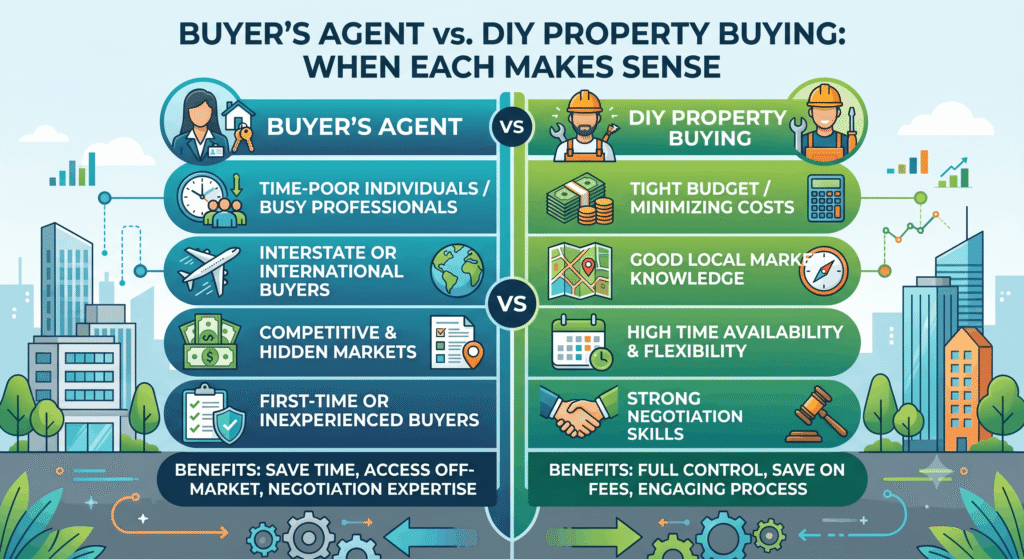
| Best for | Time-poor, interstate, competitive markets, inexperienced buyers | Confident buyers, familiar areas, tight budgets, those who enjoy the process |
When a Buyer’s Agent Makes Sense
A buyer’s agent is most worth the fee when:
- You’re time-poor. A busy professional’s time is worth more than the hours a property search consumes.
- You’re buying interstate or remotely. You can’t inspect 20 properties in another city — a local agent can.
- The market is hot and competitive. Off-market access and fast, confident bidding matter most when stock is scarce and prices are climbing.
- You’re inexperienced or anxious about negotiating. If the idea of bidding at auction makes you queasy, paying a pro can pay for itself.
- You’re an investor needing data-driven selection. Choosing the right suburb and property for capital growth is a skill; the right agent earns their fee in better selection.
- High stakes / high price point. On a $2M purchase, a small percentage saved is a large dollar figure.
When DIY Property Buying Makes Sense
DIY is often the smarter choice when:
- You’re buying in an area you know well. Local knowledge is the very thing you’d otherwise pay for.
- You have the time and enjoy the process. If researching properties is genuinely interesting to you, you’re already doing half the job.
- Your budget is tight. On a modest first home, $10,000–$15,000 in agent fees is money that could go to your deposit or buffer.
- You’re confident and prepared. If you’ll do the comparable-sales homework and keep emotion in check, you can negotiate well yourself.
- The market is calm. When stock is plentiful and prices are flat, the off-market advantage shrinks.
Real Australian Examples
Example 1: The first-home buyer (DIY usually wins)
Mia, 29, buying a $620,000 unit in a Brisbane suburb she’s rented in for three years.
Mia knows the area block by block, has time on weekends, and is on a tight budget where every dollar counts toward her deposit and buffer. She does her own comparable-sales research, attends open homes, and negotiates directly. DIY is the strong choice — paying $12,000+ for local knowledge she already has would simply eat into her deposit. Her smart move: hire a buyer’s agent for a one-off negotiation-only service (~$700) on the property she chooses, getting professional help exactly where she’s weakest, for a fraction of a full-service fee.
Example 2: The investor (buyer’s agent often wins)
David, 41, in Melbourne, buying his third investment property — this time interstate in Perth for capital growth.
David can’t fly to Perth every weekend, doesn’t know which suburbs are about to grow, and needs a data-driven decision, not an emotional one. A local Perth buyer’s agent with on-the-ground knowledge and off-market access is worth the fee — better suburb and property selection can mean tens of thousands in extra growth, and the fee is a capital cost on an investment asset. The buyer’s agent makes sense.
Example 3: The busy professional (buyer’s agent usually wins)
Priya, 38, a surgeon in Sydney, buying a $1.6M family home in a competitive market.
Priya’s time is scarce and valuable, the market is hot with off-market deals changing hands quietly, and she has no appetite for losing weekends to inspections or stress-bidding at auction. A fixed-fee buyer’s agent saves her dozens of hours, gets her in front of properties before they hit the portals, and bids dispassionately on her behalf. For a high-price purchase where a small percentage saved is a large sum, the buyer’s agent is clearly worth it.
Actionable Property Buying Tips (For Either Path)
Whether you DIY or hire help, these tips protect you:
- Always research comparable sales. Know what similar properties recently sold for (not asking prices) before you make an offer.
- Get a building and pest inspection. Never skip this — a $500 report can save you tens of thousands.
- Get loan pre-approval first. You negotiate from strength when your finance is sorted.
- Set a hard ceiling and write it down. Emotion is the enemy; a pre-committed limit is your defence.
- Use a conveyancer or solicitor to review contracts before you sign.
- If hiring a buyer’s agent: prefer fixed or capped fees, confirm exactly what’s included, check their licence, and ask for recent client references.
- If going DIY: consider hiring a buyer’s agent for just the negotiation or auction — the highest-value, highest-risk moment — even if you do everything else yourself.
- Never let a selling agent’s urgency rush you. “Other buyers are interested” is a tactic; stay on your own timeline.
Pros and Cons at a Glance
Buyer’s agent — pros: saves time, off-market access, professional negotiation, emotional objectivity, expert selection. Buyer’s agent — cons: significant fee, potential conflict of interest (percentage fees), you cede some control, quality varies between agents.
DIY — pros: free, full control, builds your knowledge, ideal in familiar areas. DIY — cons: time-heavy, emotionally risky, no off-market access, negotiating against professionals, costly if you get it wrong.
Frequently Asked Questions
Should I use a buyer’s agent for my first home? Often not — if you’re buying in an area you know and have time to do the work, DIY keeps thousands in your pocket for your deposit. But if you’re nervous about negotiating, a one-off negotiation-only service is a low-cost middle ground.
How much does a buyer’s agent cost in Australia? Typically 1.5%–3% of the purchase price, or a fixed fee of around $8,000–$21,000 (plus GST), with premium full-service agencies charging more. Negotiation- or auction-only services usually cost $500–$1,000.
Do buyer’s agents really save you money? They can — through better negotiation, avoiding overpaying, and selecting better-performing properties. Whether they save more than their fee depends on the agent’s skill and your alternative (a confident, prepared DIY buyer may achieve similar results for free).
Is a fixed fee or percentage fee better? Fixed (or capped) fees are generally better for buyers because the agent earns the same regardless of price, removing the incentive to push you toward a higher purchase price.
Can a buyer’s agent help with just the auction? Yes. Many offer auction-bidding or negotiation-only services for a few hundred to around a thousand dollars per property — a popular option for DIY buyers who want a pro for the high-pressure moment.
Are buyer’s agent fees tax deductible? For an investment property, the fee is generally treated as a capital cost (part of your CGT cost base), not an immediate deduction. For an owner-occupied home, it isn’t deductible. Confirm with your accountant.
Is DIY property buying risky? It carries the risk of overpaying, missing defects, or buying in the wrong location — but those risks are well managed with thorough research, a building inspection, a firm price ceiling, and a good conveyancer.
The Bottom Line: It’s About You, Not the Label
There’s no universal winner in the buyer’s agent vs DIY debate — only the right fit for your situation. The honest summary:
- Choose a buyer’s agent if you’re time-poor, buying interstate, facing a hot competitive market, or unsure of your own negotiating ability — and prioritise fixed or capped fees.
- Choose DIY if you know the area, have the time, are working to a tight budget, and are willing to do the homework and keep emotion out of it.
- Or do both: handle the search yourself and bring in a buyer’s agent for just the negotiation — the smartest hybrid for many Australians.
Whatever you choose, the buyers who win are the prepared ones. They know the comparable sales, they get the inspections, they set a ceiling, and they don’t let a selling agent rush them.
Your next step: Before your next inspection, do one thing — pull the last six comparable sales in your target area and write down the absolute maximum you’ll pay. That single habit protects you more than any other, whether you go it alone or hire a pro. Then decide honestly: is your time, knowledge and nerve enough to do this yourself — or is this the moment to get a professional on your side of the table?
Disclaimer: This article is general information only and does not constitute financial, legal, tax or property advice. It does not take into account your personal circumstances. Buyer’s agent fees, licensing requirements and tax treatment vary by state and over time, and the figures here are indicative as at 2026. Always verify an agent’s licence with your state regulator and seek advice from a licensed professional, accountant and/or solicitor before making a property purchase decision.