
Most Australians who own investment property stop at one. Not because one is the goal, but because nobody handed them the next step. They buy, they hold, they hope — and a decade later they’re sitting on a single property wondering why their wealth didn’t compound the way the headlines promised.
The investors who build a genuine property portfolio in Australia do something different. They treat property like a system, not a lottery ticket. They understand that the second property is funded by the first, the third by the first two, and so on — a chain reaction powered by equity, time and disciplined cash flow.
This guide is the full Australian investment property strategy for getting from zero (or one) to five properties over roughly ten years. It’s written for first-home buyers and early investors who want the real mechanics — borrowing capacity, deposits, equity, growth suburbs, tax, risk — explained in plain English, with worked examples and a realistic year-by-year timeline.
A quick, important note before we start: the rules changed in 2026. The May 2026 Federal Budget announced significant reforms to negative gearing and capital gains tax (taking effect from 1 July 2027), and lending has tightened. We’ll cover exactly what that means for your strategy. Let’s build the plan.
What a 5-Property Portfolio Actually Looks Like
Before the “how,” let’s be honest about the “what.”
A 5 property portfolio doesn’t mean five mansions. For most Australians it means a mix of modest, well-located homes and units — typically valued between $450,000 and $800,000 each — bought over time and held for the long term. The wealth comes not from the properties themselves but from two compounding forces:
- Capital growth — the increase in each property’s value over time.
- Leverage — using the bank’s money (and your growing equity) to control more assets than your savings alone could buy.
In one sentence: Building a property portfolio is the practice of using equity from properties you already own to fund the deposits on the next ones, while rental income and tax positions keep the whole structure affordable.
That’s the engine. Everything below is about feeding it safely.
Is five properties in ten years realistic?
For some households, yes. For others, it’s three or four — and that can still be life-changing. Your realistic ceiling depends on:
- Your income and borrowing capacity (the single biggest constraint in 2026).
- How fast your properties grow (you cannot recycle equity that hasn’t appeared yet).
- Your savings rate and cash buffers.
- How tight lending conditions are when you want to buy.
This playbook shows the path to five. Treat it as a target and a framework, not a guarantee.
Step 1: Set the Goal in Reverse
The biggest mistake in property investing Australia-wide is buying first and planning never. Strong portfolios are reverse-engineered from an end number.
Start with a question: What do I actually want this portfolio to do for me? Common answers:
- Replace or supplement income in retirement.
- Pay off the family home faster.
- Fund children’s education or create generational wealth.
Then work backwards. If your goal is, say, $50,000 a year in passive rental income (in today’s dollars) at retirement, you can roughly reverse-engineer how much net property equity and rental yield you need to get there — and therefore how many properties.
A simple goal-setting framework
- Define the target: a dollar figure and a date.
- Translate it into assets: how much net equity / passive income that requires.
- Break it into properties: how many purchases, at what price points.
- Map the gaps: deposits, borrowing capacity, and time between buys.
- Review annually: adjust as values, income and rules change.
This is the heart of how to build wealth through property — clarity first, purchases second.
Step 2: Understand Your Borrowing Capacity (the Real Ceiling)
Here’s the truth most beginners learn too late: the bank, not the market, decides how big your portfolio gets. Your borrowing capacity — also called serviceability — is the amount lenders will let you owe based on your income, expenses and existing debts.
In 2026 this is tighter than it was during the low-rate boom, for two reasons:
- The APRA serviceability buffer is 3%. Lenders must check whether you could still afford repayments if your interest rate rose 3 percentage points above the actual rate. With variable investor rates sitting around 6–6.5%, you’re being assessed at roughly 9%+. That single rule cuts maximum borrowing by an estimated 15–20%.
- A new debt-to-income (DTI) “speed limit” applies from February 2026. APRA now restricts banks to issuing no more than 20% of new loans to borrowers whose total debt exceeds six times their gross household income. If your debt-to-income ratio is under 6×, this doesn’t affect you. If you’re a portfolio builder stacking loans, it can become a hard wall — and lender capacity for high-DTI loans resets quarterly, so timing matters.
How to maximise your borrowing capacity
- Reduce or close unused credit cards and limits — banks count the limit, not the balance.
- Pay down personal loans and car finance before applying.
- Increase and document stable income (overtime, bonuses, rental income).
- Choose lower-rate loans — a lower rate plus the 3% buffer means a lower assessment rate.
- Keep your DTI in check — every new loan pushes you closer to the 6× ceiling.
- Use a mortgage broker who understands portfolio lending and which lenders assess existing debts and rental income most generously (servicing calculators vary enormously between lenders).
Pro tip: Two households with identical incomes can have wildly different borrowing capacities depending on which lenders they use and how their existing debts are structured. This is where good advice pays for itself.
Step 3: The Deposit Strategies That Get You Started
You can’t buy without a deposit. Here are the main ways Australians fund that first (and second) purchase.
Genuine savings
The classic route. A 20% deposit avoids Lenders Mortgage Insurance (LMI), but it’s slow. Many investors deliberately buy with a smaller deposit and pay LMI to get into the market sooner, because time in the market often beats a bigger deposit.
The First Home Guarantee (for owner-occupiers)
If you’re a first-home buyer, the First Home Guarantee is now far more powerful than it used to be. Following the 2025–26 expansion:
- Income caps removed — you can now access it regardless of income.
- Unlimited places — the old 35,000-place annual cap is gone.
- Buy with a 5% deposit, no LMI — the government guarantees up to 15% of the property’s value.
- Higher property price caps, for example up to $1.5 million in Sydney, $1 million in Brisbane, $950,000 in Melbourne, $900,000 in Adelaide and $850,000 in Perth (caps vary by region — confirm your zone).
A common portfolio launch pad is to buy your first home with the scheme’s 5% deposit, let it grow, then convert that growth into investment deposits. (The scheme is for owner-occupiers, not investment properties — but the home you buy can become the foundation of everything that follows.)
Equity (the strategy that actually scales)
This is the big one — important enough to get its own step below.
Other levers
- Gifted or family-guaranteed deposits (a parent using their equity as security).
- Buying with a partner, friend or sibling to combine deposits and incomes.
Step 4: The Equity Engine — How Portfolios Really Grow
If you only remember one concept from this guide, make it this one.
Equity is the portion of a property you actually own — its market value minus what you owe.
Equity = Property value − Loan balance
But you can’t usually access all your equity. Lenders typically let you borrow up to 80% of a property’s value. So the equity you can actually use looks like this:
Usable equity ≈ (Property value × 80%) − Loan balance
A worked example
Say you bought a property for $550,000 with a $495,000 loan. Four years later, at around 6% annual growth, it’s worth roughly $695,000.
- 80% of $695,000 = $556,000
- Minus your loan of $495,000
- Usable equity ≈ $61,000
That $61,000 can become the deposit and costs for your next property — without you saving another cent. You refinance (replace or top up your existing loan) to release that equity, then use it as the deposit on property number two. This is sometimes called equity recycling, and it’s the chain reaction that turns one property into five.
Key tools, in plain English
- LVR (Loan-to-Value Ratio): how much you’re borrowing against a property’s value. A $400,000 loan on a $500,000 property is an 80% LVR. Lower LVR = less risk and usually better rates. Above 80% LVR generally triggers LMI.
- LMI (Lenders Mortgage Insurance): a one-off cost that protects the lender (not you) when your deposit is under 20%. It can run into the tens of thousands, but it lets you buy sooner.
- Refinancing: replacing your existing loan with a new one — to get a better rate, or to release equity for the next deposit.
- Offset account: a transaction account linked to your loan. Money sitting in it is “offset” against your loan balance, so you pay interest on less. Park $30,000 in an offset against a $500,000 loan and you only pay interest on $470,000 — while keeping that cash fully accessible. It’s one of the most powerful and flexible tools in any investor’s kit.
- Rental yield: the income a property generates as a percentage of its value. Gross yield = (annual rent ÷ property value) × 100. A $500,000 property renting at $500/week earns $26,000 a year — a 5.2% gross yield. Net yield subtracts running costs and is the figure that actually matters for cash flow.
Step 5: Positively Geared vs Negatively Geared (and Why 2027 Changes Everything)
“Gearing” simply means borrowing to invest. Whether a property is positively or negatively geared depends on whether it makes or loses money each year before tax.
| Negatively geared | Positively geared | |
|---|---|---|
| Definition | Annual costs exceed rental income | Rental income exceeds annual costs |
| Cash flow | Costs you money to hold | Pays you to hold |
| The bet | Capital growth will outweigh the losses | Income now, growth as a bonus |
| Typical location | Capital-city growth suburbs | Higher-yield regional areas |
| Risk | Relies on growth and your income to fund shortfalls | Lower holding risk, sometimes slower growth |
Worked example: a negatively geared property
- Value: $600,000, loan $540,000 at 6.3% interest-only = $34,020/year interest
- Rent: $480/week = $24,960/year (4.2% gross yield)
- Running costs (rates, insurance, management, maintenance): ~$7,000/year
- Pre-tax shortfall: about $16,060/year
Historically, the investor could deduct that loss against their salary, reducing their tax bill. The property cost them money each year, but they bet on capital growth to more than make up for it.
Worked example: a positively geared property
- Value: $450,000, loan $360,000 at 6.3% interest-only = $22,680/year interest
- Rent: $560/week = $29,120/year (6.5% gross yield)
- Running costs: ~$5,500/year
- Pre-tax surplus: about $940/year
This property pays you a small amount to own it, and any growth is a bonus. Positively geared properties protect your borrowing capacity (they add income rather than draining it), which makes them valuable as a portfolio grows.
⚠️ The big 2026 change you must plan around
For decades, negative gearing against salary was the backbone of Australian property strategy. That is changing.
In the 2026–27 Federal Budget (announced 12 May 2026), the government announced that, from 1 July 2027:
- Negative gearing on established residential properties will be limited. For established homes purchased after 7:30pm AEST on 12 May 2026, rental losses will only be deductible against rental income or capital gains from rental properties — not against your salary.
- Properties already held before that date are grandfathered and keep current rules.
- New builds are exempt — investors in eligible newly built homes keep both negative gearing and the existing CGT discount.
- The 50% capital gains tax discount is being replaced with a system based on inflation (cost base indexation) plus a minimum 30% tax on capital gains, for gains accruing after 1 July 2027.
Important: these measures are not yet law — they were announced and introduced as legislation, intended to start 1 July 2027. But you should build your plan with them in mind.
What it means for portfolio builders:
- The classic “buy any established property and negatively gear it against your wage” model is being narrowed for new purchases.
- New builds become more attractive for those who want negative-gearing benefits.
- Cash flow and rental yield matter more than ever — a strategy that leans on positive or neutral cash flow is more resilient to these changes than one that depends on salary tax deductions.
- Always get current, personalised advice from a licensed accountant or financial adviser before relying on any tax position.
Step 6: Choosing Growth Suburbs
You make money in property when you buy, not when you sell — and that means buying in the right place. Capital growth, not luck, is what produces the equity that funds your next purchase.
What strong growth suburbs tend to have
- Population and jobs growth — people moving in, employment expanding nearby.
- Infrastructure investment — new transport, hospitals, schools, town centres (these reshape demand).
- Supply constraints — limited land or new dwellings, so demand outpaces stock.
- Gentrification signals — cafés, renovations, owner-occupiers moving in.
- Affordability runway — priced below the city median, with room to rise.
- A healthy rent-to-price ratio — so the property is affordable to hold while it grows.
A simple suburb research checklist
- ☐ Is population forecast to grow over the next 10 years?
- ☐ Is there committed infrastructure spending nearby?
- ☐ What’s the vacancy rate? (Under ~2% signals strong rental demand.)
- ☐ What’s the gross rental yield versus the city average?
- ☐ What’s the ratio of owner-occupiers to renters? (More owner-occupiers can support prices.)
- ☐ Has the suburb shown long-term growth, not just a recent spike?
- ☐ Can you afford to hold a property here through a downturn?
Spreading purchases across different states and markets also matters — property markets move in cycles that don’t sync up, so diversification smooths your portfolio’s overall performance and can help with state-based land tax thresholds.
Step 7: Cash Flow Management — How Portfolios Survive
More portfolios are sunk by cash flow than by bad property choices. Growth is wonderful, but you have to hold a property long enough to realise it — and that takes cash.
Build buffers before you build the portfolio
- Keep a cash buffer (in an offset account) of at least 3–6 months of repayments per property. This is your shock absorber for vacancies, repairs and rate rises.
- Stress-test every purchase at a higher interest rate than today’s — the bank already does, and so should you.
- Budget for the unglamorous costs: vacancy periods, property management (typically 6–9% of rent), repairs, insurance, rates, and land tax.
- Don’t over-leverage. The investors who blow up are almost always the ones with no buffer when rates rise or a tenant leaves.
The danger zone
The riskiest moment isn’t buying — it’s the stretch right after, when buffers are thin and you’re tempted to buy again too soon. Discipline here is what separates a five-property portfolio from a forced fire-sale.
Step 8: Tax Benefits (and Their Limits)
Tax is a tailwind, not a reason to buy. A property that only makes sense because of tax breaks is a bad property. That said, the legitimate benefits matter:
- Deductible expenses: interest, property management, council rates, insurance, repairs and maintenance can generally be claimed against rental income.
- Depreciation: you can claim the declining value of the building (capital works) and certain fixtures and fittings, often via a quantity surveyor’s depreciation schedule. This is a “paper” deduction — it reduces taxable income without costing you cash.
- Capital Gains Tax (CGT): currently, assets held more than 12 months receive a 50% CGT discount — though this is set to change from 1 July 2027 (see Step 5). Plan disposals with current rules in mind and professional advice.
Plain-English definition — Depreciation: A tax deduction for the gradual wear-and-tear of a building and its fittings over time. You don’t spend the money each year, but you can still claim it, lowering your tax bill.
Always use a registered tax agent or accountant. Tax law is complex, individual, and — as 2026 has shown — subject to change.
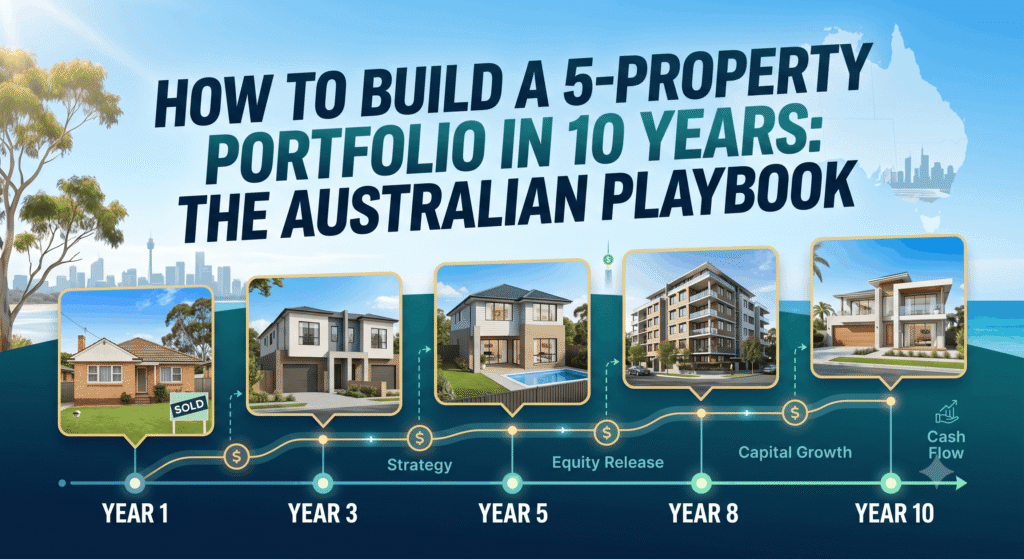
Step 9: The Realistic 10-Year Timeline
Here’s an illustrative decade-long path from first home to five properties. The numbers are simplified and assume a dual-income household, modest capital growth of around 5–6% per year, disciplined saving, and supportive lending conditions. Your real path will differ — treat this as the shape of the journey, not a promise.
Year 0–1: Foundation
Buy your first home using the First Home Guarantee (5% deposit, no LMI). Set up an offset account and start building a cash buffer. Get your finances “lender-ready”: clean credit, minimal consumer debt, documented income.
Year 2–3: First investment
Your home has grown. Release usable equity via a refinance and buy Property 2 — an investment in a growth suburb or a higher-yield regional market. Keep your DTI under control. (Two properties.)
Year 4–5: Build momentum
Both properties have grown and rents have risen. Recycle equity again to buy Property 3. Around now, you’ll start spreading purchases across lenders and possibly states to manage borrowing capacity and land tax. (Three properties.)
Year 6–7: The serviceability test
This is where many investors hit the wall — the bank’s serviceability and DTI limits bite. You may need to pause, pay down debt, boost income, or lean toward positive cash flow purchases to keep borrowing. With patience, you add Property 4. (Four properties.)
Year 8–10: Consolidate and complete
Add Property 5 when equity, cash flow and serviceability align. Then shift focus from acquiring to optimising: review interest rates, consider paying down debt to reduce risk, and let compounding do the heavy lifting. (Five properties.)
Years 10+: Harvest
A mature portfolio held for another decade can generate meaningful equity and, eventually, passive income — the original goal from Step 1.
Reality check: If lending tightens, growth stalls, or life happens, this might be a 12–15 year journey to four properties instead of ten years to five. That’s still an excellent outcome. The framework holds; the timeline flexes.
Step 10: Risks (and How to Manage Them)
Authoritative property advice doesn’t hide the risks — it manages them.
- Interest rate rises: Manage with buffers, fixing a portion of debt, and stress-testing every purchase. (Rates rose again in early 2026 — assume they can move.)
- Vacancy and bad tenants: Use a good property manager, landlord insurance, and high-demand locations.
- Falling values / negative equity: Buy quality, diversify markets, and never over-leverage.
- Borrowing capacity wall: The most common ceiling. Manage DTI, diversify lenders, and prioritise income-positive purchases as you scale.
- Over-leverage / cross-collateralisation: Avoid tangling all properties as security for each other (cross-collateralisation), which can trap you with one lender and complicate selling. Keep loans standalone where possible.
- Policy and tax change: As 2026 proved, the rules can shift. Don’t build a strategy that only works under one specific tax setting.
- Concentration risk: Five properties in one suburb is not a portfolio — it’s a bet. Diversify.
Step 11: Scaling Beyond the First Couple of Properties
The skills that get you to two properties are not the skills that get you to five. Scaling well means:
- Diversifying lenders: different banks assess your existing debts and rental income differently. Spreading loans across lenders preserves borrowing capacity and avoids being captive to one bank.
- Mixing the portfolio: balance negatively/neutrally geared growth properties with positively geared income properties so the portfolio stays serviceable.
- Considering ownership structures: individual names, partnerships, trusts or companies each have different tax, asset-protection and land-tax implications. Get advice before you buy — restructuring later is expensive.
- Building a team: a portfolio-savvy mortgage broker, an investment-focused accountant, a buyer’s agent (optional), a quantity surveyor and a great property manager. You don’t scale alone.
Your 5-Property Portfolio Checklist
- ☐ Defined goal (dollar figure + date), reverse-engineered into a number of properties
- ☐ Borrowing capacity assessed by a broker; DTI understood and managed
- ☐ Consumer debt minimised; credit file clean
- ☐ Deposit strategy chosen (savings, First Home Guarantee, or equity)
- ☐ Cash buffer of 3–6 months’ repayments per property, in offset
- ☐ Suburb research framework applied to every purchase
- ☐ Each property stress-tested at a higher interest rate
- ☐ Gearing and cash flow position understood — and resilient to the 2027 tax changes
- ☐ Ownership structure confirmed with an accountant before buying
- ☐ Lenders diversified as the portfolio grows
- ☐ Annual portfolio review locked into the calendar
Frequently Asked Questions
How much income do I need to build a 5-property portfolio in Australia?
There’s no single figure, but borrowing capacity is the main constraint. With the APRA 3% serviceability buffer and the new 6× debt-to-income cap, a higher and stable household income — supplemented by rental income — makes the path far smoother. A broker can model your specific capacity.
Can I really build a property portfolio with no savings?
Not from zero — you need a deposit for the first property. But after that, the equity from your existing properties can fund future deposits, meaning you may not need fresh savings for subsequent purchases. This is the core of equity recycling.
What is a good rental yield in Australia?
It varies by market, but gross yields around 4–5% are common in capital cities, while higher-yield regional areas can reach 5–7%+. The right yield depends on your strategy: growth investors accept lower yields, cash-flow investors seek higher ones.
Is negative gearing still worth it in 2026?
For properties bought and held before 12 May 2026, current rules continue (grandfathered). For new purchases of established homes, negative gearing against your salary is set to end from 1 July 2027 (not yet law), though new builds remain exempt. The shift makes cash flow and yield more important than ever — get current professional advice.
What’s the difference between LVR and LMI?
LVR (Loan-to-Value Ratio) is how much you’re borrowing against a property’s value. LMI (Lenders Mortgage Insurance) is a cost you pay when your LVR is above 80% (i.e. deposit under 20%) — it protects the lender, not you.
How long should I wait between property purchases?
Long enough to rebuild your cash buffer and for equity to grow — often 18 months to 3 years, depending on growth and your serviceability. Buying too fast with thin buffers is one of the most common ways portfolios fail.
Should I buy interest-only or principal-and-interest loans?
Many investors use interest-only loans to maximise cash flow and deductibility while building a portfolio, then switch to principal-and-interest to reduce debt as they consolidate. Each has trade-offs — discuss with your broker and accountant.
The Bottom Line: Start the System, Then Trust It
A five-property portfolio isn’t built by people who are smarter, richer or luckier than you. It’s built by people who started one system and kept feeding it — equity into deposits, deposits into properties, properties into more equity — while managing cash flow and risk along the way.
The 2026 environment is tougher than the boom years: lending is tighter, rates are higher, and the negative-gearing playbook is being rewritten for 2027. But tougher conditions reward good strategy more, not less. Investors who focus on quality locations, healthy cash flow and disciplined borrowing will keep building portfolios long after the headlines move on.
You don’t need to buy five properties this year. You need to buy one — the right one, structured the right way — and set up the system that funds the next.
Your next step: Sit down this week and do two things — (1) write your goal in reverse (the number, the date), and (2) book a conversation with a portfolio-experienced mortgage broker to find out your real borrowing capacity. Everything else in this playbook flows from those two numbers. The best time to start was ten years ago. The second-best time is now.
Disclaimer: This article is general information only and does not constitute financial, tax, legal or credit advice. It does not take into account your personal circumstances, objectives or needs. Property investment carries risk, including the risk of loss. Lending criteria, government schemes and tax laws change — several measures referred to here (including the negative gearing and CGT reforms) were announced as at the 2026–27 Federal Budget and are not yet law as at the date of writing. Always seek advice from a licensed mortgage broker, financial adviser, accountant and/or solicitor before making any investment or borrowing decision.
3 Responses