
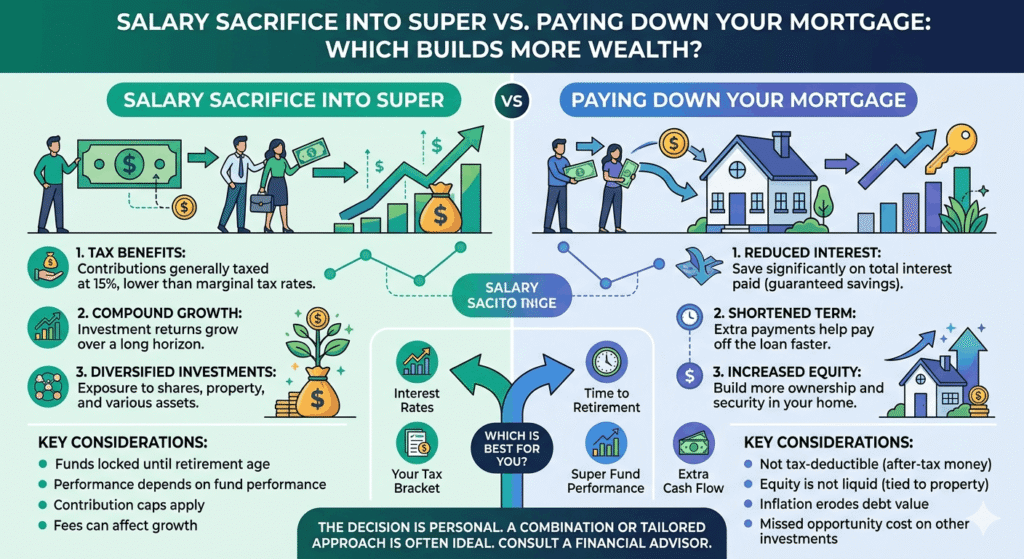
It’s one of the most common financial questions Australians ask, and for good reason: every spare dollar feels like it should be doing the most good possible, and the right answer doesn’t always feel obvious. Should you salary sacrifice that dollar into super, where it’s taxed concessionally and grows for decades? Or should it go straight onto your mortgage, where it guarantees a return equal to your interest rate and brings the day you’re debt-free that much closer?
With mortgage rates sitting well above the ultra-low levels of a few years ago, and cost-of-living pressure squeezing household budgets, this decision carries more weight than it used to. A higher mortgage rate makes extra repayments more attractive in isolation, but it doesn’t automatically settle the question — because the comparison isn’t simply about interest rates. It’s about tax treatment, time horizon, risk tolerance, liquidity, and what stage of life you’re in.
There is no single right answer that applies to everyone, and any article claiming otherwise is oversimplifying a genuinely personal decision. What this guide can do is walk you through how each strategy actually works, model realistic scenarios across different life stages, and give you a clear framework for working out which approach — or which blend of approaches — fits your specific situation.
Here’s what’s ahead: how salary sacrifice and extra mortgage repayments each work mechanically, a detailed head-to-head comparison, three real-world scenarios modelled over 10 years, the role of offset accounts and debt recycling as middle-ground options, and a decision framework to help you (and your adviser) land on the right approach for your circumstances.
Quick Answer: Salary Sacrifice or Pay Down Your Mortgage?
For many Australians, salary sacrifice into super tends to deliver stronger long-term wealth outcomes due to its tax advantages and decades of compounding, particularly for those with a long time horizon to retirement. Paying down your mortgage offers a guaranteed, risk-free return equal to your interest rate and reduces financial stress and monthly repayment pressure sooner. A hybrid approach — using an offset account for flexibility while still contributing meaningfully to super — is often the most practical middle ground for many households.
| Factor | Salary Sacrifice Into Super | Extra Mortgage Repayments |
| Tax treatment | Concessional 15% (or 30% above the Division 293 threshold) instead of marginal rate | No direct tax benefit on an owner-occupied home loan |
| Return type | Variable, based on investment markets — not guaranteed | Guaranteed, equal to your mortgage interest rate |
| Access to funds | Generally locked until retirement (preservation age) | Accessible via redraw or offset, depending on loan structure |
| Best suited to | Longer time horizons, higher marginal tax rates, comfort with market risk | Shorter horizons, lower risk tolerance, desire for certainty and reduced stress |
Understanding Salary Sacrifice Into Super
Salary sacrifice is a formal arrangement with your employer to redirect part of your pre-tax salary into your super fund, instead of receiving it as take-home pay.
How Salary Sacrifice Works
You agree with your employer (usually via a simple form through payroll) to direct a set amount or percentage of your salary into super before income tax is calculated, reducing your taxable income and your take-home pay by a smaller amount than the full contribution, because of the tax saved.
Concessional Contribution Caps for 2025–26
The concessional contributions cap for FY2025–26 is $30,000 per year, which includes your employer’s compulsory Superannuation Guarantee contributions, your salary sacrifice amounts, and any personal deductible contributions combined.
Tax Treatment of Contributions
Concessional contributions are taxed at 15% inside your super fund, rather than your personal marginal rate, which can be as high as 45% plus the 2% Medicare levy for high-income earners — a substantial immediate tax saving for most contributors.
Carry-Forward Concessional Contributions
If your Total Superannuation Balance was under $500,000 at the end of the previous financial year, you may be able to carry forward unused concessional cap amounts from the past five years, allowing a larger contribution in a single year without exceeding the cap.
Division 293 Considerations
If your income plus concessional contributions exceeds $250,000 in a financial year, an additional 15% tax applies to the contributions above that threshold, raising the effective rate on that portion to 30%. Even so, this remains well below the 47% top marginal rate including Medicare levy, so salary sacrifice usually remains worthwhile even for high earners affected by Division 293.
Pro Tip: If you’re unsure whether Division 293 affects you, our dedicated guide on Division 293 tax walks through exactly how the threshold and calculation work.
Understanding Extra Mortgage Repayments
Putting extra money onto your home loan is simple, flexible, and guarantees a specific outcome — but the mechanics of how you do it matter.
Principal and Interest Loans
On a standard principal and interest loan, extra repayments directly reduce your outstanding balance, which reduces the interest charged on all future repayments — effectively earning you a guaranteed return equal to your mortgage interest rate.
Offset Accounts
An offset account is a transaction account linked to your home loan; the balance in it is subtracted from your loan balance when interest is calculated, without actually reducing the loan itself. This preserves full access to your money while still reducing interest charged.
Redraw Facilities
A redraw facility lets you access extra repayments you’ve already made, but unlike an offset account, the funds are taken back out of the loan structure when withdrawn, which can affect tax treatment if you later use part of the property for investment purposes.
Interest Savings Over Time
Because mortgage interest is calculated on a reducing balance, extra repayments made earlier in the loan term have a larger cumulative effect than the same amount paid later, since they reduce the balance interest is charged on for a longer remaining period.
Example: On a $600,000 loan at 6.3% over 30 years, making an extra $500 per month in repayments could save well over $150,000 in interest and cut several years off the loan term — the exact figures depend on your specific loan terms and any rate changes over time.
Salary Sacrifice vs. Mortgage: Head-to-Head Comparison
| Factor | Salary Sacrifice Into Super | Extra Mortgage Repayments |
| Tax benefits | Strong — concessional 15–30% tax vs. marginal rate up to 47% | None directly, for an owner-occupied home loan |
| Investment returns | Variable, market-linked, historically strong over long periods but not guaranteed | Guaranteed, equal to your mortgage rate |
| Risk | Market risk; balance can fall in value, especially short-term | Effectively no risk — a known, fixed benefit |
| Liquidity | Low — generally inaccessible until preservation age and retirement conditions are met | High, if using an offset account; lower if paid directly off the loan without redraw |
| Flexibility | Limited — once contributed, funds are governed by super rules | High — repayment amounts can be adjusted at will |
| Emotional benefits | Less immediate; benefit is felt at retirement | Often significant — many people feel real relief and reduced stress as debt shrinks |
| Access to funds | Restricted until a condition of release is met | Available via offset or redraw, subject to loan terms |
| Retirement outcomes | Directly builds retirement savings in a tax-advantaged structure | Indirect — frees up cash flow in retirement, but doesn’t directly build a retirement nest egg |
Neither column is universally “better.” The right balance depends on how much you value certainty and flexibility today versus tax-advantaged growth for a retirement that may be decades away.
Real-World Scenarios
These scenarios use stated assumptions to illustrate how each strategy might play out. They are not predictions, guarantees, or personal advice — actual outcomes depend on your specific circumstances, future interest rates, and investment performance.
Single Professional Earning $220,000
Assumptions: mortgage balance $550,000 at 6.3%, 25 years remaining, super balance $180,000, monthly surplus cash flow $1,500, marginal tax rate 47% (including Medicare levy), illustrative long-term balanced super return of 6.5% per year before fees and taxes.
| Strategy | Approach | Illustrative 10-Year Outcome |
| Salary sacrifice | Direct full $1,500/month into super via salary sacrifice | Meaningfully larger super balance from contributions plus compounding, with mortgage balance reduced only by standard repayments |
| Extra mortgage repayments | Direct full $1,500/month onto the mortgage | Mortgage paid off significantly faster, with interest savings building over the decade, but no additional super growth beyond standard contributions |
| Hybrid | Split between offset account and a moderate salary sacrifice amount | Partial mortgage interest savings via the offset balance, combined with steady (if smaller) additional super growth |
Couple With Young Children
Assumptions: combined income $180,000, mortgage balance $650,000 at 6.3%, 27 years remaining, combined super balance $140,000, monthly surplus cash flow $800, marginal tax rates of 30% (covering most of their combined income), childcare and near-term cash flow needs as a significant consideration.
| Strategy | Approach | Illustrative 10-Year Outcome |
| Salary sacrifice | Direct surplus into super | Tax benefit is more moderate at a 30% marginal rate, and locking funds away may strain near-term flexibility during high-expense family years |
| Extra mortgage repayments | Direct surplus onto the mortgage via an offset account | Builds a flexible buffer that can be accessed if needed for family expenses, while still reducing interest charged |
| Hybrid | Prioritise an offset buffer first, then add modest salary sacrifice once a comfortable buffer is established | Balances family flexibility in the short term with some long-term retirement benefit once cash flow allows |
Pre-Retiree Aged 55+
Assumptions: income $150,000, mortgage balance $200,000 at 6.3%, 8 years remaining, super balance $650,000, monthly surplus cash flow $2,000, shorter time horizon to retirement, and a strong personal preference for reducing debt before retiring.
| Strategy | Approach | Illustrative 10-Year Outcome |
| Salary sacrifice | Use catch-up (carry-forward) contributions where available | Strong short-term tax benefit and a meaningful super boost, but a shorter runway for compounding before retirement |
| Extra mortgage repayments | Direct surplus onto the mortgage | Mortgage likely cleared well before retirement, significantly reducing living costs and stress in retirement |
| Hybrid | Clear the mortgage first using extra repayments, then maximise super contributions once debt-free | Sequenced approach: certainty first, then concentrated catch-up super contributions in the remaining working years |
These outcomes are illustrative only, based on the stated assumptions, and do not account for fees, changing interest rates, super fund performance, or individual tax circumstances. They are not forecasts or guarantees.
Pro Tip: Notice that the “right” strategy shifts meaningfully with age and time horizon. A pre-retiree with only a short runway to retirement weighs certainty and debt freedom much more heavily than someone in their 30s with decades of compounding ahead.
The Role of Offset Accounts
An offset account is one of the most underrated tools in this entire decision, because it removes some of the apparent trade-off between flexibility and interest savings.
How Offset Accounts Work
The balance in your offset account is subtracted from your home loan balance before interest is calculated each day, meaning $20,000 sitting in offset against a $500,000 loan means you only pay interest on $480,000 — while the $20,000 remains fully accessible as cash.
Advantages Over Redraw Facilities
Unlike redraw, which pulls money back out of the loan structure (and can complicate things if the property is later used for investment purposes), offset funds were never part of the loan itself, which keeps the loan’s tax treatment cleaner and more straightforward.
Flexibility Benefits
Because offset funds remain fully liquid, they’re available instantly for emergencies, opportunities, or life changes, without needing to apply for access or wait for processing, unlike funds locked inside superannuation.
When an Offset Account May Outperform Extra Repayments
If there’s any chance you might want to access the funds later, or convert the property to an investment in future, an offset account generally preserves more flexibility and better tax outcomes than paying the same amount directly off the loan principal.
Debt Recycling as a Hybrid Strategy
For some households, the choice isn’t strictly between super and mortgage — debt recycling offers a way to work toward both goals simultaneously.
Converting Non-Deductible Debt Into Deductible Debt
Debt recycling involves paying down your non-deductible home loan, then borrowing the same amount back through a separate loan split to invest in income-producing assets, converting that portion of your debt into tax-deductible investment debt over time.
Tax Implications
Interest on the investment loan split is generally tax-deductible, since it’s used to generate income — a different tax mechanism to salary sacrifice, but one that can be used alongside it for some households.
Risks and Benefits
Debt recycling adds investment, market, and leverage risk to your financial position, which makes it more complex and higher-risk than either salary sacrifice or simple extra repayments — it’s generally only suitable for those with stable income, real equity, and a genuine appetite for investment risk.
Want the full picture? Our dedicated guide on debt recycling in Australia covers the complete six-step framework, real examples, and the risks involved in detail.
When Salary Sacrifice Makes More Sense
- High-income earners, where the gap between your marginal tax rate and the concessional super tax rate is largest.
- Where your employer offers contribution matching, effectively giving you free additional super for contributing yourself.
- Long investment time horizons, typically 15 years or more to retirement, allowing more time for market volatility to smooth out.
- Strong risk tolerance and comfort with your super balance fluctuating in value over the short to medium term.
When Paying Down Your Mortgage Makes More Sense
- Low risk tolerance, where the certainty of a guaranteed return matters more than the potential for higher (but variable) investment returns.
- Approaching retirement, where a shorter time horizon leaves less room to ride out market volatility before needing to draw down savings.
- High mortgage rates, where the guaranteed return from extra repayments is especially attractive compared to historical periods of lower rates.
- Need for liquidity, particularly through an offset account, where keeping funds accessible matters more than locking them away in super.
Common Mistakes to Avoid
- Exceeding contribution caps — losing track of total concessional contributions, including employer Superannuation Guarantee payments, and breaching the $30,000 cap.
- Ignoring emergency funds — directing every spare dollar into super or the mortgage without keeping accessible savings for genuine emergencies.
- Overlooking Division 293 tax — not factoring in the additional 15% tax that applies to concessional contributions once income and contributions exceed $250,000.
- Closing offset accounts too early — losing the flexibility and interest-saving benefit of an offset account by withdrawing funds for a purpose that could have waited.
- Focusing only on tax savings — choosing a strategy purely for its tax outcome, without weighing risk tolerance, liquidity needs, and personal comfort with debt or investment volatility.
Common Mistake: Don’t direct every spare dollar into super or your mortgage at the expense of a genuine emergency fund. Both strategies reduce your accessible cash; without a buffer, an unexpected expense can force you to use higher-cost credit, undoing much of the benefit of either approach.
Decision Framework
Rather than a single universal answer, work through these factors in order to find the approach that fits your situation.
Step 1: Consider Your Age and Time Horizon
More years until retirement generally favours salary sacrifice, since there’s more time for compounding to work and more time to recover from any market downturns.
Step 2: Compare Your Mortgage Rate to Likely Investment Returns
A higher mortgage rate makes guaranteed extra repayments more attractive relative to historical long-term super returns; a lower mortgage rate tilts the comparison back toward salary sacrifice.
Step 3: Check Your Marginal Tax Rate
The higher your marginal tax rate, the larger the immediate tax benefit from salary sacrifice — though always weigh this against your Division 293 position if your income is near or above $250,000.
Step 4: Assess Your Super Balance and Retirement Goals
A lower super balance relative to your retirement goals may favour catching up through salary sacrifice, particularly if carry-forward contributions are available to you.
Step 5: Honestly Assess Your Risk Tolerance
If market volatility genuinely keeps you up at night, the guaranteed certainty of extra mortgage repayments may be worth more to you than a potentially higher, but uncertain, long-term return.
| Your Situation | Likely Better Fit |
| Young, high income, long time horizon, comfortable with risk | Salary sacrifice, potentially combined with debt recycling |
| Mid-career, family, moderate income, valuing flexibility | Offset account first, then modest salary sacrifice |
| Pre-retiree, shorter horizon, valuing certainty | Extra mortgage repayments, then catch-up super contributions once debt-free |
| Variable income, lower risk tolerance | Offset account and emergency buffer prioritised over either extreme |
Annual Review Checklist
Whichever path you choose, revisiting the decision each year keeps your strategy aligned with your changing circumstances.
- Super contributions: confirm your total concessional contributions (employer plus salary sacrifice) against the $30,000 cap
- Mortgage review: check your current interest rate against the market and consider whether refinancing is worthwhile
- Interest rates: reassess the comparison between your mortgage rate and your super fund’s recent and long-term returns
- Cash flow: review your monthly surplus and whether your current split between super and mortgage still fits your budget
- Tax planning: check whether you’re approaching the Division 293 threshold or have unused carry-forward concessional contributions available
Downloadable checklist opportunity: Convert this annual review checklist into a one-page printable PDF with checkboxes, as a lead-generation download for an annual financial health check.
FAQs
Is salary sacrificing better than paying off my mortgage?
It depends on your age, marginal tax rate, mortgage rate, and risk tolerance — there’s no universal answer, though salary sacrifice often suits those with a longer time horizon and higher marginal tax rate.
Should I use my offset account or contribute more to super?
An offset account preserves flexibility and liquidity while still reducing mortgage interest, making it a strong option if you may need access to funds; super suits money you’re confident you won’t need before retirement.
Can I access salary sacrifice contributions early?
Generally no — concessional contributions are subject to superannuation preservation rules and are not accessible until you meet a condition of release, such as reaching preservation age and retiring.
What happens if I exceed the concessional cap?
Excess concessional contributions are added to your assessable income and taxed at your marginal rate, with an additional interest charge, so it’s important to track your total contributions across all sources.
Is it better to pay off my mortgage before contributing to super?
Not necessarily — it depends on your mortgage rate, marginal tax rate, and time horizon; many people benefit from a hybrid approach rather than fully prioritising one over the other.
What is the concessional contributions cap for 2025–26?
$30,000 per year, covering employer Superannuation Guarantee contributions, salary sacrifice, and personal deductible contributions combined.
Does salary sacrifice reduce my take-home pay significantly?
It reduces your take-home pay by less than the full contribution amount, because the contribution is made before income tax is calculated.
Can I change my salary sacrifice amount during the year?
Yes, in most cases — salary sacrifice arrangements can typically be adjusted by submitting an updated form to your employer or payroll team.
Is an offset account the same as paying extra off my mortgage?
No — offset funds remain accessible as cash and reduce interest charged without reducing the loan balance itself, while extra repayments directly reduce the loan balance.
What is debt recycling and how does it relate to this decision?
Debt recycling converts non-deductible mortgage debt into tax-deductible investment debt, offering a middle path that combines elements of both debt reduction and wealth building outside super.
How does Division 293 tax affect this decision?
If your income plus concessional contributions exceeds $250,000, an additional 15% tax applies to contributions above that threshold — reducing, but not eliminating, the tax benefit of salary sacrifice for high earners.
Should pre-retirees prioritise their mortgage or super?
Many pre-retirees prioritise becoming mortgage-free before retirement for the certainty and reduced living costs it provides, then use remaining working years for catch-up super contributions.
Can I do both salary sacrifice and extra mortgage repayments?
Yes — a hybrid strategy, splitting surplus cash flow between both, is a common and often sensible approach for many households.
Does paying off my mortgage faster help my super in retirement?
Indirectly — being mortgage-free reduces your living costs in retirement, meaning your super balance needs to stretch further, even though it doesn’t directly add to your super balance.
What’s the biggest risk of choosing salary sacrifice over the mortgage?
Market risk — your super balance can fall in value, particularly over shorter periods, whereas extra mortgage repayments provide a guaranteed, risk-free benefit.
Conclusion
There’s no universal winner between salary sacrifice and extra mortgage repayments — and any guide claiming otherwise is glossing over how personal this decision really is. What matters is matching the strategy to your age, your mortgage rate, your marginal tax rate, your super balance, and how comfortable you genuinely are with risk and reduced liquidity.
For many Australians, the most practical answer isn’t an either-or choice at all. An offset account preserves flexibility while still reducing mortgage interest, modest salary sacrifice captures meaningful tax advantages without locking away your entire surplus, and the balance between the two can shift as your circumstances change over time.
Because your income, mortgage rate, super balance, and life stage will all evolve, this isn’t a decision to set once and forget. Reviewing your approach annually — ideally alongside a licensed financial adviser who can model your specific numbers — keeps your strategy aligned with where you actually are, not where you were when you first decided.
Ready to work out the right balance for your situation? Speak with the Centria Finance team about your mortgage and refinancing options, and connect with a licensed financial adviser to model your specific salary sacrifice and mortgage strategy.
2 Responses