
Ask most Australians when “tax time” happens, and they’ll say July — the month their employer issues an income statement, their bank sends interest summaries, and they finally sit down with an accountant or open a tax app. It’s an understandable assumption, but it’s also the reason so many people miss out on legitimate tax savings every single year.
By the time July arrives, the financial year is already over. Your income has already been earned, your super contributions have already (or haven’t) been made, and any asset you sold has already triggered whatever capital gain or loss it was going to trigger. A tax return doesn’t change any of that — it simply reports what already happened. The real opportunity to legally reduce your tax bill exists in the months before 30 June, not after it.
This distinction between tax planning and tax return preparation isn’t just semantic. It’s the difference between proactively shaping your financial outcome and passively reporting on a result that’s already locked in. This guide explains exactly what separates the two, why timing matters as much as the strategy itself, and what practical tax planning looks like for employees, property investors, business owners, and high-income earners specifically — plus a month-by-month roadmap so you’re not scrambling in the last week of June.
Quick Answer: Tax Planning vs Tax Return
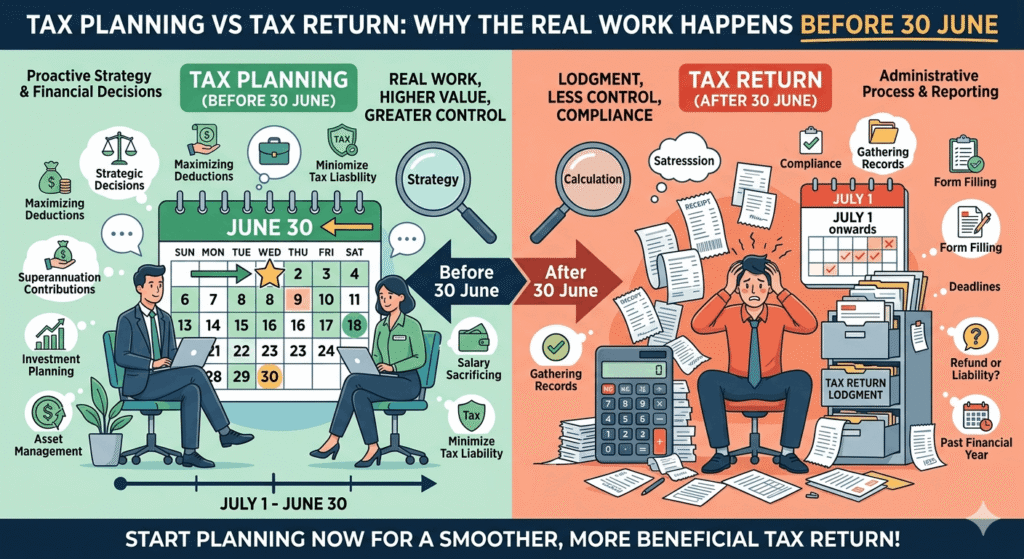
Tax planning happens before 30 June and focuses on actively reducing your tax legally — through timing decisions, super contributions, and deduction planning made while the financial year is still open. Tax return preparation happens after 30 June and simply reports what has already occurred during the year, with very limited ability to change the outcome at that point. The greatest tax-saving opportunities exist during the planning phase, while the financial year is still in progress, not during return preparation.
| Factor | Tax Planning | Tax Return Preparation |
| Timing | Before 30 June, throughout the financial year | After 30 June, once the year has ended |
| Purpose | Actively reduce tax through timing and strategy | Accurately report income and deductions already incurred |
| Ability to change the outcome | High — decisions can still influence the result | Low — mostly limited to correctly claiming what already happened |
| Typical activities | Super contributions, expense timing, capital gains management | Gathering records, lodging the return, claiming eligible deductions |
What Is Tax Planning?
Tax planning is the proactive process of arranging your financial affairs, within the law, to legally minimise the tax you’ll ultimately owe.
Definition
At its core, tax planning means making decisions — about super contributions, the timing of income or expenses, investment structuring, or asset sales — while there’s still time for those decisions to affect your tax outcome for the current financial year.
Goals
The goal isn’t simply to minimise tax at any cost; it’s to make timing and structuring decisions that are both tax-efficient and consistent with your broader financial goals, like building super, growing investments, or supporting a business.
Timing
Effective tax planning is genuinely a year-round activity, but it becomes most time-sensitive in the final few months before 30 June, when the window for many strategies (super contributions, asset sales, prepaying expenses) is about to close.
Who Needs It
Anyone with income beyond simple, single-employer PAYG wages benefits from at least some tax planning — but it’s particularly valuable for property investors, business owners, high-income earners, and anyone with investment income or capital gains.
Example: An employee considering an additional $10,000 salary sacrifice contribution to super needs to act before 30 June for that contribution to count toward the current financial year — waiting until July means the opportunity for this financial year has passed entirely.
What Is a Tax Return?
A tax return is the formal report you (or your tax agent) lodge with the ATO after the financial year ends, summarising your income, deductions, and tax position for that year.
Purpose
The tax return calculates exactly how much tax you owe (or are owed as a refund) based on what actually happened during the financial year — it’s a reporting and reconciliation exercise, not a planning one.
Reporting Obligations
You’re legally required to accurately report all assessable income and can claim all legitimate deductions you’re entitled to, supported by appropriate records.
Common Misconceptions
A common misconception is that a good accountant can “find” significant extra tax savings during return preparation in July. In reality, by that point, most major levers (super contributions, asset sale timing, structuring) have already closed for the year that’s just ended — a skilled accountant can ensure everything legitimate is being claimed, but can’t undo decisions (or non-decisions) already locked in by 30 June.
Lodgment Deadlines
Individuals lodging their own tax return generally need to do so by 31 October following the end of the financial year, while those using a registered tax agent often have access to later lodgment deadlines, provided they’ve engaged the agent by the relevant date.
Pro Tip: If you want your accountant to do more than just report your numbers each July, book a dedicated tax planning conversation in April or May instead — a separate meeting, well before 30 June, focused specifically on what you can still influence.
Why Tax Planning Must Happen Before 30 June
The reason timing matters so much comes down to a simple principle: most tax outcomes are determined by what happens within the financial year itself, not by how the return is later prepared.
Timing of Deductions
An expense generally needs to be incurred within the financial year to be deductible in that year — paying for a deductible expense on 1 July instead of 28 June simply pushes the deduction into next year’s return instead of this one.
Contribution Deadlines
Concessional super contributions must be received by your super fund by 30 June to count toward that financial year’s cap — and processing delays mean leaving this until the very last day is genuinely risky.
Capital Gains Management
Whether you sell an asset on 29 June or 2 July can shift a capital gain (or the ability to offset it with a loss) into an entirely different financial year, with potentially different tax consequences depending on your other income in each year.
Investment Decisions
Decisions like restructuring how an investment is held, or timing when a new investment is acquired, often need to happen before year-end to affect that year’s tax position, rather than simply being reported on after the fact.
Example: An investor with a large capital gain from selling shares in May has until 30 June to also realise a capital loss on an underperforming holding, offsetting some of that gain. If they wait until preparing their tax return in August, the financial year (and the opportunity) has already closed — the loss can still be used, but only in a future year, not against this year’s gain.
Common Mistake: Believing that a capital loss or extra super contribution can be applied to a financial year retroactively, simply because the tax return hasn’t been lodged yet, is a costly misunderstanding. The relevant date is when the transaction or contribution actually occurred, not when the return is prepared.
Tax Planning Strategies for Employees
Salary Sacrifice Into Super
Arranging additional pre-tax super contributions through your employer before 30 June reduces your taxable income for the current year, taxed concessionally inside super instead of at your marginal rate.
Work-Related Deductions
Reviewing and finalising work-related expense records (uniforms, tools, self-education, home office hours) before year-end ensures nothing is missed and genuinely incurred costs are properly captured.
Prepaying Deductible Expenses
Where cash flow allows, prepaying certain deductible expenses (such as income protection premiums) before 30 June can bring the deduction forward into the current financial year.
Income Protection Insurance
Reviewing whether you hold adequate income protection insurance outside super, and whether premiums are paid (and therefore deductible) before year-end, is a simple but often overlooked action item.
Tax Planning Strategies for Property Investors
Loan Interest Reviews
Reviewing whether your investment loan structure and interest rate are still competitive, and confirming interest has been correctly allocated if you have mixed-purpose borrowing, is worth doing before year-end documentation is finalised.
Depreciation Schedules
If you haven’t already commissioned a quantity surveyor report, or completed a renovation that hasn’t been reflected in your existing schedule, arranging this before year-end ensures the current year’s depreciation claim is accurate and complete.
Repairs vs. Improvements
If you’re planning maintenance or renovation work, timing it (and correctly classifying it) before 30 June affects whether it’s an immediate deduction this year or a capital works claim spread over future years.
Capital Gains Timing
If you’re considering selling an investment property, the financial year the sale settles in can significantly affect your tax position, particularly if your income varies meaningfully between years.
Tax Planning Strategies for Business Owners
Trust Distributions
If your business operates through a discretionary trust, trustee resolutions for the year’s distributions generally need to be properly documented before the deed’s deadline, commonly 30 June — leaving this until the tax return is prepared is too late.
Asset Purchases
Reviewing whether bringing forward planned equipment or asset purchases before year-end makes sense, including checking current instant asset write-off thresholds with your accountant, is a common pre-30 June consideration.
Super Contributions
Business owners, including those who pay themselves via trust distributions rather than a standard wage, need to actively arrange personal deductible super contributions before year-end, since these don’t happen automatically the way employee Superannuation Guarantee payments do.
Income Deferral
Where genuinely possible and commercially reasonable, deferring the issuing of invoices for work completed right at year-end (or bringing forward deductible expenses) can shift income between financial years — though this needs to reflect real commercial timing, not artificial manipulation.
Tax Planning Strategies for High-Income Earners
Concessional Super Contributions
Maximising concessional contributions up to the $30,000 cap (or more using carry-forward amounts, if eligible) before 30 June remains one of the most effective levers available to high-income earners.
Division 293 Considerations
If your income is near or above $250,000, forecasting your Division 293 position before year-end helps you understand the likely additional tax on your concessional contributions, rather than being surprised by a notice months later.
Debt Recycling
Reviewing progress on an existing debt recycling strategy, or considering starting one, often benefits from a clear-eyed assessment before year-end of how much has been (or could be) recycled in the current financial year.
Investment Structures
Decisions about whether new investments should be held personally, jointly, or through a trust are far easier to implement cleanly before an asset is purchased than to unwind and restructure afterward.
Want the detail behind these strategies? Our dedicated guides on reducing tax on a $200k+ salary, Division 293 tax, and debt recycling walk through each of these strategies in much greater depth.
Common Tax Planning Mistakes
- Waiting until July — assuming tax time starts after the financial year ends, missing the window for super contributions, asset sale timing, and other genuinely time-sensitive decisions.
- Chasing deductions without a strategy — making ad hoc purchases purely for a tax deduction, without considering whether the underlying spending genuinely makes financial sense.
- Ignoring record keeping — leaving expense and income record-keeping until the return is being prepared, by which point details and receipts are easily lost or forgotten.
- Exceeding contribution caps — losing track of total concessional contributions (including employer contributions) and inadvertently breaching the cap in the rush to maximise a last-minute contribution.
Tax Planning Timeline: January to June
Spreading tax planning across the second half of the financial year, rather than compressing it into June, gives you considerably more options.
January
- Review your income and tax position for the first half of the financial year.
- Check progress against your annual concessional super contribution cap.
February
- Review investment performance and consider any capital gains or losses realised so far.
- If self-employed or a business owner, review profit projections for the year.
March
- Book a dedicated tax planning meeting with your accountant, separate from your eventual tax return appointment.
- Review depreciation schedules for any investment properties, updating for renovations if needed.
April
- Finalise decisions on any planned asset sales, considering which financial year best suits the resulting capital gain or loss.
- Review trust distribution planning if applicable, well ahead of the 30 June deadline.
May
- Confirm planned super contributions with payroll or your fund, allowing processing time before 30 June.
- Consider prepaying eligible deductible expenses if cash flow allows.
June
- Finalise and document trustee resolutions for any discretionary trust distributions.
- Complete any tax-loss harvesting before 30 June.
- Confirm all planned super contributions have actually been received by your fund, not just submitted.
- Gather records and documentation in preparation for your eventual tax return.
Pro Tip: Don’t leave super contributions to the last few days of June. Processing delays between your bank, your employer’s payroll, and your super fund mean a contribution submitted on 28 June can occasionally miss being received by 30 June — submit with at least a week or two of buffer.
Real-World Case Studies
PAYG Employee Earning $220,000
Actions taken before 30 June: Salary sacrificed an additional $12,000 into super (within the $30,000 cap), and finalised work-related deduction records before year-end.
Estimated tax saving: A meaningful reduction in taxable income, taxed concessionally inside super instead of at the top marginal rate.
Lesson learned: Acting in May, rather than waiting for the tax return appointment in August, meant the contribution was comfortably received by the fund before the deadline.
Property Investor With Two Rentals
Actions taken before 30 June: Commissioned an updated depreciation schedule after a kitchen renovation, and brought forward minor maintenance work that had been planned for the new financial year anyway.
Estimated tax saving: A larger, more accurate depreciation claim, plus an immediate deduction for maintenance that would otherwise have fallen into the following year.
Lesson learned: Reviewing the depreciation schedule proactively, rather than assuming the original schedule still reflected the property’s current state, uncovered a meaningfully larger claim.
Family Business Owner
Actions taken before 30 June: Finalised and documented the family trust’s distribution resolution in early June, after a dedicated planning meeting with their accountant in April to model different distribution scenarios.
Estimated tax saving: A more tax-effective distribution of business profit across family members, properly documented and defensible if reviewed.
Lesson learned: Planning the distribution in April, rather than rushing it in the final days of June, allowed time to genuinely model different scenarios rather than defaulting to the prior year’s approach.
These case studies are illustrative composites based on common scenarios and do not represent guaranteed outcomes for any individual.
How Technology and AI Are Changing Tax Planning
Open Banking
The Consumer Data Right allows secure, real-time sharing of transaction data with accountants and planning tools, making it easier to review your tax position throughout the year rather than only at the end.
Digital Expense Tracking
Apps that automatically categorise deductible expenses as they occur mean less reconstruction work (and fewer missed deductions) when 30 June arrives.
AI Forecasting Tools
Modern tax planning software can model the likely impact of different super contribution levels, asset sale timing, or income deferral scenarios, helping you and your adviser compare options concretely before 30 June rather than guessing.
Real-Time Reporting
Increasingly integrated accounting and payroll systems give a clearer, more current picture of year-to-date income and tax position, supporting planning decisions made in April or May with reasonably accurate, up-to-date numbers.
Tax Planning Checklist
Work through this checklist in the lead-up to 30 June, ideally starting no later than April or May.
- Income review: forecast your likely total income for the financial year, including any bonuses, capital gains, or one-off payments
- Deductions: finalise and organise records for all work-related, investment, and business deductions incurred during the year
- Investments: review any planned asset sales and consider which financial year the sale should fall into
- Super contributions: confirm planned concessional contributions against the $30,000 cap (and any available carry-forward amount), allowing processing time before 30 June
- Record keeping: ensure receipts, statements, and depreciation schedules are organised and complete, not scattered across the year
Downloadable checklist opportunity: Convert this checklist into a one-page printable PDF EOFY action plan, as a lead-generation download timed for release each March or April.
FAQs
Is tax planning worth it?
For most people with more than simple PAYG income, yes — proactive planning before 30 June can meaningfully reduce tax legally in ways that aren’t possible once the financial year has ended.
When should I start tax planning?
Ideally well before June — many of the most effective strategies need weeks or months of lead time, particularly super contributions and trust distribution planning.
Can I reduce tax after 30 June?
Very few opportunities remain once the financial year ends — tax return preparation focuses on accurately claiming what already happened, not changing the outcome.
How much can tax planning save?
It varies enormously depending on your income, structure, and circumstances — from a modest amount for a simple PAYG employee to a substantial sum for a high-income earner or business owner with multiple levers available.
What’s the difference between tax planning and tax avoidance?
Tax planning uses legal strategies and concessions as intended; tax avoidance involves contrived arrangements designed purely to avoid tax, which the ATO can challenge and unwind.
Do I need an accountant for tax planning?
It’s strongly recommended, particularly once your situation includes investments, a business, or income beyond simple employment — a dedicated planning conversation is different from your annual return appointment.
When is the deadline for super contributions to count this financial year?
Contributions must be received by your super fund by 30 June, not simply submitted or requested by that date — processing time needs to be factored in.
Can I still make tax-deductible super contributions after 30 June?
Any contribution made after 30 June counts toward the following financial year instead, not the one that’s just ended.
What happens if I miss a tax planning deadline?
Generally, the opportunity for that financial year is lost — most strategies can’t be applied retroactively once the relevant date or contribution deadline has passed.
Is EOFY tax planning only for high-income earners?
No — while the dollar value of savings is often larger for high-income earners, employees, investors, and business owners at various income levels can all benefit from proactive planning.
What records do I need for tax planning?
Up-to-date income, expense, and investment records throughout the year, not just at tax time, make planning decisions far easier and more accurate.
Can a tax agent help with planning, not just lodging my return?
Yes — many registered tax agents offer dedicated tax planning services separate from return preparation, ideally booked in the first half of the calendar year.
Does tax planning apply to capital gains?
Yes — the timing of an asset sale, and whether losses are realised to offset a gain, are both classic pre-30 June planning decisions.
Is it too late to plan if it’s already May or June?
No, though your options narrow — some strategies like super contributions and tax-loss harvesting can still be actioned quickly if you move promptly.
How is tax planning different for business owners?
Business owners typically have additional levers, like trust distributions, asset purchase timing, and the ability to influence when income is invoiced, beyond what’s available to a simple employee.
Conclusion
Tax planning and tax return preparation might feel like the same activity to many Australians, but they sit on opposite sides of a hard deadline. One happens while the year is still open and decisions can still shape the outcome; the other happens afterward, simply reporting on what’s already locked in.
The most effective approach treats tax planning as a year-round process, not a single appointment in June, and certainly not something that begins in July when the return is finally prepared. Reviewing your position in the early months of the calendar year, well ahead of 30 June, opens up options that simply don’t exist once the deadline has passed.
Because your income, investments, and circumstances change from year to year, this isn’t a strategy to plan once and repeat unchanged. Reviewing your approach annually, ideally with a dedicated planning conversation separate from your tax return appointment, keeps you ahead of the deadline rather than reacting to it.
Ready to plan ahead of 30 June, not just report on it afterward? Speak with the Centria Finance team about your broader financial position, and book a dedicated tax planning conversation with a registered tax agent or financial adviser well before the financial year ends.
One Response