
It’s one of the more painful surprises in Australian property ownership: you sell a place you once called home, expecting the sale to be tax-free like every other home sale you’ve heard about, and then your accountant tells you there’s a capital gains tax bill. It happens more often than you’d think — to people who moved interstate for work, upgraded to a bigger house, or simply rented out their old apartment for a few years while life took them elsewhere.
These scenarios are common, and they share the same underlying tension: the family home is generally exempt from capital gains tax, but the moment you stop living in it and start earning rental income from it, that exemption isn’t automatically guaranteed to continue. Whether it does, and for how long, depends on a specific piece of tax law commonly known as the 6-year rule.
Used correctly, the 6-year rule is one of the most valuable concessions available to everyday Australian homeowners — and it’s become more valuable still since the May 2026 Federal Budget confirmed that the 50% CGT discount on other investments is being replaced with a less generous model from 1 July 2027. A correctly preserved main residence exemption now stands out even more as one of the few ways to realise a genuinely tax-free gain on an appreciating asset.
This guide explains exactly how the main residence exemption and the 6-year rule work, walks through the partial exemption calculation when you exceed the six years, covers what happens if you buy another home or move back in, and addresses the considerably stricter rules that apply if you’ve become a foreign resident. Along the way, we’ll cover the record-keeping that protects you if the ATO ever asks questions.
Quick Answer: What Is the 6-Year Rule for CGT?
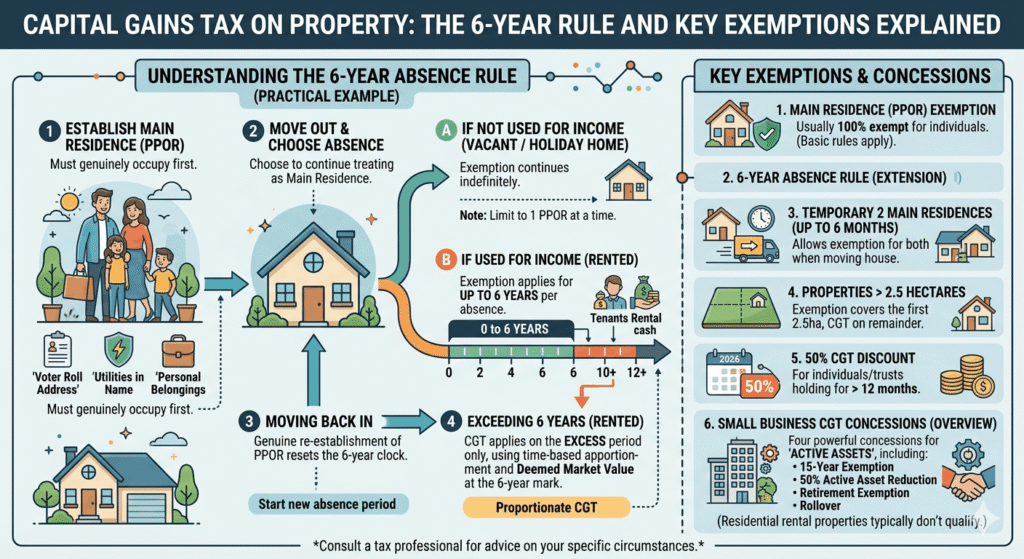
The 6-year rule, formally known as the temporary absence rule, allows Australian homeowners to continue treating a former home as their main residence for capital gains tax purposes for up to six years after moving out, provided the property is rented out and no other property is nominated as the main residence during that time. If the home is sold within six years of becoming income-producing, the gain can be fully exempt from CGT; if sold after six years, only part of the gain remains exempt.
| Question | Quick Answer |
| What does it apply to? | A property that was genuinely your main residence before you moved out and started renting it |
| How long does the exemption last? | Up to six years of income-producing absence, per absence period |
| Can I use it more than once? | Yes, if you genuinely move back in between absences, resetting the clock |
| What if I don’t rent it out? | If the property earns no income, the exemption can continue indefinitely while you’re absent |
| What’s the biggest restriction? | You cannot nominate another property as your main residence during the same period |
Understanding Capital Gains Tax on Property
Before getting into the 6-year rule specifically, it helps to understand the broader CGT framework it operates within.
What CGT Is
Capital gains tax applies to the profit (the capital gain) made when you sell an asset, including property, for more than its cost base. It isn’t a separate tax in its own right — the net gain is simply added to your assessable income and taxed at your marginal rate in the year of sale.
How Capital Gains Are Calculated
In simple terms, your capital gain is the sale price minus your cost base, which includes the original purchase price plus eligible costs like stamp duty, legal fees, and capital improvements made over time.
The 50% CGT Discount
If you’ve held the property for more than 12 months, individuals can generally reduce the taxable portion of the gain by 50% before it’s added to assessable income — a significant concession that applies on top of, not instead of, the main residence exemption where relevant.
When Property Sales Trigger CGT
Generally, selling an investment property, a former home that’s been rented out, or land triggers a CGT event. The family home you live in, however, is treated very differently.
As a general rule, your main residence — the home you actually live in — is exempt from CGT entirely when you sell it, provided you meet the eligibility requirements. This is one of the most generous and widely used tax concessions in the entire Australian tax system.
What Is the Main Residence Exemption?
The main residence exemption is the rule that makes most Australian home sales completely tax-free. Understanding its requirements is the foundation for understanding the 6-year rule that extends it.
Eligibility Requirements
Broadly, the property must be a dwelling, you must have lived in it, and it must not have been used predominantly to produce assessable income for the full period you’re claiming the exemption for (subject to the 6-year rule and other partial exemption provisions).
Moving In Requirements
You generally need to move into the property as soon as practicable after settlement for it to be considered your main residence from that point, rather than treating it as an investment first and a home later.
Intention Tests
The ATO looks at factors like where your belongings are kept, your address on the electoral roll and driver’s licence, and the connection of utilities to assess whether a property genuinely functioned as your home, rather than relying on your stated intention alone.
Spouse Rules
Couples (married or de facto) can generally only claim one main residence exemption between them for any given period, even if they technically each own a different property — though there are specific rules for managing a transition period if each partner owned a separate home before the relationship began.
Land Size Limitations
The exemption generally covers land up to two hectares used primarily for private and domestic purposes alongside the dwelling; larger landholdings may only receive a partial exemption.
Example: Jordan buys an apartment, moves in immediately, lives there for three years, then relocates for work and rents it out. Because the apartment was genuinely his home before it became income-producing, he satisfies the foundational requirement for both the main residence exemption and, potentially, the 6-year rule during his absence.
Pro Tip: Keep simple, ongoing evidence that a property was genuinely your home — utility bills in your name, your address on official documents, and the dates you moved in and out. This evidence becomes far more valuable years later than you’d expect at the time.
How the 6-Year Rule Works
The 6-year rule follows a logical sequence. Understanding each step helps you see exactly where the clock starts, what affects it, and what ends it.
Step 1: Establish the Property as Your Main Residence
You need to have genuinely lived in the property as your home before any absence begins — this is the non-negotiable foundation the entire rule depends on.
Step 2: Move Out
At some point, you move out of the property, whether for work relocation, lifestyle reasons, or simply moving to a new home.
Step 3: Rent the Property
Once you make the property available for rent and it starts earning income, the six-year clock begins ticking. If you move out but don’t rent the property at all, there’s no time limit on the exemption during that period of absence.
Step 4: Choose to Apply the Temporary Absence Rule
This isn’t automatic — you formally choose to apply the absence rule (generally at the time you prepare your tax return for the year the property is sold), which is part of why understanding your eligibility ahead of time matters.
Step 5: Sell Within Six Years
If the sale happens within six years of the property first becoming income-producing, and you haven’t nominated another main residence in the meantime, the gain can be fully exempt under the rule.
Diagram suggestion: This five-step sequence is ideal for a horizontal timeline graphic, with the six-year countdown beginning visually at Step 3 and the exemption status marked clearly at Step 5.
When the Six-Year Clock Starts
The clock starts on the day the property is first made available for rent and genuinely begins producing income — not the day you physically moved out, if there’s a gap between the two.
What Resets the Six-Year Period
Genuinely moving back into the property and re-establishing it as your main residence resets the clock. A later absence then starts a fresh six-year period of its own.
How Multiple Absences Are Treated
Each separate period of absence (separated by a genuine period of re-occupation) gets its own six-year allowance, meaning the rule can, in principle, be used more than once over the life of owning a single property.
Example: Maria buys a house in 2015 and lives in it until 2019, then moves interstate for a new role and rents it out from 1 July 2019. She sells it in June 2024 — within the six-year window from when the rental income started, and having never nominated another main residence in that time. Provided she meets the other requirements, the full capital gain on the sale can be exempt from CGT.
What Happens If You Move Back In?
Moving back in isn’t just a pause button — it has real implications for how the exemption applies going forward.
Resetting the Six-Year Period
If you genuinely re-establish the property as your main residence (not just a token visit), any future absence starts a brand-new six-year period, independent of how much of the previous six years you’d already used.
Partial Exemptions
If you move back in for a period and then move out again, sell, but you’d exceeded six years on an earlier absence before moving back in, that earlier excess period may still result in a partial exemption for that portion of ownership — the calculation can become genuinely complex with multiple absences.
Evidence Requirements
The ATO assesses whether re-occupation was genuine by looking at factors including how long you stayed, whether you reconnected utilities and services in your name, and whether your personal belongings and address details reflected an actual return home — not simply a brief stay timed around a sale.
Common Mistake: Moving back into a property for a token period (a few weeks, with minimal evidence of genuine occupation) purely to “reset” the six-year clock is a high audit risk. The ATO looks at substance, not just paperwork, when assessing whether re-occupation was genuine.
What If You Buy Another Home?
One of the strictest parts of the entire main residence exemption framework: in general, you can only have one main residence at a time.
Overlapping Main Residence Rules
If you buy a new home while still using the 6-year rule to cover your old one, you generally need to choose which property gets the exemption for the overlapping period — nominating the new property as your main residence will generally end the absence-rule exemption on the old one from that point.
The Six-Month Overlap Concession
There’s a specific concession allowing both your old and new home to be treated as your main residence for up to six months, where you’re genuinely trying to sell the old home and it was your main residence for at least three months in the 12 months before the sale, and wasn’t used to produce income in that 12-month period (or for no more than a relatively short part of it).
Choosing Which Property Receives the Exemption
Outside the six-month overlap concession, if you’re holding two properties you’ve each lived in, you’ll generally need to make a choice (often at the point of preparing the relevant tax return) about which one the exemption applies to for any period where both could otherwise qualify.
Example: Diego sells his old apartment, which he’d been renting out under the 6-year rule, but takes nine months to find a buyer after purchasing his new home. The six-month overlap concession only covers the first half of that period; depending on how the old apartment was used in the year before sale, part of the overlap beyond six months may need separate consideration.
| Scenario | Likely Outcome |
| Buy new home, sell old home within 6 months, old home wasn’t rented in the prior 12 months | Both properties may be treated as main residence during the overlap (six-month concession) |
| Buy new home, continue renting old home under the 6-year rule, no plan to sell old home soon | Generally need to choose; nominating the new home as main residence affects the old home’s exemption from that point |
| Sell old home before settling on new home | No overlap issue — only one main residence at any time |
Partial CGT Exemptions Explained
Not every scenario results in a full exemption or no exemption at all — many situations land somewhere in between.
Renting Out Part of Your Home
If you rent out a room or granny flat while still living in the property yourself, only the portion of the home used to produce income (and only for the period it was rented) is generally subject to CGT on sale, calculated proportionally.
Exceeding Six Years
If you sell after the six-year absence period has lapsed without moving back in, the exemption generally applies in full for the first six years of the absence, with the gain attributable to the period beyond six years becoming taxable on a proportional basis.
Mixed-Use Properties
Properties used partly for private purposes and partly for income-producing purposes (such as a holiday home rented out for part of the year) require apportionment between exempt and taxable use — an area the ATO has recently issued specific guidance on regarding holiday homes and similar leisure properties.
Home Office Claims
Claiming a home office deduction can, in some circumstances, affect the main residence exemption for the portion of the home used as a place of business, though this is generally a minor consideration for most employees working from home occasionally, as opposed to running a business from a dedicated, exclusively-used space.
Property First Used to Produce Income
If a property was always used to produce income from the moment you acquired it (an investment property you never lived in), the main residence exemption and the 6-year rule don’t apply at all — these provisions are specifically about a former home, not a property purchased purely as an investment.
Example calculation: Olivia owned a property for 4,000 days in total, lived in it for 2,800 days, and rented it out for 1,200 days — exceeding her six-year (2,190-day) absence allowance by some margin. Roughly, the taxable proportion of her capital gain would reflect the period beyond the exempt six years relative to her total ownership period, calculated using the specific formula in the relevant tax law, before the 50% CGT discount is then applied to any remaining taxable amount.
Special Rules for Expats and Non-Residents
This is the area where the stakes are highest and the rules are least forgiving — many Australian expats are caught out by changes that took effect several years ago but still surprise people today.
Foreign Resident CGT Changes
Since 30 June 2020, foreign residents are generally no longer entitled to the main residence exemption at all when selling Australian property, regardless of how long the property was genuinely their home before they left the country.
Loss of Main Residence Exemption
If you’re a foreign resident for tax purposes at the time of sale and don’t meet a specific exception, you’re not entitled to any main residence exemption — not even a partial one — even if the property was your genuine home for most of your ownership period.
Limited Exceptions
A narrow life events test provides a limited exception: if you’ve been a foreign resident for six years or less at the time of sale, and a qualifying life event occurred during that period (such as a terminal medical condition affecting you, your spouse, or your child under 18, or the CGT event happening due to a formal agreement following a relationship breakdown), the exemption may still be available.
Common Mistake: If you’re an Australian who has moved overseas and become a foreign resident for tax purposes, do not assume the 6-year rule will protect a sale of your former home. The rules changed significantly from 30 June 2020, and many expats only discover the impact when it’s too late to plan around it. Get specific advice before selling if there’s any chance you’re a foreign resident for tax purposes.
Example: Ben, an Australian citizen, moved to Singapore for work in 2021 and has been a foreign resident for tax purposes ever since. He still owns his old Melbourne home, which he rented out. If he sells it now, more than six years have not yet passed as a foreign resident, but if no qualifying life event has occurred, he generally won’t be entitled to the main residence exemption at all under the current rules — a markedly different outcome to what would apply if he were an Australian tax resident at the time of sale.
Record-Keeping Requirements
CGT calculations involving the main residence exemption and the 6-year rule are highly dependent on dates and evidence — good records can be the difference between a smooth claim and a stressful dispute.
Purchase Documents
Keep your original contract of sale, settlement statement, and records of stamp duty and legal fees paid at purchase.
Improvement Costs
Retain receipts and invoices for any capital improvements made over your ownership period, since these generally add to your cost base and reduce your eventual taxable gain.
Rental Records
Keep lease agreements, rental income statements, and property management records covering the entire period the property was rented, to clearly establish when the income-producing period began and ended.
Valuations
Where a property’s first use to produce income after 20 August 1996 triggers a market value cost base reset, a contemporaneous professional valuation at that date is far more reliable than attempting to reconstruct a value years later.
Ownership Records
Keep title documents and any records relevant to changes in ownership structure over time, including if a spouse’s name was added or removed from the title.
- Original contract of sale and settlement statement
- Records of stamp duty, legal fees, and other acquisition costs
- Receipts for capital improvements and renovations
- Lease agreements and rental income records for the entire rental period
- A contemporaneous market valuation, if the property was first used to produce income after 20 August 1996
- Records showing the dates you moved in and moved out (utility bills, electoral roll address, driver’s licence)
- Records of any other property you or your spouse owned and lived in during the same period
Downloadable checklist opportunity: Convert this record-keeping list into a one-page printable PDF checklist as a lead-generation download for homeowners planning to rent out or sell a former home.
Common Mistakes Property Owners Make
- Assuming the exemption is automatic — the 6-year rule is a choice you formally apply, generally when preparing the relevant tax return, not an automatic default.
- Forgetting the six-year deadline — losing track of exactly when the property first became income-producing, and missing the point where the exemption begins reducing.
- Failing to obtain valuations — not getting a contemporaneous market valuation when a property first becomes income-producing, making it far harder to substantiate a cost base reset years later.
- Claiming excessive home office deductions — not understanding how claiming part of a home as a place of business can interact with the main residence exemption.
- Misunderstanding spouse rules — assuming each spouse can independently claim a full main residence exemption on separate properties at the same time.
Real-World Case Studies
Homeowner Rents Property for Four Years
Timeline: Lived in the property for six years, moved out and rented it for four years, then sold.
CGT outcome: Fully exempt — well within the six-year absence allowance, with no other main residence nominated during that time.
Lesson learned: Staying comfortably under the six-year limit, with clean records of the move-out and rental start dates, made this a straightforward, low-risk claim.
Couple Relocates Interstate
Timeline: A couple lived in their Perth home for eight years, relocated to Sydney for work, rented out the Perth property, and bought a new home in Sydney three months after listing the Perth property for sale.
CGT outcome: Used the six-month overlap concession to treat both properties as exempt during the transition, since the Perth property sold within six months and met the other overlap requirements.
Lesson learned: Understanding the six-month overlap concession in advance allowed them to buy their new home with confidence, rather than feeling pressured to sell the old one first.
Investor Exceeds the Six-Year Period
Timeline: Lived in a property for five years, then rented it out for nine years without ever moving back in, before selling.
CGT outcome: Partial exemption only — the first six years of the rental period remained exempt, but the remaining three years of the rental period resulted in a proportional taxable capital gain, with the 50% CGT discount then applied to that taxable portion.
Lesson learned: Tracking the six-year deadline matters — by the time the owner realised they’d exceeded it, there was little they could do to retroactively change the outcome.
Expat Sells Former Australian Home
Timeline: Lived in an Adelaide property for ten years, moved to the UK for work in 2022, became a foreign resident for tax purposes, rented out the property, and sold it in 2026 while still living overseas.
CGT outcome: No main residence exemption available at all, despite the property having been a genuine long-term home, because the seller was a foreign resident at the time of sale and didn’t meet the life events test.
Lesson learned: The 6-year rule’s protection effectively evaporated the moment foreign residency status applied at the time of sale — a markedly different (and costly) outcome compared with selling while still an Australian tax resident.
These case studies are illustrative composites based on common scenarios and do not represent guaranteed outcomes for any individual.
6-Year Rule Decision Framework
Work through these questions in order to get a general sense of where you stand — though a registered tax agent should confirm your specific position before you act.
Question 1: Was the Property Genuinely Your Main Residence?
If you never lived in the property as your home, the 6-year rule doesn’t apply — it only extends an exemption that already existed.
Question 2: Have You Nominated Any Other Main Residence Since Moving Out?
If you’ve claimed another property as your main residence during the same period, the 6-year rule on the original property is likely compromised for that overlapping time.
Question 3: Is the Property Earning Rental Income?
If it’s vacant and not producing income, there may be no time limit on the absence at all; if it’s rented, the six-year clock applies.
Question 4: How Long Has It Been Rented?
Under six years generally points toward a full exemption; over six years generally means a partial exemption calculation is needed.
Question 5: Are You an Australian Tax Resident?
If you’re a foreign resident for tax purposes at the time of sale, the entire analysis changes — the exemption is generally unavailable unless the life events test is met.
Decision tree suggestion: These five questions map naturally to a branching decision tree graphic, ending in one of three outcomes: full exemption likely, partial exemption likely, or exemption likely unavailable (foreign resident).
FAQs
Does the 6-year rule reset?
Yes, if you genuinely move back into the property and re-establish it as your main residence, a later absence starts a new six-year period.
Can I use the 6-year rule more than once?
Yes, for the same property, provided each absence is separated by a genuine period of re-occupation as your main residence.
Do I need to tell the ATO?
You don’t notify the ATO at the time, but you formally apply the absence rule choice when preparing your tax return for the year the property is sold.
Can I have two main residences?
Generally no, with a limited exception being the six-month overlap concession when transitioning between an old and new home.
What happens after six years?
If you haven’t moved back in and sell after the six-year mark, the exemption generally applies only to the first six years of the absence, with the remaining period resulting in a partial, taxable capital gain.
Does the 6-year rule apply if I don’t rent the property out?
If the property isn’t earning income, there’s generally no time limit on the absence — the six-year clock only starts once the property becomes income-producing.
What is the six-month overlap concession?
A rule allowing both an old and new home to be treated as your main residence for up to six months while you’re genuinely trying to sell the old one, subject to specific conditions.
Does the 6-year rule apply to foreign residents?
Generally no — since 30 June 2020, foreign residents are not entitled to the main residence exemption (including via the 6-year rule) unless they meet a narrow life events test.
What records do I need for the 6-year rule?
Purchase documents, evidence of when you moved in and out, rental records, improvement costs, and ideally a market valuation from when the property first became income-producing.
Can my spouse and I each claim a different main residence?
Generally no — couples can usually only claim one main residence exemption between them for any given period.
Does renting out a room in my home affect the main residence exemption?
Yes, generally only proportionally — the part of the home and period used to produce income may not be covered by the full exemption.
Is the 50% CGT discount the same as the main residence exemption?
No — the main residence exemption can make a gain fully tax-free, while the 50% CGT discount reduces the taxable portion of a gain that isn’t otherwise exempt.
What if I exceed six years but the gain is small?
The partial exemption calculation still applies proportionally regardless of the size of the gain — there’s no minimum threshold that waives the calculation.
Does moving overseas automatically affect my main residence exemption?
Only if you become a foreign resident for Australian tax purposes — simply travelling or working overseas temporarily while remaining an Australian tax resident doesn’t trigger the foreign resident restrictions.
Should I get a valuation when I start renting out my home?
Yes, it’s strongly recommended where the property was first used to produce income after 20 August 1996, since a contemporaneous valuation is far more reliable than reconstructing one retrospectively.
Conclusion
The 6-year rule is one of the most generous and genuinely useful concessions in the Australian tax system, letting homeowners move on with life — relocating for work, upgrading their home, or simply renting out a former apartment — without automatically losing the tax-free status of their old home.
Used correctly, it can mean the difference between a fully tax-free sale and a significant capital gains tax bill. Used incorrectly, or without the records to back up your position, it can leave you exposed at exactly the moment a sale should be a financial win.
Because the outcome depends so heavily on specific dates, genuine occupation, and your residency status at the time of sale, it’s well worth speaking with a registered tax agent before you rent out a former home, before you buy a new one while still holding the old, and certainly before you sell — particularly if there’s any chance you’ve become a foreign resident for tax purposes along the way.
Thinking about renting out or selling a property? Speak with the Centria Finance team about your broader property and lending position, and connect with a registered tax agent to confirm exactly how the main residence exemption and 6-year rule apply to your specific situation before you act.
2 Responses