
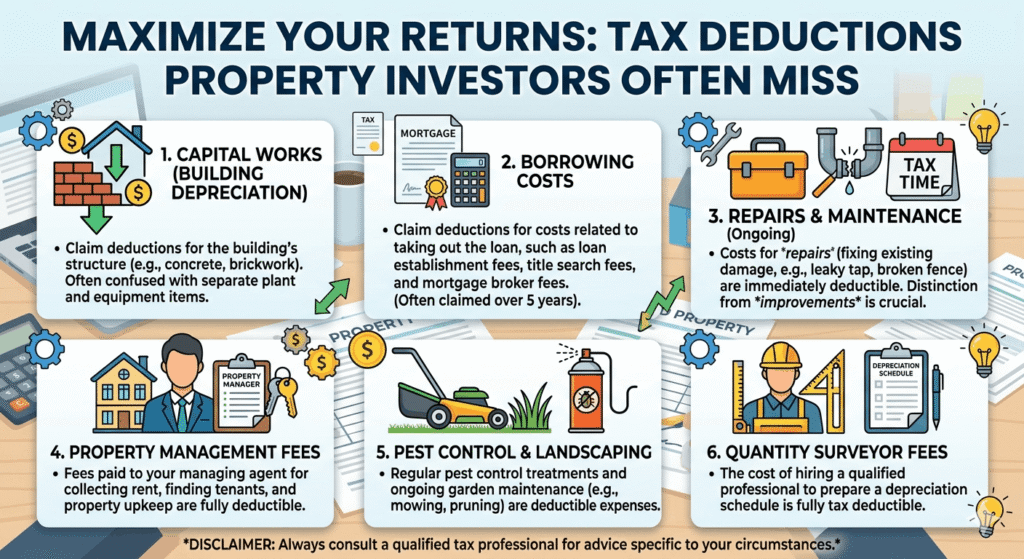
Most property investors do the basics right. They claim interest on the loan, they claim agent fees, they claim council rates. But year after year, a surprising number of legitimate deductions go unclaimed simply because investors don’t know they exist, assume they don’t qualify, or lose track of an expense paid eleven months ago.
These missed deductions aren’t trivial. Loan establishment costs, a forgotten depreciation schedule, a misclassified repair, or a prepaid expense can easily add up to thousands of dollars a year in tax that didn’t need to be paid. Multiply that across years of ownership, and the cumulative cost of under-claiming becomes genuinely significant.
It’s worth being clear about the boundary here: you can only claim expenses that are genuinely, directly related to earning rental income. This guide isn’t about pushing the limits of what’s deductible — it’s about making sure you’re claiming everything you’re legitimately entitled to, correctly classified, and properly documented.
Here’s what’s ahead: the difference between immediate deductions, capital works, and depreciating assets, a detailed walk-through of commonly missed categories from loan costs to depreciation to professional fees, the deductions you can no longer claim (and why), record-keeping that protects your claims, and real-world examples showing exactly how much these missed deductions can add up to.
Quick Answer: What Tax Deductions Do Property Investors Commonly Miss?
Property investors most commonly miss deductions for loan-related expenses (establishment fees, lender’s mortgage insurance, discharge fees), depreciation on both the building and fixtures (often because no quantity surveyor report was ever obtained), professional fees like accountant and quantity surveyor costs, the distinction between immediately deductible repairs and capital improvements, and prepaid expenses. Travel to inspect a residential rental property is no longer deductible at all, regardless of purpose, since 1 July 2017.
| Commonly Missed Deduction | Why It Gets Missed |
| Loan establishment fees and LMI | Investors assume only interest is deductible, overlooking one-off finance costs |
| Depreciation on building and fixtures | No quantity surveyor report was ever commissioned |
| Borrowing costs amortised over 5 years | Forgotten in later years after the year the loan was taken out |
| Initial repairs at acquisition (as capital cost) | Misclassified as an immediate deduction instead of added to the cost base |
| Property management and tax agent fees | Overlooked as deductible professional costs, not just “the cost of doing business” |
| Body corporate and strata levies | Confusion over which components are deductible versus capital in nature |
Understanding Rental Property Tax Deductions
Before diving into specific categories, it helps to understand the three broad buckets every rental property expense falls into.
Immediate Deductions
Expenses you can claim in full in the same financial year they’re incurred — things like interest, council rates, agent fees, and ongoing repairs and maintenance.
Capital Works Deductions
Also known as Division 43 deductions, these cover the structural building cost itself, claimed at a fixed rate (generally 2.5% per year) over an extended period, rather than all at once.
Depreciating Assets
Also known as Division 40 deductions, these cover plant and equipment within the property — items like carpets, blinds, and appliances — each depreciated according to its own effective life.
Non-Deductible Expenses
Some costs simply aren’t deductible at all, including the principal portion of loan repayments, expenses related to your own personal use of the property, and (since 2017) travel costs to inspect a residential rental property.
| Category | Example | How It’s Claimed |
| Immediate deduction | Interest, rates, agent fees, repairs | Claimed in full in the year incurred |
| Capital works (Division 43) | Original building construction cost | Claimed at a fixed annual rate over time |
| Depreciating assets (Division 40) | Carpets, blinds, hot water systems, appliances | Claimed over each asset’s effective life |
| Non-deductible | Loan principal, private use portion, travel to inspect (residential) | Cannot be claimed as a deduction |
Loan and Finance Expenses Investors Miss
Beyond ongoing interest, taking out and managing an investment loan generates several one-off costs that are often forgotten entirely.
Loan Establishment Fees
Fees charged by the lender to set up the loan are generally deductible, though typically as a borrowing cost spread over five years (or the loan term if shorter), rather than claimed immediately.
Mortgage Broker Fees
If you paid your broker directly (rather than the broker being paid by the lender), this fee is generally treated the same way as other borrowing costs.
Lender’s Mortgage Insurance
LMI, often a substantial one-off cost for investors with a smaller deposit, is generally deductible as a borrowing cost, amortised over five years or the loan term.
Title Search Fees
Fees paid to your lender or conveyancer for title searches conducted as part of securing the loan are generally included in your borrowing costs.
Loan Discharge Fees
Fees paid when paying out or refinancing a loan are generally deductible in the year they’re incurred, since the loan is being finalised rather than newly established.
Refinancing Costs
Costs associated with refinancing an investment loan (where the new loan is also used for the investment property) are generally treated similarly to the original borrowing costs.
Immediate Deduction vs. Amortisation Rules
The key distinction: ongoing costs like interest are deducted immediately each year, while one-off establishment-type borrowing costs are generally spread (amortised) over five years or the loan term, whichever is shorter — and if total borrowing costs are under $100, they can simply be claimed in full immediately.
Pro Tip: If you refinanced or took out your investment loan partway through a financial year, check whether you’re still part-way through amortising borrowing costs from that year. It’s an easy deduction to forget once the loan itself feels “settled.”
Common Mistake: Forgetting to continue claiming amortised borrowing costs in years two through five after taking out the loan is one of the most common missed deductions — the claim doesn’t end after the year you took out the loan.
Depreciation Deductions
Depreciation is consistently one of the largest, and most commonly under-claimed, deductions available to property investors — particularly because claiming it properly generally requires a specific report most investors never commission.
Division 40 Assets
These are depreciating plant and equipment assets within the property: items like carpets, blinds, hot water systems, air conditioning units, and freestanding furniture, each with its own effective life set by the ATO.
Division 43 Capital Works
This covers the structural cost of constructing the building itself (and eligible structural improvements), generally depreciated at 2.5% per year over 40 years from construction completion, for residential properties built after the relevant cutoff dates.
Quantity Surveyor Reports
A specialist quantity surveyor report is the standard way to accurately determine both the capital works and depreciating asset values for a property, especially an established one where original construction costs aren’t otherwise known — and the cost of the report itself is generally tax-deductible.
| Property Type | Typical Depreciation Position |
| New property | Full capital works and depreciating asset claims generally available from settlement, often the strongest depreciation position |
| Established property (older) | Capital works depreciation may be limited or unavailable depending on construction date; depreciating assets still claimable if eligible and correctly valued |
| Renovated property | New work completed (yours or a previous owner’s, within eligibility rules) can create fresh capital works and depreciating asset claims from the renovation |
Common Mistake: Skipping a quantity surveyor report because the property is older is a common and costly mistake. Even where capital works deductions are limited by the building’s age, the depreciating assets inside the property — carpets, blinds, hot water systems — are often still claimable and frequently overlooked entirely.
Repairs vs. Improvements
This is one of the most misunderstood distinctions in property tax, and getting it wrong in either direction causes problems.
Initial Repairs
Repairs needed to fix damage that existed at the time you purchased the property are generally treated as a capital cost (added to your cost base for CGT purposes) rather than an immediate deduction, even though they might look like an ordinary repair.
Ongoing Maintenance
Repairs that arise from normal wear and tear during your ownership and period of renting the property out — fixing a broken tap, patching a damaged wall, repainting — are generally immediately deductible in the year incurred.
Capital Improvements
Work that goes beyond restoring something to its original condition — such as adding a new deck, renovating a kitchen with higher-quality fittings, or extending the property — is generally treated as a capital improvement, deducted over time through capital works rather than claimed immediately.
Example: An investor buys a property with a damaged ceiling and repairs it before tenanting it — this is an initial repair, added to the cost base. The same investor later, after years of tenancy, repairs a different section of ceiling damaged by a leak during a tenancy — this is ongoing maintenance, immediately deductible. If, during that same repair, they also upgrade the bathroom with new fixtures well beyond simply restoring it, that upgrade portion is a capital improvement.
Pro Tip: When in doubt, ask: “Am I restoring something to its original condition, or am I creating something better or different?” Restoration generally points toward a repair; enhancement generally points toward an improvement.
Property Management and Professional Fees
The fees you pay professionals to help run and report on your investment are generally deductible, though the categories are sometimes overlooked individually.
Property Management Fees
Ongoing fees paid to a property manager or real estate agent to manage tenancies, collect rent, and arrange repairs are fully deductible.
Accountant Fees
Fees paid to a registered tax agent or accountant for preparing your tax return, specifically the portion relating to your rental property affairs, are deductible.
Tax Preparation Costs
Beyond the accountant’s time, costs like specific software subscriptions used to track and report rental income and expenses can also be deductible.
Legal Expenses
Legal fees directly related to managing the tenancy (such as preparing a lease or pursuing a tenant for unpaid rent) are generally deductible, while legal fees related to acquiring or disposing of the property itself are generally treated as capital costs instead.
Quantity Surveyor Fees
As noted above, the cost of obtaining a depreciation schedule from a quantity surveyor is itself a deductible expense, not just an investment in future deductions.
Insurance and Holding Costs
The ongoing costs of simply holding the property are often claimed correctly, but a few categories are worth double-checking.
Landlord Insurance
Premiums for landlord insurance, covering things like loss of rent and tenant damage, are fully deductible.
Building Insurance
Standard building insurance premiums on the investment property are deductible in full.
Contents Insurance
If you insure any furniture or fittings you own within the property (for a furnished rental), that portion of contents insurance is generally deductible.
Council Rates
Council rates on the investment property are fully deductible for the period it’s held as an investment.
Water Charges
Water rates and usage charges you pay as the property owner (as opposed to charges paid directly by the tenant) are deductible.
Strata Levies
Ordinary administrative and general purpose strata or body corporate levies are generally deductible, though levies specifically raised for capital improvements to common property may need to be treated as a capital cost instead.
Interest and Borrowing Costs
Interest is usually the largest single deduction for a geared investment property, but the rules around it trip up even experienced investors.
Interest Deductibility
Interest on a loan is deductible to the extent the borrowed funds are used to produce assessable income — meaning the purpose of the borrowing, not what secures the loan, determines deductibility.
Mixed-Purpose Loans
If a loan is used partly for the investment property and partly for a private purpose (such as a car or holiday), the interest needs to be apportioned between the deductible and non-deductible components — mixing purposes within a single loan account creates an ongoing administrative headache.
Offset Accounts
Keeping savings in an offset account linked to your investment loan reduces the interest charged (and therefore your deduction) without affecting the loan’s purpose or deductibility status, since the offset funds were never part of the loan itself.
Redraw Facilities
Redrawing funds from an investment loan for a private purpose creates a mixed-purpose loan from that point, complicating future interest deductibility — a clean, separate loan structure avoids this entirely.
Common Mistake: Using a redraw facility on an investment loan to fund a personal expense, even temporarily, mixes the loan’s purpose and can complicate your interest deduction calculation for the life of the loan. Keep investment and personal borrowing entirely separate.
Home Office and Administration Expenses
Managing an investment property generates small administrative costs that are individually minor but add up meaningfully across a portfolio.
Phone Calls
The portion of phone costs genuinely related to managing your rental property (calls to your property manager, tenants, or tradespeople) is deductible, generally apportioned if the phone is also used privately.
Internet Usage
Similarly, a reasonable apportioned amount of home internet costs used for managing your investment property’s administration can be claimed.
Stationery
Costs for printing, postage, and stationery directly related to your rental property record-keeping are deductible.
Software Subscriptions
Subscriptions to property management, accounting, or expense-tracking software used for your investment property are deductible.
Pro Tip: Keep a simple running log of these small administrative costs throughout the year. Individually they seem too minor to bother with, but collectively across a tax year — and especially across multiple properties — they can add up to a genuinely meaningful deduction.
Deductions Investors Can No Longer Claim
Two categories deserve specific attention because they’re frequently claimed incorrectly, often based on outdated information.
Travel Expenses
Since 1 July 2017, individual investors generally cannot claim any deduction for travel costs relating to a residential rental property, regardless of the purpose of the trip — this includes travel to inspect the property, carry out maintenance, or collect rent. This restriction applies specifically to residential properties; travel related to commercial rental properties is treated differently and may still be deductible.
Certain Plant and Equipment Deductions
Following changes affecting previously-owned residential properties, investors who purchase an established property generally cannot claim depreciation on plant and equipment assets that were already installed when they purchased the property (as opposed to assets they install themselves), unless they meet specific exclusions.
Common misconception: many investors still believe they can claim a deduction for driving to inspect their rental property, particularly if combined with another purpose like visiting family nearby. This isn’t correct for residential properties and hasn’t been since 2017 — claiming it is a straightforward compliance risk, not a grey area.
A note on holiday homes and mixed-use properties: The ATO has recently issued specific guidance (Taxation Ruling TR 2026/1) clarifying how deductions are assessed for holiday homes and similar properties only rented out for part of the year, with a transitional compliance approach for arrangements entered into before 12 November 2025. If you own a holiday home or similar mixed-use property, it’s worth reviewing your position against this guidance with your accountant.
Record-Keeping Requirements
Every deduction discussed in this guide depends on being able to substantiate it if the ATO asks.
Receipts
Keep receipts and invoices for every expense claimed, including smaller administrative costs that feel too minor to bother filing.
Bank Statements
Retain statements showing rental income received and expenses paid, to corroborate your records and clearly separate investment transactions from personal ones.
Loan Records
Keep loan statements showing interest charged, any redraws or offset activity, and documentation of the loan’s purpose at establishment.
Depreciation Schedules
Retain your full quantity surveyor report for the life of the property, since it sets out the depreciation claims you’re entitled to make each year going forward.
- Purchase contract, settlement statement, and loan establishment documents
- Quantity surveyor depreciation schedule
- All rental income records and bank statements showing rent received
- Receipts and invoices for repairs, maintenance, and improvements (clearly distinguished)
- Insurance policy documents and premium payment records
- Council rates and water charge notices
- Property management statements and invoices
- Accountant and quantity surveyor invoices
- Loan statements showing interest charged and any offset or redraw activity
Downloadable checklist opportunity: Convert this record-keeping checklist into a one-page printable PDF as a lead-generation download for property investors preparing their annual tax return.
Real-World Case Studies
First-Time Investor
Missed deductions: Never commissioned a quantity surveyor report, and hadn’t claimed loan establishment fees or LMI from when the property was purchased two years earlier.
Additional claims identified: A full depreciation schedule covering both capital works and depreciating assets, plus the remaining unclaimed years of amortised borrowing costs.
Estimated tax saving: A meaningful increase in their annual deduction, primarily driven by depreciation that had simply never been claimed.
High-Income Investor With Multiple Properties
Missed deductions: Across three properties, had mixed personal and investment funds in one loan via redraw, complicating interest deductions, and hadn’t separated strata levies for capital works from general administrative levies.
Additional claims identified: Restructured the mixed-purpose loan going forward to clean up future interest deductibility, and correctly reclassified the deductible portion of strata levies across all three properties.
Estimated tax saving: A solid one-off correction plus an ongoing improvement in deduction accuracy each year going forward.
Renovation-Focused Investor
Missed deductions: Had treated an entire bathroom and kitchen renovation as an immediate repair deduction, when much of the work constituted a capital improvement.
Additional claims identified: After correcting the classification with their accountant, the genuine repair component remained immediately deductible, while the improvement component was correctly added to capital works, creating a new depreciation claim going forward instead of a one-off (and incorrect) immediate deduction.
Estimated tax saving: While the immediate deduction was reduced by the correction, the investor avoided a significant compliance risk and gained a more accurate, sustainable depreciation claim for years to come.
These case studies are illustrative composites based on common scenarios and do not represent guaranteed outcomes for any individual.
Common Tax Mistakes Property Investors Make
- Claiming private expenses — including a portion of personal use, family stays, or non-rental periods as if they were fully deductible.
- Misclassifying improvements — treating capital improvements as immediate repairs, creating compliance risk if reviewed by the ATO.
- Forgetting borrowing costs — missing loan establishment fees, LMI, and amortised borrowing costs beyond the first year of the loan.
- Missing depreciation — never commissioning a quantity surveyor report, particularly for properties where the building is still within its depreciable life.
- Mixing personal and investment debt — using redraw facilities on an investment loan for private purposes, complicating future interest deductibility.
Annual Property Investor Tax Checklist
Work through this checklist each year before lodging your return, ideally alongside your accountant.
- Income records: total rental income received, including any short-term rental platform income
- Expense records: all receipts and invoices, categorised by immediate deduction, capital works, or depreciating asset
- Loan statements: interest charged, any amortised borrowing costs still being claimed, and confirmation the loan hasn’t been mixed with personal use
- Insurance: landlord, building, and contents insurance premium records
- Depreciation reports: an up-to-date quantity surveyor schedule, updated after any renovation or improvement
- Professional fees: accountant, property manager, and quantity surveyor invoices for the year
Downloadable checklist opportunity: Convert this annual checklist into a one-page printable PDF with checkboxes, as a lead-generation download timed for tax season.
FAQs
Can I claim mortgage repayments?
Only the interest component of your loan repayments is deductible — the principal portion, which reduces your loan balance, is not a tax deduction.
Can I claim travel to inspect my rental property?
No, not for a residential rental property — since 1 July 2017, travel expenses related to inspecting, maintaining, or collecting rent from a residential rental property are not deductible, regardless of purpose.
What expenses can I claim immediately?
Ongoing costs like interest, council rates, agent fees, ordinary repairs and maintenance, and insurance premiums are generally claimed in full in the year incurred.
Is landlord insurance deductible?
Yes, landlord insurance premiums are fully deductible as a rental property expense.
Can I claim depreciation on an older property?
Capital works deductions may be limited depending on the building’s construction date, but depreciating assets within the property, like carpets and blinds, are often still claimable if correctly valued.
Do I need a quantity surveyor report?
It’s not legally required, but it’s the standard, most reliable way to substantiate accurate depreciation claims, and the report’s cost is itself deductible.
What’s the difference between a repair and an improvement?
A repair restores something to its original condition and is generally immediately deductible; an improvement enhances or adds something beyond the original condition and is generally a capital cost claimed over time.
Can I claim legal fees for my investment property?
Legal fees directly related to managing the tenancy are generally deductible, while legal fees for acquiring or disposing of the property are generally treated as capital costs.
Are strata levies deductible?
Ordinary administrative strata levies are generally deductible, while levies raised specifically for capital improvements to common property may need to be treated as a capital cost.
Can I claim loan establishment fees?
Yes, generally as a borrowing cost amortised over five years or the loan term, whichever is shorter, rather than claimed immediately in full.
What happens if I mix personal and investment funds in one loan?
The interest becomes a mixed-purpose expense requiring apportionment between deductible and non-deductible components, which can complicate your claim for the life of the loan.
Can I claim phone and internet costs for managing my rental?
Yes, generally an apportioned amount reflecting the genuine business-related use, if the phone or internet is also used privately.
Is short-term rental (Airbnb) income treated differently for deductions?
The same general deduction principles apply, though the property’s mixed personal and rental use (if any) needs to be carefully apportioned.
What records do I need to keep for my investment property?
Purchase and loan documents, all income and expense records, a depreciation schedule, and receipts clearly distinguishing repairs from improvements, generally for at least five years after lodging the relevant return.
Can I claim the cost of preparing my depreciation schedule?
Yes, the fee paid to a quantity surveyor for preparing your depreciation schedule is itself a deductible expense.
Conclusion
Most property investors aren’t trying to push the boundaries of what’s deductible — they’re simply unaware of categories like amortised borrowing costs, the full scope of depreciation, or the precise line between a repair and an improvement. That gap between what’s legitimately claimable and what actually gets claimed adds up to real money, year after year.
The fix isn’t aggressive tax planning. It’s accurate classification, complete records, and making sure a quantity surveyor and a registered tax agent have reviewed your specific property and circumstances, ideally before tax time becomes a scramble.
Because deduction categories, depreciation rules, and ATO guidance can shift from year to year — as the recent holiday home ruling shows — it’s worth reviewing your investment property’s tax position annually rather than assuming last year’s approach still applies unchanged.
Want to make sure you’re claiming everything you’re entitled to? Speak with the Centria Finance team about your investment property financing and structure, and connect with a registered tax agent and quantity surveyor to review your specific deductions before your next tax return.
4 Responses