
Here’s one of the most overlooked facts in Australian property investing: there’s a tax deduction you can claim every single year without spending a cent — and most investors either ignore it or get it wrong.
It’s called depreciation, and it’s the decline in value of your building and its fittings over time. The Australian Tax Office lets you claim that decline against your rental income, lowering your tax bill year after year. To unlock it, you need one document — a depreciation schedule — prepared once by a quantity surveyor.
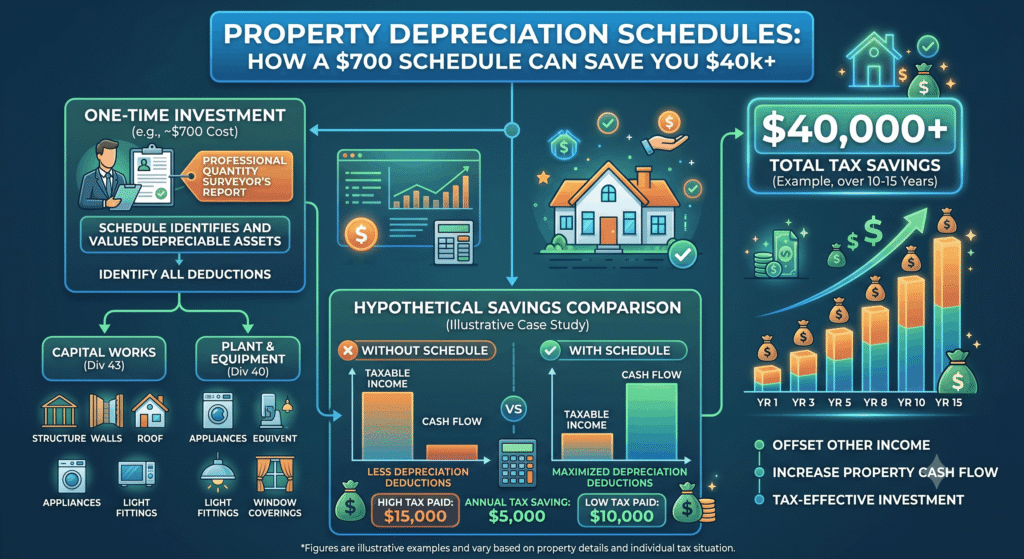
Now, you might assume that document is expensive. Maybe you’ve heard figures like $5,000. The reality is far better: a residential depreciation schedule investment property report typically costs just $400–$800 — a one-off fee that’s itself tax-deductible. And over the life of your property, it can unlock $40,000+ in actual tax savings (often far more on a new property). That’s one of the best returns on a few hundred dollars you’ll find anywhere in property.
This guide explains property depreciation Australia-wide in plain English: what a schedule is, how Division 40 and Division 43 work, the crucial difference between new and older properties, who prepares it, and real investor case studies with yearly numbers. Let’s claim what’s yours.
What Is a Property Depreciation Schedule?
A depreciation schedule is a report prepared by a qualified quantity surveyor that lists all the depreciation deductions you can legally claim on your investment property — for every financial year, often spanning 40 years.
In one sentence: It’s a once-off report that tells you (and your accountant) exactly how much you can claim each year for the wear and tear on your building and its fittings — turning the natural ageing of your property into a tax deduction.
You get it prepared once, and your accountant uses it every year at tax time. It covers two completely separate types of deduction, which we’ll unpack next.
How Depreciation Works in Australia: Division 40 vs Division 43
Australian property depreciation comes from two parts of the tax law. Understanding the difference is the key to everything.
Division 43 — Capital Works (the building itself)
Division 43 covers the structure — bricks, concrete, roofing, walls, windows, and fixed items. You claim it at a flat 2.5% per year over 40 years for residential buildings constructed after 15 September 1987.
Example: If the original construction cost of your building was $300,000, you can claim $7,500 per year (2.5%) for 40 years — that’s $300,000 in total deductions over the life of the building.
Crucially, Division 43 is available regardless of when you bought the property — even if you bought it second-hand — as long as it was built after 15 September 1987 (or renovated after that date). The 2017 rule change (below) did not touch Division 43.
Division 40 — Plant and Equipment (the fittings)
Division 40 covers the removable, mechanical items inside — air conditioners, hot water systems, carpets, blinds, ovens, dishwashers, and so on. These depreciate at individual rates set by the ATO based on each item’s “effective life,” and they’re usually front-loaded (you claim more in the early years).
This is where the 2017 rules bite hard — and where new vs old properties dramatically diverge.
| Division 43 (Capital Works) | Division 40 (Plant & Equipment) | |
|---|---|---|
| Covers | Building structure | Removable fittings & appliances |
| Rate | 2.5% flat per year, 40 years | Varies by item, front-loaded |
| Eligibility | Buildings after 15 Sep 1987 | Affected by 2017 rules (see below) |
| Affected by 2017 change? | ❌ No | ✅ Yes (big impact on second-hand) |
Deductions vs Tax Savings: The Difference That Matters
A quick but vital clarification, because investors confuse these constantly:
- A deduction reduces your taxable income.
- A tax saving is the actual dollars you keep — the deduction multiplied by your marginal tax rate.
Example: A $10,000 depreciation deduction doesn’t save you $10,000. At a 37% marginal tax rate, it saves you $3,700 in actual tax. Over many years, those annual savings add up to the $40,000+ in this article’s title.
So when you see “$40,000+ in tax savings,” that’s real money in your pocket — built from years of deductions, not a single hit.
How a ~$700 Schedule Can Save You $40,000+
Let’s prove it with a real-world style example.
Case study 1: Michael’s brand-new apartment
Michael buys a new 2-bedroom apartment in Brisbane for $620,000.
Because it’s brand new, he can claim both Division 43 and Division 40 in full. His quantity surveyor’s schedule (cost: ~$700) identifies:
- Division 43: ~$7,500/year (building structure, flat for 40 years)
- Division 40: ~$6,500 in year 1, declining over time (new appliances, carpets, A/C)
- Year 1 total deduction: ~$14,000
At Michael’s 37% marginal tax rate, that’s a year-one tax saving of ~$5,180.
| Period | Approx. total deductions | Approx. tax saved (37%) |
|---|---|---|
| Year 1 | ~$14,000 | ~$5,180 |
| Years 1–5 | ~$50,000 | ~$18,500 |
| Years 1–10 | ~$90,000 | ~$33,300 |
| Years 1–15 | ~$130,000 | ~$48,100 |
| Full 40 years (Div 43 alone) | ~$300,000 | ~$111,000 |
Michael crosses $40,000 in real tax savings before year 13 — and keeps claiming for decades after. His schedule cost ~$700 (after-tax cost ~$440 once he deducts the fee). That’s a return most investments can only dream of.
This is why a depreciation schedule is often described as the highest-ROI few hundred dollars an investor will ever spend.
New vs Older Properties: A Big Difference
Here’s the catch that trips up investors who buy established homes: the 2017 rule change.
The 2017 rule (Treasury Laws Amendment (Housing Tax Integrity) Act): If you buy a second-hand residential property after 7:30pm on 9 May 2017, you cannot claim Division 40 depreciation on the existing plant and equipment (the carpets, blinds, appliances that were already there). You can only claim Division 40 on new items you install yourself.
This means:
- New properties → claim both Division 40 and Division 43 in full — typically $10,000–$19,000+ in year-one deductions. The most depreciation-rich option.
- Established properties (bought after 9 May 2017) → Division 43 only on the existing building (plus Division 40 on anything new you install) — often $4,000–$9,000/year if built after 15 September 1987.
- Properties bought before 9 May 2017 → grandfathered; the old rules still apply, so existing plant and equipment remains claimable by that owner.
Case study 2: Sarah’s established house
Sarah buys an established house for $650,000 (built 1995, renovated by a previous owner in 2015).
Because she bought after 2017, she gets no Division 40 on the existing fittings. But she can still claim:
- Division 43 on the original 1995 building (remaining years on its 40-year clock)
- Division 43 on the 2015 renovation (a fresh 40-year clock from 2015)
- Division 40 on any new items she installs herself
Her schedule identifies ~$5,500/year in deductions early on — a tax saving of ~$2,035/year at 37%. Less than Michael’s new apartment, but over 10 years still ~$50,000 in deductions and ~$18,500 in real tax savings — for a ~$700 schedule. Still absolutely worth it.
The takeaway: New properties are dramatically more depreciation-rich than established ones post-2017. But almost every income-producing property built after 1987 (or renovated since) has worthwhile deductions hiding in it — you won’t know until a quantity surveyor looks.
Who Prepares It? Quantity Surveyors and ATO Rules
You can’t just estimate this yourself — and the ATO is increasingly strict.
- Only a qualified quantity surveyor can prepare an ATO-compliant schedule where construction costs need estimating. They’re one of the few professions the ATO recognises for this. Accountants and valuers generally can’t.
- Choose a TPB-registered quantity surveyor in Australia who provides ATO-compliant reports.
- The process: the surveyor inspects your property (or reviews plans for a new build), identifies every Division 40 and 43 item, researches construction costs, and delivers a schedule (usually within ~5 business days) covering up to 40 years.
- The fee (~$400–$800) is fully tax-deductible in the year you pay it — so the real, after-tax cost is even lower.
- Missed past years? The ATO generally lets individuals amend the previous two years’ tax returns to claim deductions you missed.
- 2026 watch: the ATO is using advanced data-matching to catch dodgy or non-compliant depreciation claims — another reason to use a professional and follow the rules.
Cash Flow and Negative Gearing Benefits
Depreciation is a non-cash deduction — and that’s what makes it special.
Plain-English point: With most deductions (interest, rates, repairs) you have to spend the money to claim it. Depreciation lets you claim the building’s natural ageing without spending anything. It’s a deduction you get “for free.”
This has two big effects:
- It improves your cash flow. Every dollar of depreciation reduces your taxable income, increasing your tax refund — money back in your pocket each year, without an out-of-pocket cost.
- It boosts negative gearing. Depreciation can turn a property that’s cash-flow neutral into one that shows a tax loss — increasing the loss you can (currently) deduct against your income, or reducing a positively geared property’s tax bill.
2026/2027 note: Negative gearing rules are changing — from 1 July 2027 (announced in the 2026–27 Budget, not yet law), losses on established homes bought after 12 May 2026 will only offset rental income/capital gains, not salary; new builds remain exempt. This affects how the depreciation-driven loss can be used, but depreciation itself remains a valuable deduction. Get current advice from your accountant.
The CGT Catch You Should Know
Depreciation isn’t entirely “free” — there’s a trade-off at sale time that honest advice should mention.
Division 43 capital works deductions reduce your property’s CGT cost base when you sell. In plain terms: if you’ve claimed $50,000 in Division 43 over the years, your taxable capital gain at sale is effectively $50,000 higher.
So some of the tax you save now is “paid back” later as capital gains tax. But it’s usually still a clear win, because:
- You get the benefit now (cash flow today is worth more than tax later).
- Capital gains have (currently) been taxed at a discount.
2027 interaction: The CGT discount is being replaced from 1 July 2027 with cost-base indexation plus a 30% minimum tax. This changes the sell-side maths, so model your situation with an accountant. (Division 40 deductions are handled separately and don’t reduce the cost base the same way.)
The key point: claim your depreciation — just go in with eyes open about the CGT interaction, and get advice on timing a sale.
Common Investor Mistakes to Avoid
- Not getting a schedule at all — by far the most common and costly mistake. Investors leave thousands on the table every year.
- Trying to estimate it yourself — non-compliant and error-prone; the ATO requires a quantity surveyor.
- Claiming Division 40 on second-hand fittings in a post-2017 established property — that’s against the rules and an ATO red flag.
- Forgetting the fee is deductible — the schedule cost reduces your tax too.
- Not getting a new schedule after renovating — improvements create fresh Division 43 (and Division 40 on new items).
- Assuming an old property has “nothing to claim” — if it was built after 1987 or renovated since, it usually does.
- An owner-occupier trying to claim — depreciation is only for income-producing (rental) properties.
Depreciation Schedule Checklist
- ☐ Is the property income-producing (rented or genuinely available for rent)?
- ☐ Was it built after 15 September 1987, or renovated since? (If so, Division 43 likely applies.)
- ☐ Is it new, or bought before 9 May 2017? (If so, Division 40 on existing fittings applies too.)
- ☐ Have you engaged a TPB-registered quantity surveyor for an ATO-compliant schedule?
- ☐ Have you given your schedule to your accountant to claim each year?
- ☐ Have you claimed the schedule fee itself as a deduction?
- ☐ Did you get an updated schedule after any renovations?
- ☐ Have you checked whether you can amend prior years for missed deductions?
Actionable Tips
- Get a schedule as soon as you buy (or start renting the property) — every year without one is deductions lost.
- Prioritise it for new properties — that’s where depreciation is richest.
- Keep all renovation receipts — they unlock fresh deductions.
- Use the diminishing value method for plant and equipment if you want bigger deductions sooner (your surveyor/accountant can advise).
- Don’t let an “old property” assumption stop you — ask a quantity surveyor; many offer a free estimate and won’t charge if the deductions don’t justify the fee.
- Coordinate with your accountant on how depreciation interacts with negative gearing and CGT — especially with the 2027 changes coming.
Frequently Asked Questions
How much does a depreciation schedule cost in Australia?
Typically $400–$800 for a residential investment property — a one-off fee that’s fully tax-deductible. Given it can unlock tens of thousands in deductions over time, the return is enormous.
How much can a depreciation schedule actually save me?
It depends on the property, but a new property can generate $10,000–$19,000+ in year-one deductions, and $40,000+ in real tax savings over the years (often far more). Established properties (post-2017) claim less — usually Division 43 only — but still typically worthwhile.
What’s the difference between Division 40 and Division 43?
Division 43 covers the building structure (2.5%/year over 40 years for post-1987 buildings). Division 40 covers removable fittings and appliances (air con, carpets, appliances), depreciated at item-specific rates. A schedule covers both.
Can I claim depreciation on an old or second-hand property?
Often yes — Division 43 (capital works) is claimable on any property built after 15 September 1987 regardless of when you bought it. But since 9 May 2017, you can’t claim Division 40 on the existing fittings of a second-hand residential property — only on new items you install.
Who can prepare a depreciation schedule?
A qualified, TPB-registered quantity surveyor. The ATO recognises quantity surveyors (not accountants or valuers) to estimate construction costs for capital works claims.
Is the depreciation schedule fee tax-deductible?
Yes — it’s deductible in the year you pay it, lowering its real cost further.
Does claiming depreciation affect capital gains tax when I sell?
Division 43 capital works deductions reduce your property’s CGT cost base, so your taxable gain at sale is higher by the amount claimed. It’s usually still worthwhile (the benefit now outweighs the cost later), but model it with your accountant — especially with the 2027 CGT changes.
I’ve owned my rental for years without a schedule — is it too late?
No. Get a schedule now, and you can generally amend the previous two years’ tax returns to claim missed deductions. Don’t leave it any longer.
The Bottom Line: The Easiest Tax Win in Property
Of all the ways to improve your returns as a property investor, few are as simple — or as overlooked — as a depreciation schedule. For a one-off, tax-deductible fee of a few hundred dollars, you unlock a deduction you can claim every year, often for decades, without spending another cent. On a new property, that can mean $40,000+ in real tax savings over time — and frequently much more.
The maths is hard to argue with: spend ~$700 once, save tens of thousands over the years. Yet countless investors never get one, or assume their property is “too old” to bother. Don’t be one of them. Whether your property is brand new or built in the 90s, you won’t know what’s hiding in it until a quantity surveyor takes a look.
Your next step: If you own an income-producing property and don’t have a depreciation schedule, do one thing this week — contact a TPB-registered quantity surveyor for an estimate (many offer a free assessment and won’t charge if the deductions don’t justify the fee). Then hand the schedule to your accountant and start claiming. It may be the highest-return phone call you make all year — and if you’ve owned the property a while, ask about amending prior years too. Your investment property tax savings are sitting there waiting to be claimed.
Disclaimer: This article is general information only and does not constitute financial, tax, legal or accounting advice. It does not take into account your personal circumstances, objectives or needs. Depreciation entitlements depend on the property’s age, type, construction date, your purchase date and how you use it. Tax rules change, and figures here (including costs and savings examples) are indicative as at 2026. The negative gearing and CGT measures referred to were announced as at the 2026–27 Federal Budget and are not yet law as at the date of writing. Depreciation schedules should be prepared by a qualified, registered quantity surveyor, and you should seek advice from a registered tax agent or accountant before claiming. Always confirm current rules with the ATO or your adviser.
2 Responses