
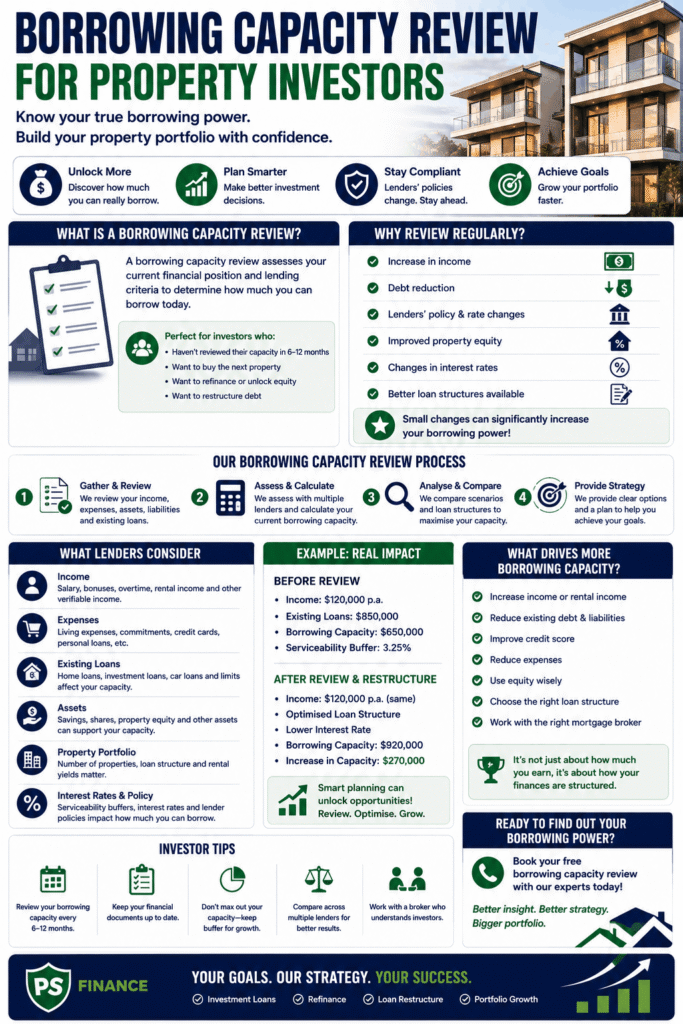
If you’re planning to buy another investment property in 2026, the question that matters most isn’t “what can I afford?” — it’s “what will a lender let me borrow?” Those two numbers are rarely the same, and the gap between them has been widening.
Borrowing capacity — not deposit size, not property choice — is the single biggest constraint stopping Australian investors from scaling a portfolio. Interest rates have moved several times since early 2026, APRA’s serviceability buffer remains locked at 3 percentage points, and a debt-to-income cap introduced in February 2026 now caps how much high-DTI lending banks can write. Each of these settings quietly shrinks what you’re approved for, even if your actual ability to make repayments hasn’t changed at all.
This guide breaks down exactly how lenders calculate borrowing capacity for property investors, the factors that move the number up or down, and the practical steps you can take to improve your position before your next application. You’ll also find example scenarios, a printable review checklist, and answers to the questions investors ask most.
Quick Answer: What Determines Borrowing Capacity for Property Investors?
Borrowing capacity for property investors is calculated from gross income (including a discounted share of rental income), minus existing debt repayments, living expenses, and dependants’ costs — all assessed at an interest rate roughly 3 percentage points above the actual loan rate. The result is the maximum loan a lender believes you can service without financial stress.
| Factor | How It Affects Borrowing Capacity |
| Income | Higher, more stable income increases capacity; overtime and bonuses are often only partly counted. |
| Existing debts | Every credit card limit, personal loan, BNPL account, and other mortgage reduces capacity. |
| Living expenses | Lenders use either your declared expenses or a benchmark minimum, whichever is higher. |
| Rental income | Lenders typically count 70–80% of rental income to allow for vacancies and costs. |
| Credit score | Affects approval likelihood and pricing; doesn’t directly change the serviceability formula. |
| Loan type | Interest-only loans, on average, reduce capacity compared with principal and interest. |
| Interest rate buffers | APRA requires assessment at your rate plus roughly 3%, regardless of your actual rate. |
What Is Borrowing Capacity?
Borrowing capacity is the maximum amount a lender is willing to lend you, based on its assessment of your income, expenses, debts, and risk profile. It’s not a single fixed number — it changes lender to lender, and it changes every time your financial position changes.
Borrowing Capacity vs. Pre-Approval
These two terms get used interchangeably, but they’re different things. Borrowing capacity is the theoretical ceiling a lender’s calculator produces. Pre-approval is a formal, conditional commitment from a specific lender after they’ve verified your documents. You can have strong borrowing capacity on paper and still be declined pre-approval if your documentation doesn’t support the numbers, or vice versa.
Why Online Calculators Differ From Real Lender Assessments
Generic online calculators use simplified, generic assumptions. Real lender assessments factor in their own risk appetite, their current rental income shading policy, their treatment of HECS debt, and internal credit risk overlays that aren’t published anywhere. It’s common for two lenders to offer borrowing capacities that differ by $100,000 or more for the exact same applicant.
How Lenders Assess Property Investors
Investor applications go through extra scrutiny compared with owner-occupier applications, because lenders treat a second (or fifth) property as additional risk exposure.
| Lender Term | What It Means for You |
| Income verification | Payslips, tax returns, and group certificates are cross-checked. Self-employed investors typically need two years of tax returns. |
| Existing property portfolio | Lenders assess your full portfolio — every mortgage, every rental property — not just the new purchase. |
| Rental income shading | Most lenders only count 70–80% of gross rental income, sometimes referred to as a “haircut” on rental yield. |
| Debt-to-income ratio (DTI) | Total debt divided by gross income. Lenders increasingly cap new lending above 6x DTI under APRA’s high-DTI lending limit. |
| Household expenses | Assessed using either your declared living expenses or the Household Expenditure Measure (HEM) benchmark, whichever is higher. |
| Credit history | Missed payments, defaults, and excessive recent credit enquiries can reduce approval likelihood and capacity. |
| Loan-to-value ratio (LVR) | Higher LVR (smaller deposit) often triggers Lenders Mortgage Insurance and can tighten servicing requirements. |
Lender jargon, plain English: “Shading” means discounting. “Servicing” means proving you can afford repayments. “DTI” is simply total debt divided by income. “Buffer rate” is the inflated interest rate lenders test you against, not the rate you’ll actually pay.
Key Factors That Impact Borrowing Capacity
Each of the factors below moves your borrowing capacity independently. Reviewing them one at a time is the fastest way to find where you’re losing capacity unnecessarily.
Employment Income
How lenders assess it: Base salary is counted close to 100%. Overtime, bonuses, and commissions are usually averaged over 1–2 years and only partially counted (often 50–80%).
Common mistake: Assuming a recent pay rise or one-off bonus will be counted at full value immediately.
Improvement tip: Provide at least 6–12 months of payslips showing consistency, and ask your employer for a letter confirming any pay increase is ongoing.
Rental Income
How lenders assess it: Lenders apply a shading discount (typically 20–30%) to gross rental income to account for vacancies, agent fees, and maintenance.
Common mistake: Using the full advertised rent figure when estimating your own borrowing capacity, rather than the shaded figure a lender will actually use.
Improvement tip: Get a written rental appraisal from a property manager and calculate your own estimate using an 70–75% shading factor to set realistic expectations.
Existing Debts
How lenders assess it: Every personal loan, car loan, and other mortgage is included in full, regardless of whether you’re paying it off ahead of schedule.
Common mistake: Forgetting to account for a partner’s debts on a joint application, or assuming a soon-to-be-paid-off loan won’t count.
Improvement tip: Pay out or consolidate small personal loans before applying, since each repayment is treated as an ongoing commitment.
Credit Cards and Personal Loans
How lenders assess it: Lenders assess credit cards on their full limit, not your balance — a $20,000 limit card is treated as a $20,000 liability even if you pay it off monthly.
Common mistake: Keeping high credit card limits “just in case” without realising they’re actively reducing borrowing capacity.
Improvement tip: Reduce credit card limits to what you actually use, or close unused cards entirely, at least 1–2 months before applying.
HECS/HELP Debt
How lenders assess it: Treated as a compulsory expense based on your income and the relevant repayment threshold, reducing net income available for servicing.
Common mistake: Assuming a small remaining HECS balance won’t materially affect the assessment.
Improvement tip: Factor HECS repayments into your own calculations early; paying it off won’t always help if your income still exceeds the repayment threshold.
Buy Now, Pay Later Accounts
How lenders assess it: Increasingly treated like a credit facility by major lenders, with active accounts and certain limits counted as ongoing commitments.
Common mistake: Not disclosing BNPL accounts, which can also raise red flags during a lender’s bank statement review.
Improvement tip: Close inactive BNPL accounts and consolidate or pay down active ones before applying for finance.
Interest Rates and Buffers
How lenders assess it: APRA requires lenders to test serviceability at your actual rate plus a buffer of roughly 3 percentage points, regardless of how low your actual rate is.
Common mistake: Calculating your own affordability at today’s rate and assuming the lender will use the same figure.
Improvement tip: Always model your numbers at your expected rate plus 3% to get a realistic picture of what a lender will actually approve.
Number of Dependents
How lenders assess it: Each dependant increases the assumed living expense allowance, which directly reduces the income available for loan repayments.
Common mistake: Underestimating how much each dependant reduces capacity, especially for larger families.
Improvement tip: Be upfront and accurate; understating dependants can cause issues at verification and won’t improve your actual outcome.
Living Expenses
How lenders assess it: Lenders compare your declared expenses against the Household Expenditure Measure (HEM) benchmark and use whichever figure is higher.
Common mistake: Declaring unrealistically low expenses, which can trigger lender scrutiny of bank statements and erode trust in the application.
Improvement tip: Review and genuinely reduce discretionary spending (subscriptions, dining out) for 3 months before applying, then declare it accurately.
Borrowing Capacity by Investor Profile
These illustrative scenarios show how borrowing capacity can vary by investor profile. They use general assumptions and a 3% buffer above a typical 2026 investment loan rate — actual results vary significantly by lender.
First-Time Investor
| Metric | Detail |
| Annual income | $95,000 (single applicant, PAYG) |
| Deposit | $80,000 |
| Existing debts | $15,000 car loan, one credit card ($6,000 limit) |
| Estimated borrowing capacity | $480,000–$520,000 |
Dual-Income Couple
| Metric | Detail |
| Annual income | $170,000 combined |
| Deposit | $150,000 |
| Existing debts | Owner-occupier mortgage $450,000, two credit cards ($15,000 combined limit) |
| Estimated borrowing capacity | $620,000–$680,000 |
Self-Employed Investor
| Metric | Detail |
| Annual income | $140,000 (two-year average, sole trader) |
| Deposit | $120,000 |
| Existing debts | Business car lease $25,000, no personal loans |
| Estimated borrowing capacity | $500,000–$560,000 |
Investor With Multiple Properties
| Metric | Detail |
| Annual income | $155,000 plus shaded rental income from 2 properties |
| Deposit | Equity release from existing portfolio |
| Existing debts | Two investment mortgages totalling $780,000 |
| Estimated borrowing capacity | $300,000–$380,000 (constrained by DTI cap) |
Note: These figures are illustrative only. Two lenders assessing the identical applicant can produce meaningfully different results — this is precisely why a broker who can compare multiple lenders’ policies is valuable for investors.
How to Increase Your Borrowing Capacity
Most investors can lift their borrowing capacity without changing their income at all — simply by tidying up the variables a lender actually measures.
Reduce non-deductible debt
Strategy: Pay down personal loans and car loans first; this debt has no tax offset and directly reduces capacity.
Trade-off to consider: May use savings that could otherwise go toward your deposit.
Close unused credit cards
Strategy: Lenders assess card limits, not balances. Closing a $10,000 limit card you don’t use can meaningfully lift capacity.
Trade-off to consider: Closing cards can briefly affect your credit score; do this with some lead time before applying.
Increase rental yield
Strategy: Even a modest rent increase improves the shaded rental income lenders count toward serviceability.
Trade-off to consider: Raising rent too aggressively risks vacancy, which works against you.
Restructure loans
Strategy: Switching from interest-only to principal and interest can sometimes help; for others, the reverse improves cash flow assessment.
Trade-off to consider: Restructuring may involve break costs or new establishment fees.
Extend loan terms
Strategy: A longer loan term lowers the assessed monthly repayment, which can increase capacity.
Trade-off to consider: You’ll pay more interest over the life of the loan.
Improve credit scores
Strategy: Paying bills on time and reducing credit enquiries supports a stronger application and smoother approval.
Trade-off to consider: Credit score improvements take months, not days — plan ahead.
Review living expenses
Strategy: Genuinely reducing discretionary spending for a few months before applying can lift declared serviceable income.
Trade-off to consider: This must be a real, sustained change — lenders cross-check bank statements.
Common Borrowing Capacity Mistakes
- Assuming equity equals borrowing power — equity supports your deposit; it doesn’t change whether you can service a new loan.
- Overestimating rental income — using advertised rent instead of the shaded figure a lender will actually apply.
- Ignoring lender buffers — modelling affordability at today’s rate instead of rate-plus-buffer.
- Applying with multiple lenders simultaneously — each hard credit enquiry can temporarily lower your credit score and raise red flags.
- Taking on new debt before applying — a new car loan or credit card right before applying can quietly shrink your capacity at the worst possible time.
Tools and Calculators Investors Should Use
| Tool | When to Use It |
| Borrowing capacity calculator | Use early in your research, to set realistic expectations before approaching a lender or broker. |
| Mortgage repayment calculator | Use once you have a target purchase price, to understand actual monthly cash flow impact. |
| Cash flow calculator | Use before purchasing, to model the property’s net position after rent, expenses, and loan repayments. |
| Rental yield calculator | Use when comparing potential properties, to assess income return relative to purchase price. |
| Debt-to-income calculator | Use if you already hold multiple properties, to check your position against the current 6x DTI threshold. |
How Often Should Investors Review Borrowing Capacity?
Borrowing capacity isn’t a one-time calculation. It moves with interest rates, lender policy, and your own finances — which means a number that was accurate six months ago may no longer reflect what you’d actually be approved for today.
| Trigger | Recommended Review Timing |
| Before purchasing another property | Always — capacity should be reconfirmed before each new application. |
| After refinancing | Within 1 month, since loan terms and repayments change. |
| Following interest rate changes | Within 1–2 months of any official cash rate movement. |
| When income changes | Immediately — a pay rise, job change, or reduced hours both help and hurt capacity. |
| After portfolio growth | Every time a new property settles, since the DTI calculation changes. |
Borrowing Capacity and AI-Powered Lending
Lending assessment is shifting away from manual document review and toward automated, data-driven decisioning.
Open Banking
Consumer Data Right (CDR) sharing now lets investors securely share verified bank transaction data directly with lenders, speeding up expense verification and reducing reliance on manually submitted statements.
Automated Assessments
Many lenders now run an initial serviceability calculation automatically the moment income and liability data is submitted, giving investors a near-instant indicative figure before full underwriting.
Digital Mortgage Applications
End-to-end digital applications reduce paperwork and turnaround times, though investors with more complex portfolios often still benefit from broker involvement to navigate multiple lender policies.
AI Underwriting Tools
Lenders are increasingly using AI-assisted underwriting to flag inconsistencies, assess risk patterns across large applicant datasets, and speed up approvals — while human underwriters retain final sign-off on investor and high-value applications.
Borrowing Capacity Review Checklist
Print this checklist and work through it before your next application or portfolio review.
- Income documents: recent payslips, group certificates, and (if self-employed) two years of tax returns
- Debt review: full list of credit cards, personal loans, BNPL accounts, and other mortgages with current limits
- Expense audit: 3 months of bank statements reviewed for accurate, genuine living expense figures
- Credit report review: check for errors, missed payments, or excessive recent credit enquiries
- Portfolio analysis: current value, rent, and outstanding loan balance for every existing investment property
- Rate buffer check: model your servicing position at your expected rate plus 3%
- DTI check: confirm where your total debt sits relative to the 6x income threshold
- Broker consultation: compare at least two to three lenders’ current investor servicing policies
Real-World Case Studies
Case Study 1: The First-Time Investor Who Closed a Card
Maya, 29, earned $92,000 and was told her borrowing capacity was $410,000 — not enough for the property she wanted. A broker identified that an unused $15,000 credit limit was being treated as a full liability. After closing the card and waiting six weeks for it to clear her credit file, her capacity rose to $465,000.
Case Study 2: The Couple Who Restructured Debt
James and Priya had $180,000 combined income but were constrained by a $35,000 car loan and two store cards. Consolidating the car loan into a lower repayment and closing both store cards lifted their capacity from $590,000 to roughly $650,000 within two months.
Case Study 3: The Self-Employed Investor Who Improved Documentation
Tom, a self-employed tradesperson, was initially assessed using only his most recent (lower) tax year. By working with his accountant to finalise an outstanding return showing stronger recent income, his two-year average increased, lifting his assessed borrowing capacity by roughly $70,000.
Case Study 4: The Multi-Property Investor Who Hit the DTI Ceiling
Anjali owned three investment properties with strong rental income but found her next application declined outright. The issue wasn’t serviceability — it was the 6x debt-to-income threshold. By paying down one smaller loan and shifting her next application to a lender with available high-DTI lending capacity that quarter, she secured approval.
FAQs
How much can I borrow for an investment property in Australia?
It depends on your income, debts, expenses, and the lender’s policy, but most investors can expect a borrowing capacity roughly 4–6 times their gross annual income, reduced by existing debt commitments.
What is a good debt-to-income ratio for property investors?
Below 6 times gross income keeps you outside APRA’s high-DTI lending cap, which currently limits banks to allocating only 20% of new lending above that threshold.
Does rental income count toward borrowing capacity?
Yes, but lenders typically only count 70–80% of gross rental income to account for vacancies, management fees, and maintenance costs.
Why is my borrowing capacity lower than I expected?
The most common reasons are unused credit card limits, the APRA interest rate buffer, underestimated living expenses, or existing debts you may not have factored in.
Can I increase my borrowing capacity quickly?
Some changes, like closing unused credit cards, can show results within weeks. Others, like improving a credit score or building income history, take several months.
Do all lenders calculate borrowing capacity the same way?
No. Each lender sets its own policies on rental income shading, expense benchmarks, and treatment of debts, which is why capacity can vary significantly between lenders for the same applicant.
How does HECS debt affect borrowing capacity for investors?
HECS is treated as a compulsory expense based on income, which reduces the income available for loan repayments in a lender’s serviceability calculation.
Is borrowing capacity the same as pre-approval?
No. Borrowing capacity is an estimate of your lending ceiling; pre-approval is a lender’s conditional commitment after verifying your actual documents.
How often should I check my borrowing capacity?
Before any new purchase, after refinancing, after interest rate changes, and whenever your income or portfolio changes materially.
Should I use a mortgage broker to assess borrowing capacity?
Most investors benefit from broker input, since brokers can compare servicing calculators and policies across multiple lenders rather than relying on one bank’s assessment.
5 Responses